
MSRST: Tackling the Cold-Start Problem through Social Tensor Factorization
Multi-Sided recommendation based on social tensor factorization
The paper proposes a Multi-Sided Recommendation based on Social Tensor Factorization (MSRST). It introduces a novel "social tensor" model that integrates multidimensional contextual data (temporal, spatial, social) with an adaptive social network range to achieve real-time recommendation and outperform SOTA methods.
TL;DR
Researchers have developed a Multi-Sided Recommendation based on Social Tensor Factorization (MSRST). Unlike traditional systems that process massive, sparse global tensors, MSRST builds a localized "social tensor" centered on the active user’s network. This approach reduces response times from minutes to ~3.7 seconds and significantly boosts accuracy for new users by leveraging social affinity as a latent bridge.
Context: The Curse of Dimensionality & Sparsity
Context-aware recommendation systems (CARS) aim to answer the "5 W's" (Who, What, Where, When, Why). Tensor factorization is the natural mathematical choice for this, as it allows for the interdependency of multiple dimensions (User × Item × Context). However, the "standard" tensor approach suffers from two fatal flaws:
- Extreme Sparsity: With every new context dimension (e.g., location, time), the number of cells grows exponentially, but the number of actual ratings remains constant.
- Computational Lag: Factorizing a massive global tensor in real-time is nearly impossible, leading to a disconnect between a user's current context and the system's response.
The Core Innovation: The "Social Tensor"
The authors' fundamental insight is that not all users are relevant to a specific recommendation task. Instead of a global tensor , they construct a localized social tensor .
1. Adaptive Multi-Hop Range
The system doesn't just look at direct friends. It uses an adaptive function to determine how many "hops" away in the social network it should look for data. If the system's previous recommendations were "hits," it may tighten the scope; if it's struggling (e.g., a cold-start user), it expands the hop range to find meaningful neighbors.
2. Social Affinity Regularization
To solve the cold-start problem (where a new user has zero history), the paper introduces an Affinity Matrix. Even if User A has never watched a movie, the system looks at the behavior of User B (who has a high social affinity with User A) and propagates that preference into the latent factor space.
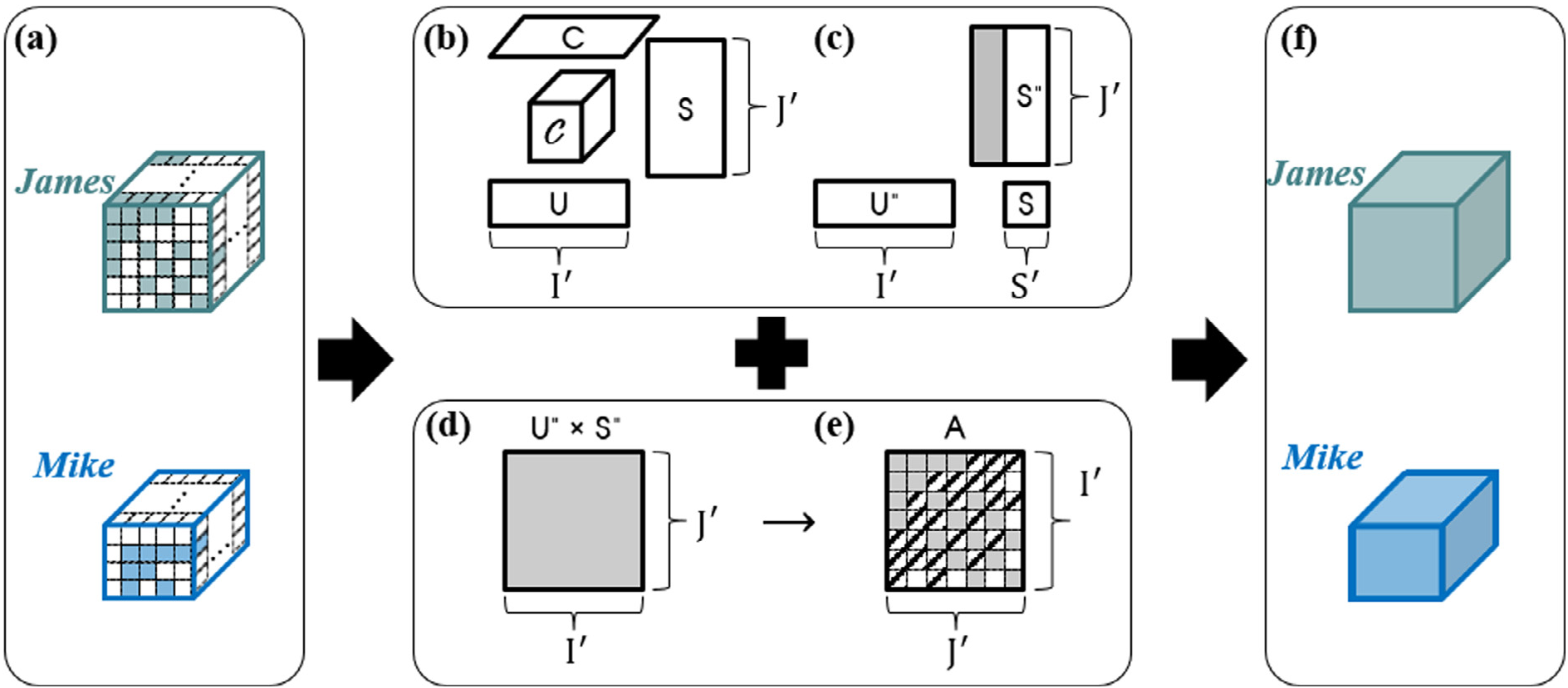 Figure: The detailed workflow of social tensor factorization, illustrating the transition from a social network to a decomposed core tensor.
Methodology: Bridging Intuition and Math
The objective function is designed to minimize the reconstruction error of the social tensor while being constrained by the affinity matrix:
Here, controls how much the social relationships () influence the user latent factors (). This ensures that even if is near-empty (cold start), is informed by social context.
Experimental Results
The researchers tested MSRST against competitive baselines like MRTF (Multiverse Recommendation) and RSSR (Social Regularization).
- Cold-Start Dominance: MSRST-A-E-O achieved a P@5 of 0.255 for new users, whereas standard Collaborative Filtering (UCF) collapsed to 0.025.
- Real-Time Efficiency: By focusing only on the social neighborhood, the tensor size is reduced. This dropped the response time from 154.9s (MRTF) to just 3.7s.
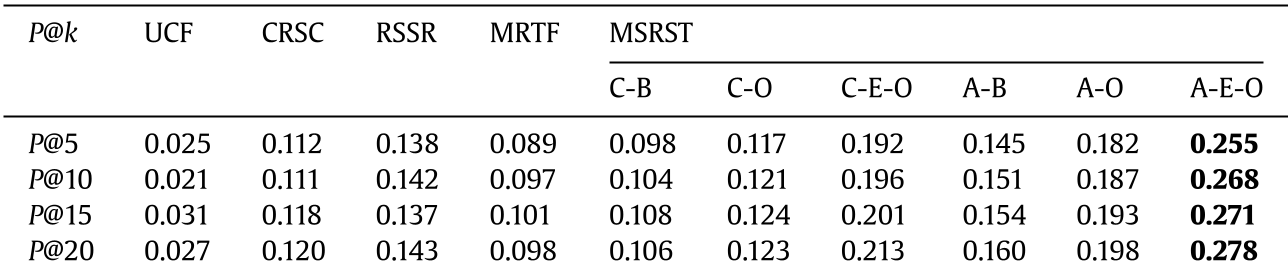 Table: Precision results in cold-start scenarios, showing the clear advantage of MSRST-A-E-O.
Critical Insight & Conclusion
The true value of this work lies in the multi-sided output. Instead of just returning a movie title, the system returns a triplet: (Movie, Time, Location). For example, it might recommend "Titanic" not just because you like romance, but because your close friend Mary is also available at the theater on a Saturday afternoon.
Limitations: The reliance on social network data might pose privacy concerns and requires a high-quality initial social graph. However, for platform-centric ecosystems (like Facebook or WeChat), this provides a robust roadmap for real-time, context-heavy discovery.
Takeaway: In the era of big data, "smaller is faster." By refining the recommendation context to a social ego-network, we can solve the computational bottlenecks of high-order tensors.