
MADM: Cracking the Temporal Code of Video Virality in Social Networks
Multi-Source-Driven Asynchronous Diffusion Model for Video-Sharing in Online Social Networks
This paper introduces the Multi-source-driven Asynchronous Diffusion Model (MADM), a continuous-time framework for predicting video-sharing behavior in Online Social Networks (OSNs). By analyzing longitudinal data from Renren, the authors utilize an exponential mixture model to characterize activation latency driven by multiple influential sources.
TL;DR
Why do some videos explode across social media while others vanish? Most models treat time as a series of ticks on a clock, but human behavior is asynchronous and messy. This paper introduces MADM, a model that accurately predicts when a user will share a video by analyzing the combined, time-decaying influence of all their friends, anchored specifically to the most recent friend who shared it.
Background: Beyond Discrete Steps
Classic models like the Independent Cascade (ICM) or Linear Threshold (LTM) assume diffusion happens in synchronized rounds. In reality, you might see a video shared by a friend at 9 AM and another at 2 PM; your decision to re-share follows a continuous-time decay. Prior works used simple curves to guess this decay, but they lacked empirical proof. Using a massive dataset from Renren (the "Facebook of China"), this research uncovers the mathematical signature of our social latency.
The "Why": Information Fatigue and Heterogeneity
The authors identify two fatal flaws in previous research:
- Distribution Mismatch: A single exponential curve doesn't fit real data.
- Source Confusion: When five friends share the same video, how do you mathematically combine their pressure on you?
The "Aha!" moment comes from the Exponential Mixture Model. It suggests that the social network is composed of two types of people: "Active" users (quick to share) and "Inactive" users (slow to move). A mixture of two exponential curves fits this reality far better than one.
Methodology: The MRS Insight
The core of the Multi-source-driven Asynchronous Diffusion Model (MADM) lies in the Most Recent Source (MRS).
1. Model Architecture
The researchers derived that for any user, the activation probability density decreases exponentially with time, but the starting point of that decay shifts every time a new friend shares the video.
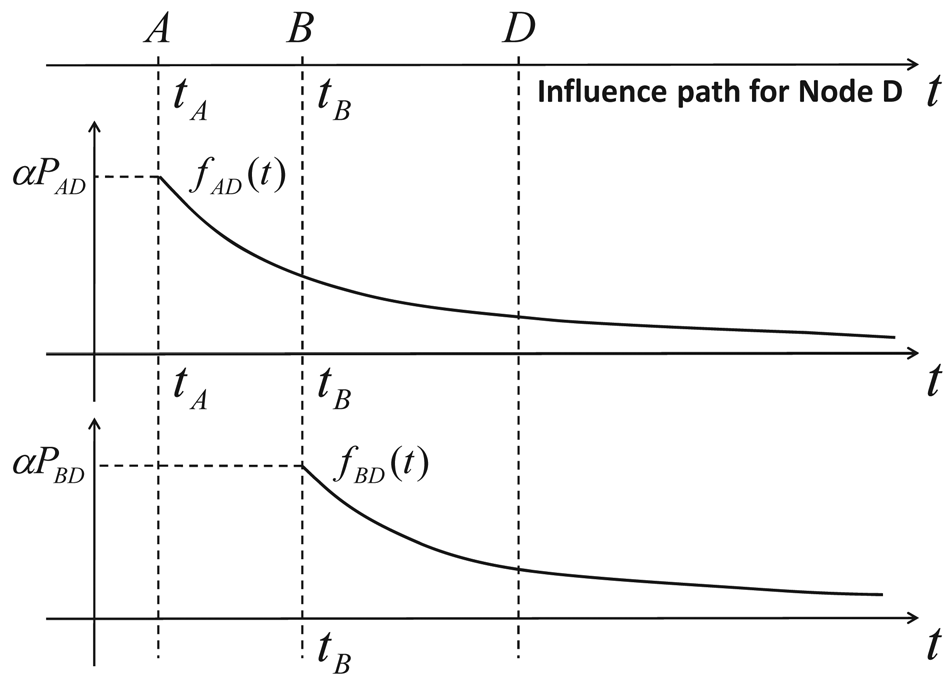 Figure: The asynchronous influence of multiple sources (A, B, C) on a target user (D).
2. Parameter Learning via EM
Because they use a mixture model, they employ the Expectation-Maximization (EM) algorithm. This allows the model to learn the "mixing weights" (what percentage of users are fast vs. slow) and the "decay rates" from hundreds of millions of sharing events.
Experiments: Measuring the "Tick-Tock"
The study analyzed 6.4 million distinct videos and 2.8 million users.
Key Findings on Popularity:
Counter-intuitively, popular videos spread slower on average per social link. Why? Because they have a "long tail" of interest that persists for days, whereas niche videos either go viral instantly in a small circle or die immediately.
Predictive Power:
The model was tested on its ability to predict the exact hour a user would click "share."
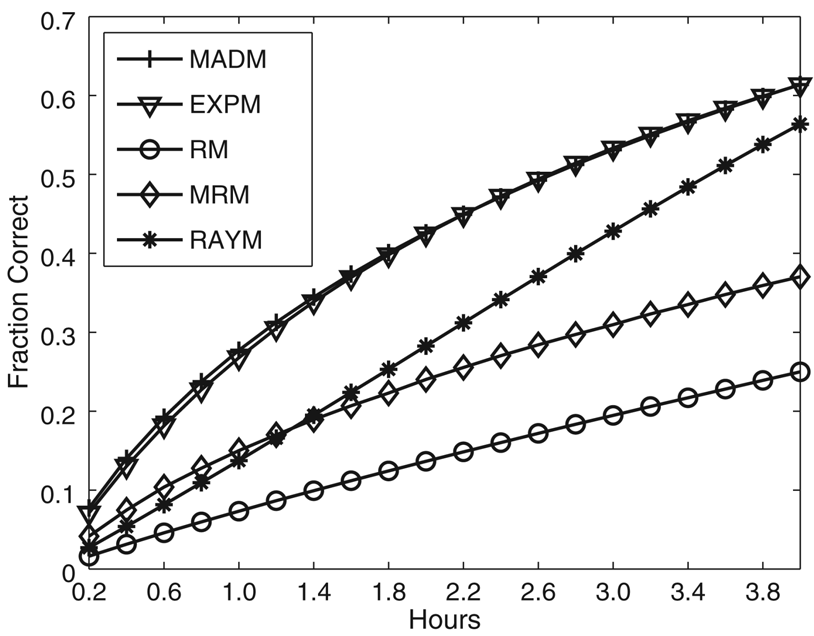 Figure: Accuracy comparison across different models. MADM consistently stays at the top.
As seen in the chart, MADM outperforms the Rayleigh Model (common in epidemiology) and the Exponential Model (EXPM). At a 4-hour tolerance, MADM hits 63% accuracy—a high mark given the inherent randomness of human social behavior.
Critical Insight & Limitations
Takeaway: The study proves that the "latest nudge" is the most important temporal predictor. If you want to predict when someone will act, look at their most recent social exposure, but weigh it by the cumulative "pressure" of all previous exposures.
Limitations: The model assumes all sharing happens inside the app. In the age of TikTok and cross-platform embedding, external influence (seeing a video on a news site before seeing it on a social feed) remains a "black box" that MADM hasn't yet opened.
Conclusion
MADM moves the needle for network traffic engineering and social marketing. By understanding the asynchronous nature of influence, platforms can better predict server loads and marketers can optimize the timing of "social nudges."