
MS-TrBPadaboost: Solving Social Link Sparsity via Self-Adaptive Multi-Source Transfer Learning
A Multi-source Self-adaptive Transfer Learning Model for Mining Social Links
The paper introduces MS-TrBPadaboost, a multi-source self-adaptive transfer learning model designed for social link mining. By combining Back-Propagation (BP) neural networks with an AdaBoost-style ensemble framework, it adaptively transfers knowledge and samples from multiple source social networks to a target network, achieving significant SOTA improvements in link prediction accuracy.
TL;DR
Minig social links is notoriously difficult when data is sparse. This paper introduces MS-TrBPadaboost, a model that doesn't just look at one source of data, but dynamically learns how much to trust multiple source networks (like Foursquare or Gowalla) to predict links in a target network. It achieves up to a 38% F1-score improvement over standard boosting models in highly sparse scenarios.
Background & Motivation: The "Stranger" Problem
Most early research in link prediction focused on "acquaintance networks"—think telephone logs or academic co-author lists. In these systems, the structural "rules" are consistent. However, modern social networks (Weibo, Twitter, etc.) are a mix of friends and strangers.
The authors identified two critical flaws in current SOTA:
- Source Neglect: Existing methods often treat all source domains as equally useful, even if one source is noisier than the other.
- Classifier Homogeneity: Traditional multi-source models tend to collapse toward the "best" source, losing the diversity of weak learners that makes ensemble methods like AdaBoost powerful.
Methodology: The Core of MS-TrBPadaboost
The model's innovation lies in its ability to extract and transfer both Knowledge (model weights) and Samples (actual data points) adaptively.
1. Knowledge Extraction (Complexity to Intuition)
The model uses BP (Back-Propagation) neural networks as the "weak learners." The weights and thresholds () of these networks are treated as the "Knowledge Matrix" A.
2. Self-Adaptive Weighting
Instead of a fixed transfer rate, the model calculates a Probability Matrix B. In each iteration, it checks how well a source-trained classifier performs on the target data. If a source's knowledge helps reduce error, its probability of being selected in the next round increases.
 Note: The model iterates to refine the Sample Weight Matrix (Q) and the Transfer Probability (B), ensuring the ensemble stays stable.
3. Handling Data Skew
Social networks are naturally imbalanced (most people aren't linked). MS-TrBPadaboost specifically balances the transfer of positive samples to prevent the model from becoming biased toward predicting "no link."
Experimental Validation
The authors tested the model on real-world datasets: Foursquare, Gowalla, and Brightkite.
Key Performance Insights:
- The Sparsity Advantage: The model shines brightest when "known links" are at their lowest (1%). In these extreme cases, it vastly outperforms single-source models.
- F1-Score Mastery: By adaptively switching between sources, MS-TrBPadaboost avoids "negative transfer" (where bad source data hurts the target model).
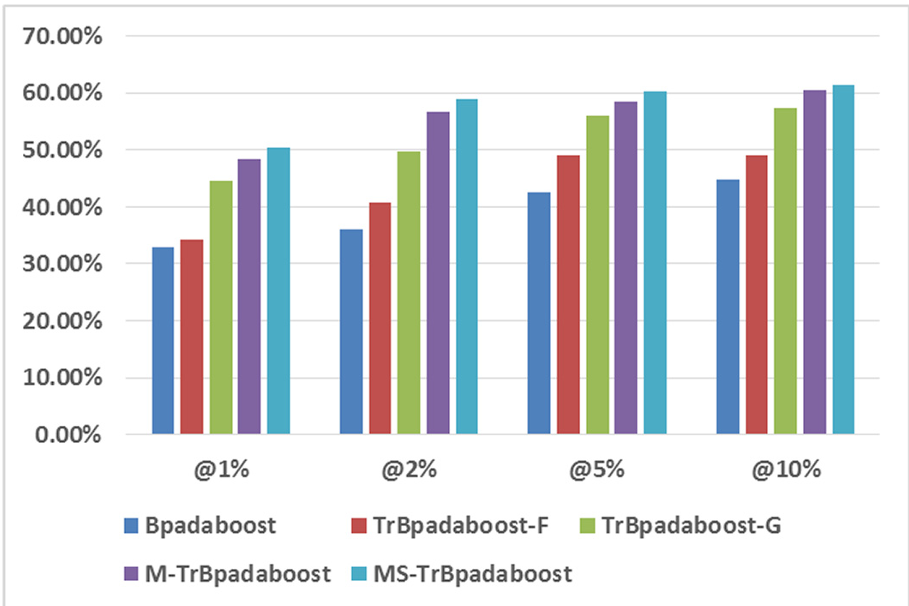 As the training sample size increases, MS-TrBPadaboost maintains a consistent lead over the basic BPadaboost and non-adaptive multi-source methods.
Critical Analysis & Conclusion
MS-TrBPadaboost provides a robust framework for Social Link Mining, but its value extends beyond just "adding friends." Its self-adaptive weight mechanism provides a blueprint for any transfer learning task where multiple, potentially conflicting source domains exist.
Limitations: The model currently relies on handcrafted features (Common Friends, Jaccard Coefficient). Future iterations could benefit from replacing the BP weak learners with Graph Convolutional Networks (GCNs) to automatically learn structural embeddings, potentially pushing the F1-score even higher in stranger-heavy networks.
The Takeaway: If your target data is sparse, don't just find one source—find many, and let a self-adaptive ensemble filter the signal from the noise.