
Predictive EDM: Leveraging Multi-split Bagging Ensembles for Early Student Success
Multi-split optimized bagging ensemble model selection for multi-class educational data mining
This paper proposes a systematic Multi-split Optimized Bagging Ensemble approach for Educational Data Mining (EDM) to predict student performance in multi-class scenarios (Good, Fair, Weak). By integrating six base machine learning algorithms with hyper-parameter tuning and systematic model selection, the framework achieves SOTA classification accuracy, reaching up to 93.1% on specific university datasets.
TL;DR
Predicting student failure is a race against time. This paper introduces a sophisticated Optimized Bagging Ensemble model that identifies "at-risk" students with over 93% accuracy. By analyzing data at the 20% and 50% stages of course delivery, the researchers demonstrate that we don't need to wait until the final exam to know who needs help.
The "Binary" Trap in Educational Data
In the world of Educational Data Mining (EDM), most researchers fall into the "Binary Trap"—classifying students simply as Good or Weak. While simple, this approach is often too blunt. It lumps "Fair" students—those who are struggling but not failing—in with either the top performers or those at total risk.
The authors of this study argue for a three-tier classification (Good, Fair, Weak). The challenge? Multi-class problems are exponentially harder, especially when "Fair" and "Good" students share similar behavioral boundaries, and "Weak" students represent a tiny, imbalanced fraction of the dataset.
Methodology: Beyond Simple Voting
The core innovation lies in the Systematic Ensemble Selection. Instead of just picking a popular algorithm like Random Forest or SVM, the authors build "baggings" of six different types:
- Tree-based: Random Forest (RF)
- Vector-based: SVM with RBF kernel
- Distance-based: K-Nearest Neighbors (k-NN)
- Probabilistic: Naive Bayes (NB)
- Regression: Multinomial Logistic Regression (LR)
- Connectionist: Multi-layer Neural Networks (NN)
The Multi-Split Robustness
To ensure the results weren't just "lucky" on a specific subset of data, the team used a 200-split approach. They only kept models where the Gini Index (a measure of statistical dispersion) exceeded a specific threshold.
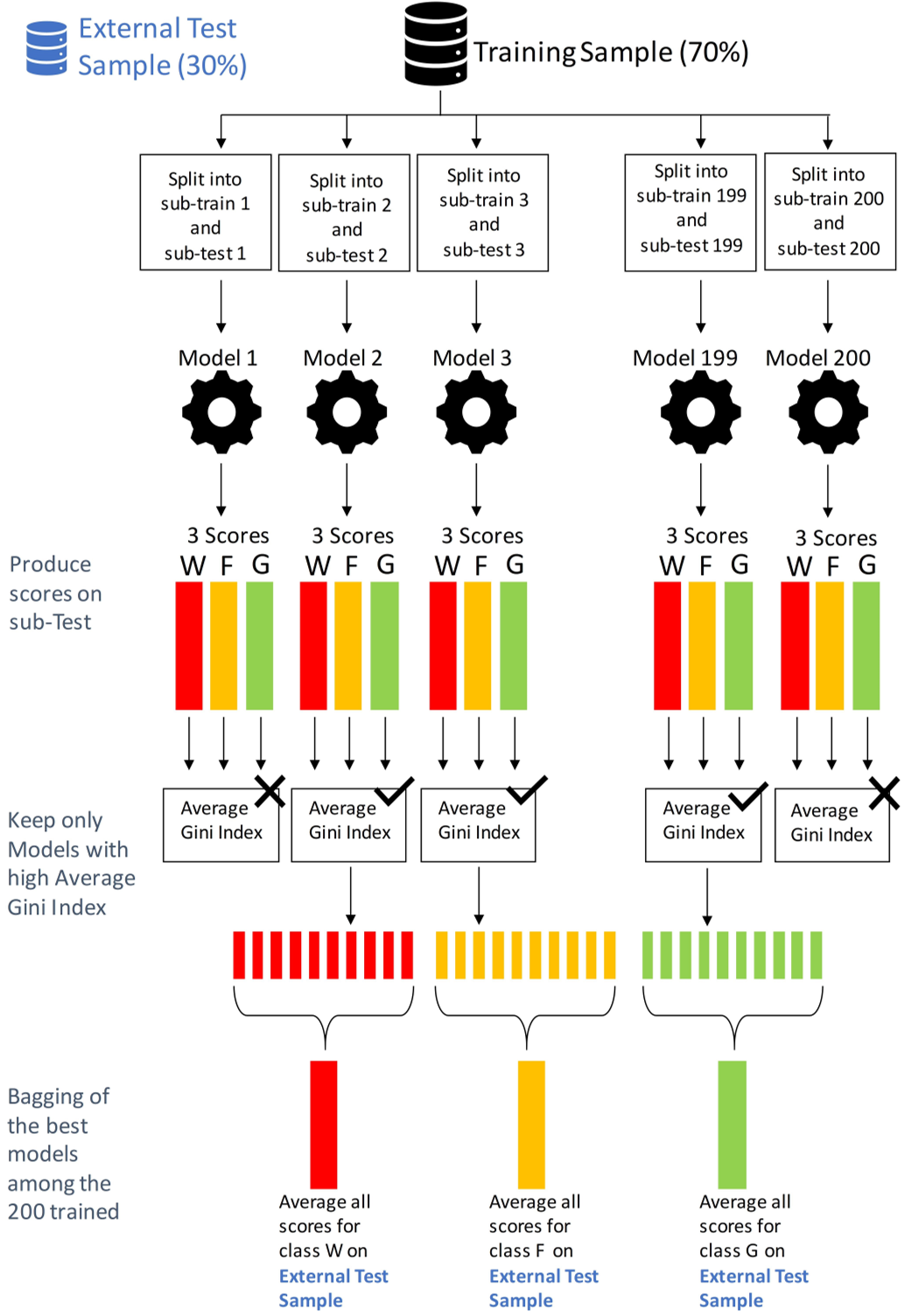 The workflow: from data splits to sub-training, Gini validation, and final ensemble aggregation.
Key Insights: What Actually Predicts Success?
The study highlights a fascinating shift in feature importance as a course progresses:
- At 20% Stage: Initial assignments and early quizzes are the primary signals.
- At 50% Stage: "Evaluate" category tasks (based on Bloom’s Taxonomy) become the strongest predictors. These are complex tasks requiring high-level synthesis, making them perfect "litmus tests" for overall student mastery.
 Comparison Table: The Ensemble method consistently outperforms individual base learners across both datasets and both time stages.
Results & Academic Significance
The results prove that Ensembles are superior due to Variance Reduction.
- Accuracy: On Dataset 2, accuracy improved from 88.2% (20% stage) to 93.1% (50% stage).
- Statistical Rigor: By calculating p-values for 256 possible ensemble combinations, the authors ensured their findings weren't artifacts of chance.
However, the study also highlights a limitation: Small datasets (like Dataset 1) remain a hurdle. In very small samples, "Fair" students are often misclassified because they sit precisely on the manifold boundary between "Good" and "Weak."
Critical Perspective & Conclusion
This work shifts EDM from descriptive (what happened?) to prescriptive (what will happen?). The use of the Gini Index instead of simple Accuracy is a masterstroke—it provides a more nuanced look at how well a model separates classes without being biased by arbitrary probability thresholds.
Future Outlook: The next step for this technology is integration into Learning Management Systems (LMS) like Moodle or Canvas. Imagine an "Early Warning System" that pings an instructor at Week 3, identifying exactly which 5 students are statistically likely to fail based on their first assignment. This isn't just data science; it's a tool for educational equity.