
Multi-Stage Facial Mastery: Enhancing Age and Gender Prediction via LRI and Saliency
Muti-stage learning for gender and age prediction
The paper proposes a multi-stage learning framework for gender and age prediction from facial images, utilizing an encoder-decoder saliency detection network followed by a prediction network with Local-Region-Interaction (LRI). By isolating the "people" foreground and modeling local feature relationships, it achieves SOTA results on FG-Net, Adience, and CACD datasets.
TL;DR
Predicting age and gender from a single "in-the-wild" image is notoriously difficult due to background clutter and high intra-class variance. This paper introduces a multi-stage learning framework that first "cleans" the image using a person-specific saliency segmentation network and then applies a novel Local-Region-Interaction (LRI) layer to capture long-range dependencies between facial features. The result? A measurable leap in accuracy across three major benchmarks.
The Core Challenge: Noise and Nuance
Most existing gender and age classifiers take the entire image as input. However, the authors argue that:
- Background Interference: Irrelevant pixels around the face (hair, clothes, scenery) introduce noise that leads to overfitting.
- Missing Local Interactions: Global features collected by a standard CNN don't explicitly model how the relative appearance of the eyes, nose, and mouth changes as we age. For instance, the sagging of specific muscle groups or the relationship between wrinkles in different regions is key.
Methodology: The Two-Stage Approach
1. Saliency-Based Segmentation
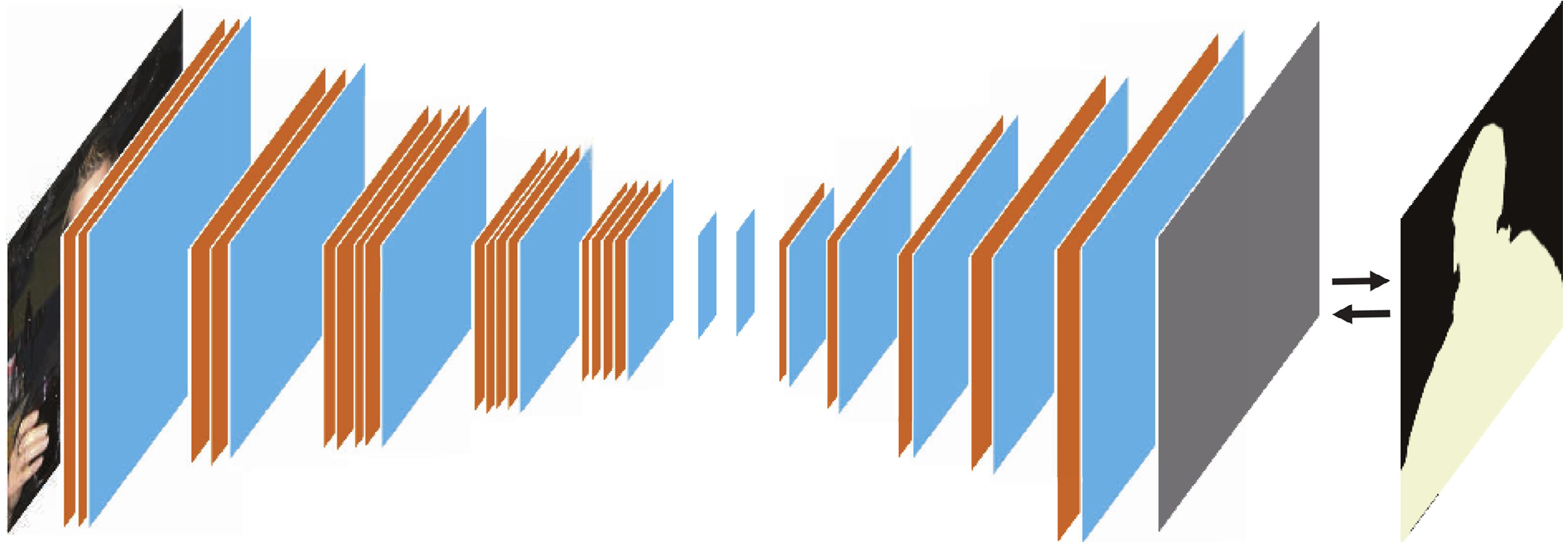
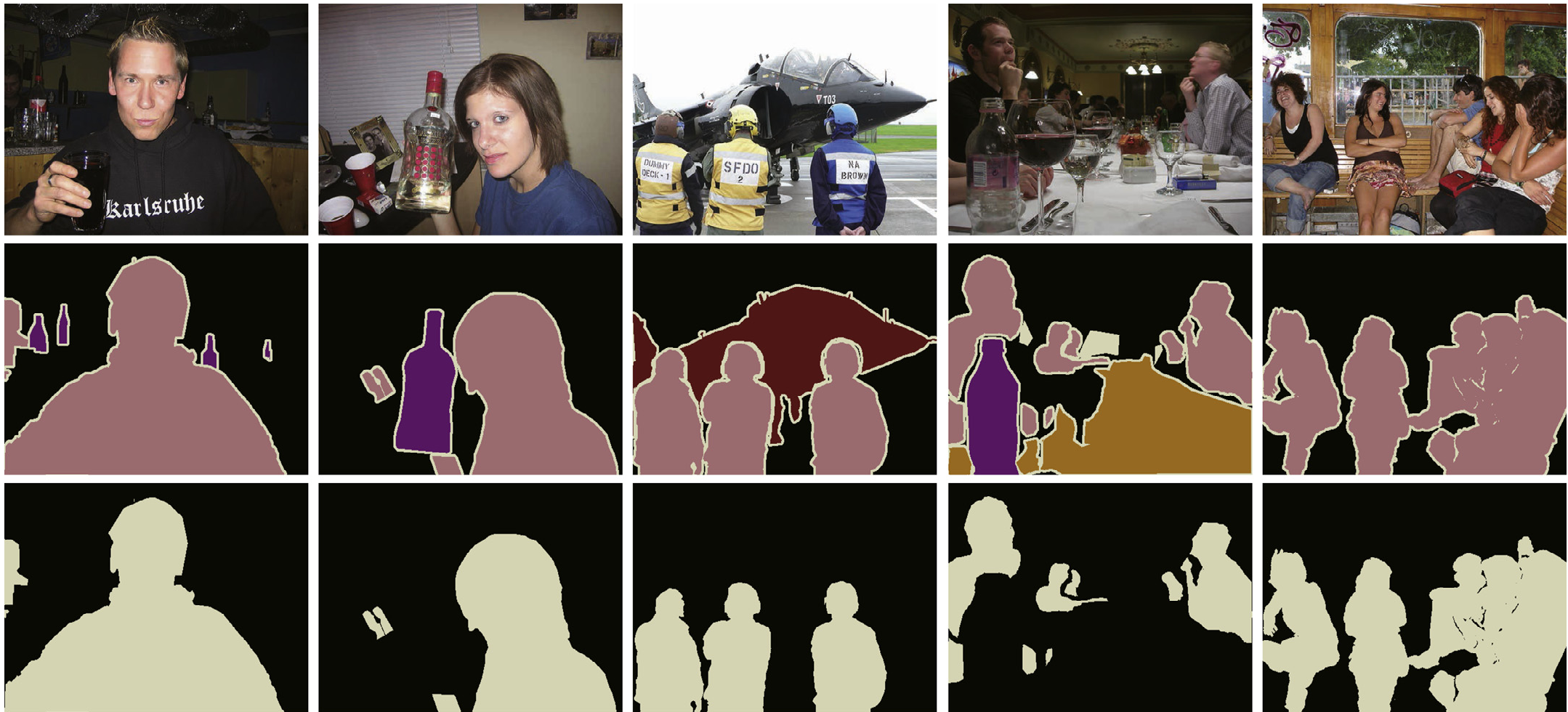
The first stage utilizes a modified encoder-decoder (starting from VGG16) trained on a person-repurposed PASCAL VOC dataset. The goal is simple: classify every pixel as "person" or "other." Only the foreground regions are passed to the next stage, effectively neutralizing background noise.
2. The LRI (Local-Region-Interaction) Layer
Instead of using standard Fully Connected (FC) layers—which are parameter-heavy and prone to overfitting—the authors propose a Local-Region-Interaction layer. Inspired by Bilinear Pooling, LRI calculates the interaction between pairs of local feature regions.
- Why it works: By modeling how one face region looks in relation to another, the network captures "2nd-order" information.
- Efficiency: Unlike standard bilinear pooling, LRI eliminates redundant self-interactions and takes advantage of facial symmetry to reduce computational cost.
Experimental Validation
The authors tested three modes for age prediction: Classification, Regression, and a hybrid "Mid-mode".
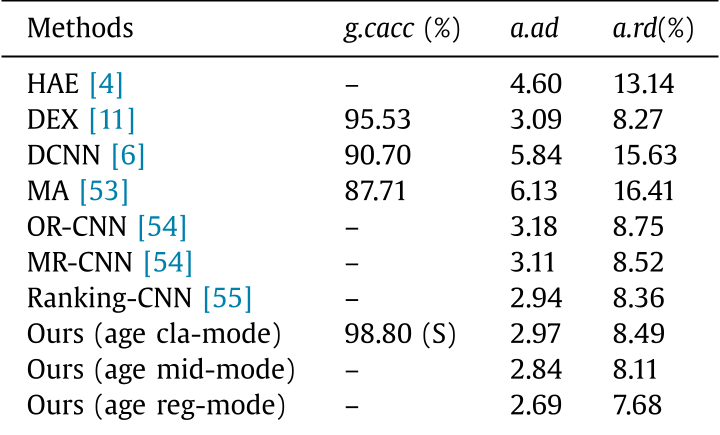
- SOTA Achievement: On the challenging FG-Net dataset, their "reg-mode" achieved an Average Absolute Difference (a.ad) of 2.69, significantly better than the DEX (3.09) and DCNN (5.84) baselines.
- Gender Precision: Accuracy on FG-Net hit 98.80%, proving that removing background noise via saliency allows the model to focus on subtle gender-specific facial textures.
Critical Insight & Conclusion
The true value of this work lies in its acknowledgment that not all pixels are equal. By combining pixel-level segmentation with higher-order feature interactions, the model effectively recreates a "human-like" focus on specific facial landmarks.
Takeaways for the Industry:
- Segmentation as Preprocessing: If your classification task is struggling with overfitting, adding a saliency/segmentation stage to extract the ROI is a proven booster.
- Beyond Global Pools: Global Average Pooling is great for parameters but terrible for spatial relationships. LRI provides a middle ground: better than FC layers, more descriptive than GAP.
Limitations: The model currently focuses on images containing only one person and struggles slightly with extreme skin color variations in the training distribution. Future versions could benefit from Metric Learning to further separate those tricky intra-class differences.