
MOMS: Bridging Activation and Dynamics for Optimal Social Opinion Steering
Multi-stage opinion maximization in social networks
The paper introduces a novel Multi-stage Opinion Maximization Scheme (MOMS) for preventative health in social networks. By integrating a Multi-stage Independent Cascade (MIC) model with a weighted voter model, it achieves state-of-the-art results in maximizing the proportion of individuals adopting desired healthy lifestyles.
TL;DR
In the context of preventative health (e.g., promoting exercise or healthy eating), simply reaching people isn't enough—you have to change their minds. This paper presents MOMS (Multi-stage Opinion Maximization Scheme), a framework that treats social influence as a multi-stage process. By combining a new Activated Voter Model with a clever hybrid search algorithm, the authors significantly increase the "desired opinion" spread across social networks while keeping computational costs manageable.
Contextual Positioning
Within the landscape of social network analysis, we have moved from simple Influence Maximization (making people "aware") to Opinion Maximization (making people "agree"). While earlier works focused on static snapshots, this paper is a significant "methodological refinement" that addresses the temporal nature of social change through multi-stage interventions.
The Core Problem: The Static and Greedy Trap
Prior research in this domain faced two major bottlenecks:
- Modeling Gap: Most models use Independent Cascade (IC) for activation, but ignore how opinions fluctuate after activation. Conversely, opinion models (like the Voter model) often assume nodes are already participating.
- Algorithm Bottleneck: Greedy algorithms are accurate but too slow for large-scale networks (), while local heuristics (like Degree) are fast but often miss the optimal clusters.
Methodology: The "Activated Voter" Insight
The brilliance of the MOMS framework lies in its integrated propagation logic. Instead of treating activation and opinion shift as separate sequences, it uses the Activated Voter Model.
1. The Propagation Engine
The model calculates the probability of a node adopting opinion at time based on its influential neighbors: Where represents the "Influence" of node , defined as the total number of nodes can activate in a single round.
2. The Multi-stage Strategy (MOMS)
Instead of blowing the entire "seed budget" at , MOMS breaks the process into stages. This allows the strategy to adapt as the network's opinion landscape shifts.
- Phase I: Candidate Pruning: Uses a heuristic potential influence score to narrow down the search space.
- Phase II: Hybrid Seeding: For each stage, it uses a Greedy algorithm for the most critical seeds (the "heavy lifters") and a fast Heuristic for the rest.
 Fig 1: Conceptual overview of social influence propagation in preventative health.
Experimental Validation
The authors tested MOMS against four heavy-hitters: Degree, Chen's semi-local centrality, EPN2, and Tsang’s group-fairness approach.
Key Results:
- Higher Ceiling: MOMS consistently achieved higher proportions of "desired opinions" across all 6 datasets (URV, HF, NIPS, Advogato, NetHEPT, Twitter).
- Stability: The performance gap between MOMS and baselines actually widens as the time step increases, suggesting that the model captures the long-term dynamics of opinion change better than static heuristics.
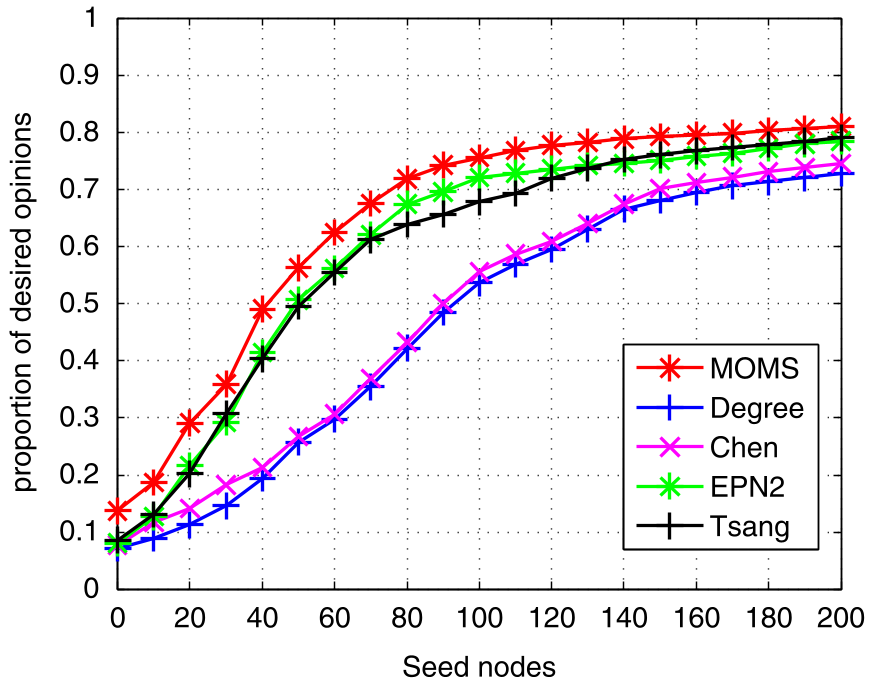 Fig 2: Proportion of desired opinions as a function of the number of seed nodes on the URV dataset.
Critical Analysis & Takeaways
Why does it work? MOMS succeeds because it recognizes that influence is path-dependent. By using a multi-stage approach, the algorithm can "course-correct." Furthermore, the hybrid selection algorithm effectively bypasses the -hard nature of the problem by identifying a "Candidate Set" first, which mathematically reduces the search complexity to .
Limitations: The paper assumes a cooperative or neutral environment. In the real world, "negative influence" or "counter-campaigns" (e.g., junk food marketing) often actively fight against the desired opinion. Future work should integrate adversarial opinion dynamics.
Conclusion: This work provides a highly practical blueprint for public health officials and social marketers. By shifting focus from "massive initial reach" to "sustained multi-stage engagement," we can achieve significantly better behavioral outcomes in complex social networks.