
MOO: Beyond Binary States in Social Influence Modeling
Multi-state Open Opinion Model based on Positive and Negative Social Influences
This paper introduces the Multi-state Open Opinion (MOO) model, a novel social influence diffusion framework that incorporates five distinct opinion states and both positive and negative social influences. By utilizing a dynamic Diffusion Matrix and a State Transition Table, the model achieves superior accuracy in predicting user opinion evolution compared to traditional binary-state models.
TL;DR
The Multi-state Open Opinion (MOO) model breaks the limitations of traditional "Active/Inactive" social influence models by introducing five granular opinion states and accounting for negative influence. By treating opinion as a continuous value that decays over time and mapping it to states via a transition table, the model reflects the complexity of real-world human interactions and significantly improves prediction accuracy for diverse social events.
Background Positioning
In the landscape of social network analysis, modeling how a "virus" or "idea" spreads has historically relied on the Linear Threshold (LT) and Independent Cascade (IC) models. While effective for simple viral marketing, these frameworks are essentially binary and "one-way." The MOO model, presented at ASONAM '15, represents a significant shift toward a more nuanced, psychological perspective on influence, acknowledging that people can be neutral, negative, or even change their minds back and forth.
Problem & Motivation: The Flaws of Binary Logic
Existing SOTA models (LT, IC, and even Heat Diffusion) primarily operate on two flawed assumptions:
- Influence is Positive: They assume a user is either "infected" by an idea or not. In reality, negative word-of-mouth is often more powerful than positive influence.
- Commitment is Permanent: Once a node becomes "Active," it stays active. This ignores the "forgetting curve" and the possibility of a user being persuaded back to a neutral or opposing stance.
The authors recognized that to predict opinions accurately, we need a model that handles opinion competition (positive vs. negative) and state fluidity.
Methodology: The Architecture of Multi-state Influence
The MOO model quantifies opinion through three main components:
1. The Five-State Spectrum
Instead of 0 or 1, nodes exist in a spectrum:
- PA / NA (Active): Users who hold opinions and actively try to influence their neighbors.
- PI / NI (Inactive): Users who hold opinions but remain silent.
- N (Neutral): Users with no stance, serving as the "battleground" for influence.
2. State Transition Table (STT)
This is the model's Inductive Bias. It defines the thresholds required for a user to move from "Neutral" to "Positive Inactive" or "Positive Active." Crucially, because the opinion is a value (), positive and negative influences can cancel each other out.
3. Dynamic Diffusion with Temporal Decay
The influence isn't static. The authors use a Diffusion Matrix (DM) coupled with an exponential decay factor:
As time () passes, the impact of the original message weakens (controlled by ), allowing the system to eventually reach a stable convergence state.
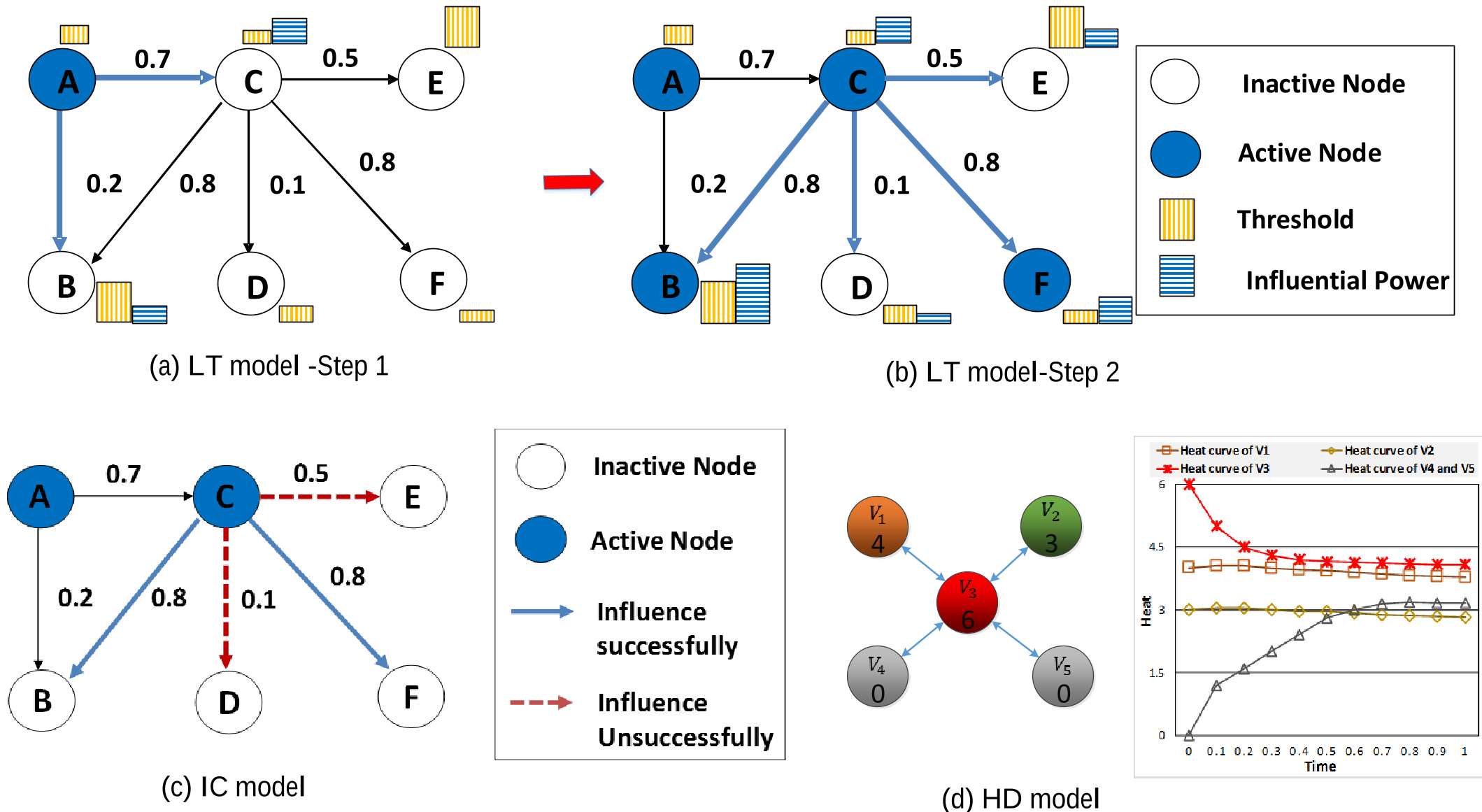 Figure 1: The mapping from continuous Opinion Values to discrete Opinion States via the STT.
Experiments & Results: Proving the Power of Complexity
The authors benchmarked MOO against HD, LT, and IC models using data collected from a custom Facebook application.
Key Observation: The "Negative" Advantage
The most striking results occurred in Negative Events. Traditional models like LT and IC, which have no concept of "Negative Active" states, failed to predict how negative sentiments suppress adoption.
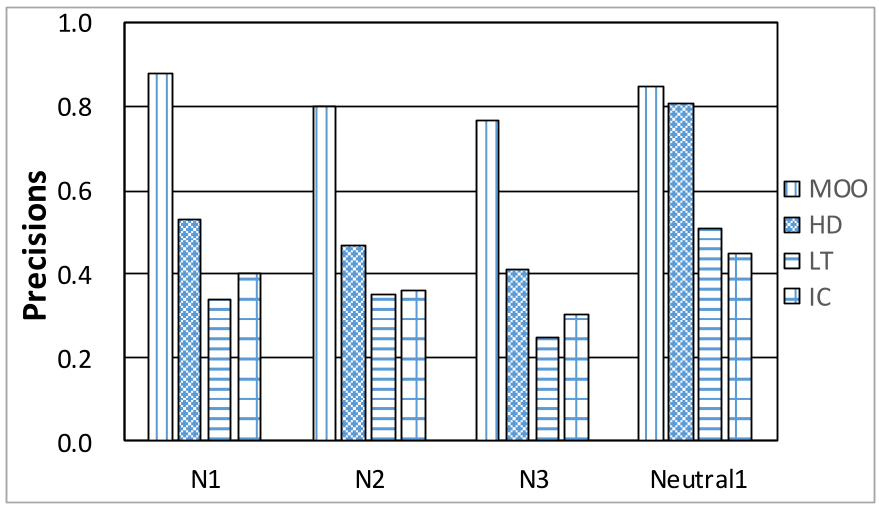 Figure 2: Precision across positive events. MOO consistently maintains higher accuracy as it captures the nuances of "Inactive" positive supporters.
The Role of Decay ()
The study found that:
- High (Fast Decay): Best for positive/negative events where people have strong, stubborn initial views.
- Low (Slow Decay): Best for neutral events where opinions are more "malleable" and change over multiple rounds of discussion.
Critical Analysis & Conclusion
Takeaway
The MOO model's primary contribution is the validation that Neutrality and Negativity are not just "lack of activity" but active components of the social fabric. By allowing reversible transitions and incorporating time-decay, the model moves social network analysis closer to social science.
Limitations
While innovative, the model assumes a somewhat homogeneous decay rate () for all users. In reality, different individuals (e.g., influencers vs. followers) might have different "memory" or "stubbornness" profiles. Furthermore, the thresholding in the STT requires careful parameter tuning which might vary significantly across different social platforms.
Future Prospect
This framework provides a solid foundation for modern "Polarization" studies. Extending MOO with deep learning (e.g., Graph Neural Networks) to learn the feature-based transition thresholds instead of setting them manually could be the next frontier in opinion modeling.