
MultiC2: Harmonizing Task and Worker Heterogeneity in Crowdsourcing
Multi-task Crowdsourcing via an Optimization Framework
The paper introduces MultiC2, a novel optimization framework for multi-task crowdsourcing that jointly models task and worker dual heterogeneity using a low-rank weight tensor. By bypassing traditional label inference steps, it directly learns weighted ensemble classifiers from noisy and missing labels, achieving SOTA performance on benchmarks like 20 Newsgroups and WebKB.
TL;DR
Researchers from Arizona State University have developed MultiC2, an optimization framework that tackles the "double trouble" of crowdsourcing: Task Heterogeneity (related but different objectives) and Worker Heterogeneity (varying levels of expertise). Unlike traditional methods that try to fix labels before training, MultiC2 learns directly from the mess, using a low-rank tensor approach to capture hidden structures.
The Core Challenge: The Two-Step Pitfall
In the standard machine learning workflow, if you have noisy labels from workers on MTurk, you usually use a method like Majority Voting or Dawid-Skene (EM) to "guess" the ground truth labels first. Only then do you train your classifier.
The problem? If your initial "guess" is wrong, your classifier is doomed to follow suit. This error propagation is particularly lethal in Multi-Task Learning (MTL), where the relationships between tasks are often ignored during the label cleaning step.
The Insight: Tensors as the Bridge
The authors suggest that instead of flattening the data, we should view it as a Three-Way Weight Tensor of size (Task Worker Feature).
The intuition is powerful:
- Low-Rank Commonality: Even if workers are diverse, their behaviors across similar tasks share a latent structure. By minimizing the Tensor Trace Norm, the model enforces this "shared wisdom."
- Adaptive Ensemble: Not all workers are equal. The framework uses an Entropy-based Ensemble to automatically silence spammers and reward experts without needing any "gold standard" check questions.

Methodology: Beyond the SVD
The optimization problem is solved using Block Coordinate Descent (BCD). The algorithm cyclically updates two main components:
- The Intermediate Matrices (): Solved via Singular Value Thresholding (SVT), which acts as the "compressor" for the low-rank structure.
- The Weight Tensor (): Solved via Gradient Descent.
To make this practical for large-scale "Big Data" scenarios, the authors proved that the gradient is separable with respect to workers. This led to the Batch-RBCD (Randomized Block Coordinate Descent) algorithm, which allows parallel processing and significantly faster convergence.
Experimental Results: Beating the Ground Truth?
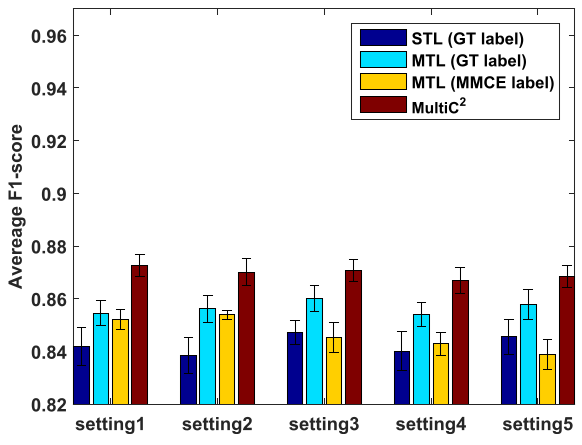
The most striking result appeared in the 20 Newsgroups benchmark. In several settings, MultiC2 actually outperformed MTL trained on Ground Truth labels.
Why? The authors suggest that the ensemble of weak classifiers acts as a regularizer, reducing the variance and the risk of overfitting compared to a single model trained on clean data.
Case Study: Real-World Animals
On the Animal Breed dataset (Cat vs. Canidae vs. Horse), identifying breeds is a task where laymen often fail. Using labels from 31 real human workers, MultiC2 consistently achieved higher Accuracy and F1-scores than standard MTL pipelines.
| Dataset (Task) | MTL (MMCE Labels) | MultiC2 (Proposed) |
|---|---|---|
| Cat Breed | 0.7260 | 0.8174 |
| Canidae Breed | 0.7743 | 0.8132 |
| Horse Breed | 0.8093 | 0.8430 |
Deep Insight & Conclusion
MultiC2 shifts the paradigm from "data cleaning" to "structural learning." By treating worker noise as a structural component rather than an outlier, it extracts value from even "smart adversaries" (workers who are consistently wrong but in a predictable way).
Limitations: The framework currently relies on a logistic loss, which while robust, might struggle with extremely high-dimensional spaces without further feature selection.
Future Outlook: As we move toward more complex AI tasks, the ability to synthesize "soft knowledge" from diverse human agents into a unified tensor-based model will be a cornerstone of scalable, reliable machine learning.