
Beyond Data Scarcity: Multi-Task Deep Learning in the Legal Domain
Multi-Task Deep Learning for Legal Document Translation, Summarization and Multi-Label Classification
This paper introduces a Multi-Task Deep Learning (MTDL) approach for the legal domain, utilizing a unified "MultiModel" architecture to perform translation, summarization, and multi-label classification simultaneously. The researchers demonstrated that by leveraging transfer learning across related legal tasks, their model outperforms state-of-the-art (SOTA) specialized systems like the Transformer and JEX.
TL;DR
Researchers from the Technical University of Munich have demonstrated that you don't always need massive, task-specific datasets to conquer the complex legal domain. By using Multi-Task Deep Learning (MTDL), they trained a single model to handle translation, summarization, and classification at once. The result? They crushed existing State-of-the-Art (SOTA) baselines, proving that "learning to translate" can actually help a model "learn to summarize" legal documents.
The Problem: The "Expert Annotation" Bottleneck
The legal sector is drowning in text but starving for annotated data. Unlike "ImageNet" or "SQUAD," which can be outsourced to general crowdsourcing platforms, legal documents require JD-level expertise to label. This creates a massive barrier to entry for Deep Learning (DL), which usually demands tens of thousands of examples to converge. This paper addresses a critical question: Can we use knowledge from data-rich tasks (like translation) to boost performance on data-poor tasks (like legal classification)?
Methodology: The Architecture of Unified Intelligence
The authors utilized the MultiModel architecture, originally proposed by Google Brain. Unlike standard Transformers that are often fine-tuned for a single purpose, the MultiModel is designed for versatility.
Core Components:
- Modality Nets: These handle different I/O formats (though this study focused on the "language" modality).
- Encoder-Decoder-Mixer: A fully convolutional backbone that processes unified embeddings.
- Command Tokens: The secret sauce. A specific token is passed to the decoder to tell it which task (e.g., "Summarize this") to perform.
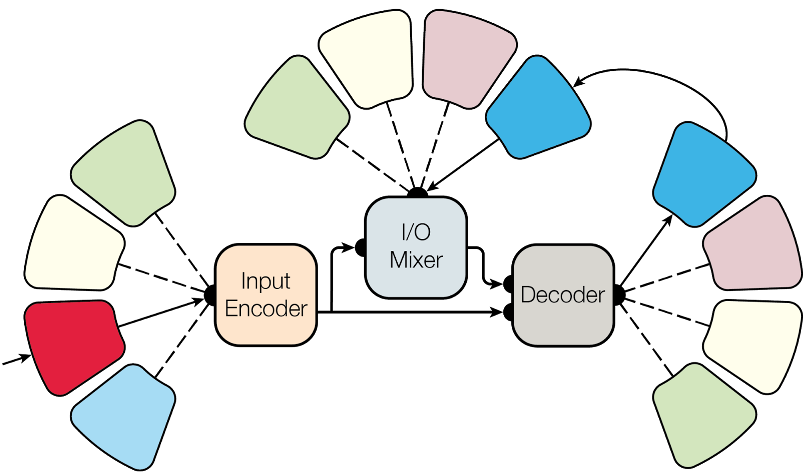 Figure 1: The MultiModel building blocks consisting of Modality Nets and a convolutional Seq2Seq core.
Experiments: More Tasks, Better Results?
The study focused on the JRC-Acquis and Europarl corpora across seven languages. The most fascinating discovery was the JA-3 combination: training German translation, summarization, and multi-labeling simultaneously.
Performance Breakthroughs:
- Translation: The MultiModel Base (MM-B ja-3) hit a BLEU score of 55.11 on the DCEP dataset, outperforming the standalone Transformer.
- Summarization: The MultiModel didn't just win; it dominated, doubling the ROUGE scores compared to the Transformer baseline.
- Classification: In the EuroVoc multi-label task—a notoriously difficult problem with 6,000+ labels—the MTDL approach reached an F1-score of 0.65, significantly higher than the 0.51 achieved by the previous SOTA, JEX.
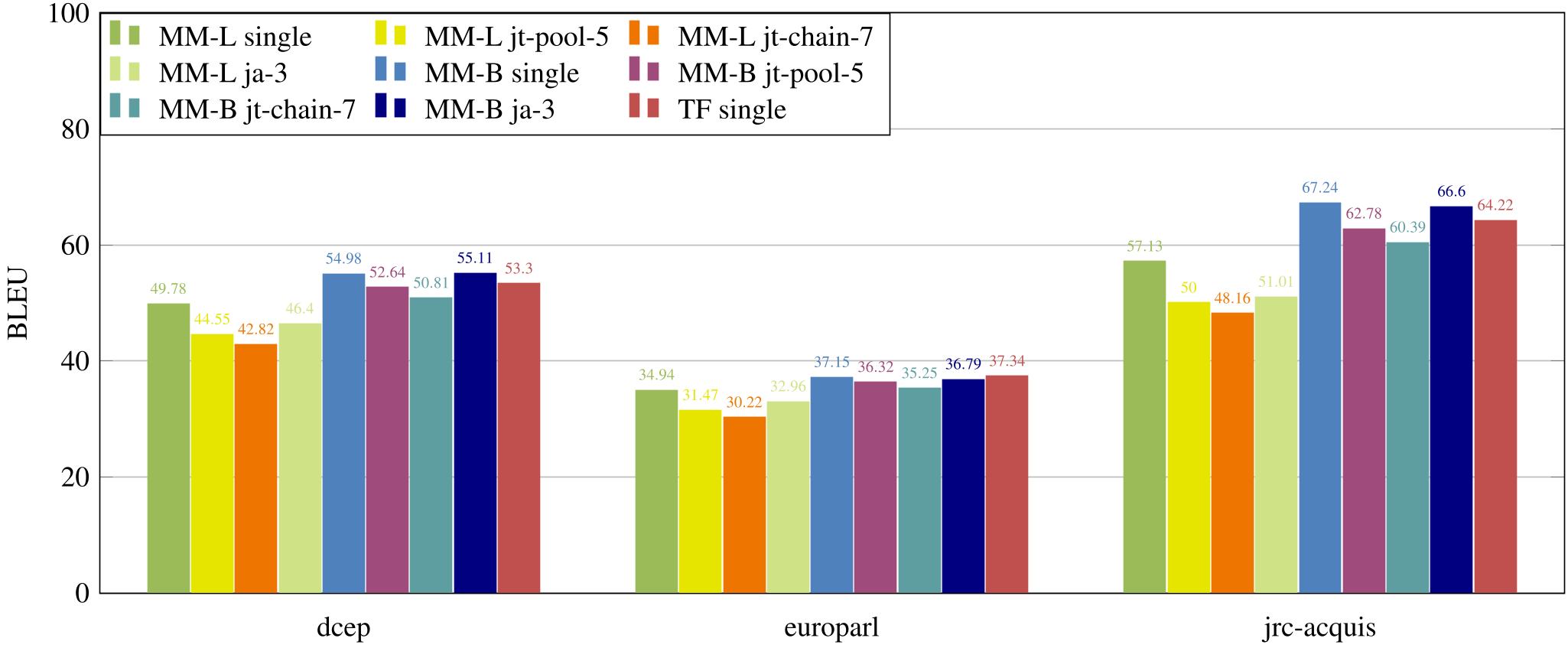 Figure 2: BLEU score performance showing that joint training across task families (JA-3) often yields the highest precision.
Critical Insight: Why Does This Work?
The success of this approach lies in Transfer Learning. In legal documents, the "logic" and "syntax" are often consistent across tasks. When a model learns the high-dimensional semantic mapping required for translation, it develops a robust internal representation of legal language. This representation acts as a "head start" for summarization and classification, preventing the model from overfitting on the smaller datasets typically available for those tasks.
Summary & Outlook
This research provides a blueprint for applying AI in high-stakes, low-data environments.
- Key Takeaway: Joint training with at least one high-volume task is the most effective way to solve data scarcity.
- Limitation: Balancing model capacity is tricky. Small models (MM-Light) struggle to juggle too many tasks, while overly large models can overfit if not balanced by enough data from at least one task.
For legal-tech developers, the message is clear: stop looking at translation and classification as separate silos. In the world of Deep Learning, everything is a single, unified language problem.