
Multi-task Gated Contextual Attention: Decoding the Synergy of Sentiment and Emotion
Multi-task Gated Contextual Cross-Modal Attention Framework for Sentiment and Emotion Analysis
The paper introduces a Multi-task Gated Contextual Cross-Modal Attention framework for joint sentiment and emotion analysis. It leverages text, acoustic, and visual modalities across multiple utterances, achieving new SOTA results on the CMU-MOSEI dataset (Emotion F1: 79.06%, Sentiment Acc: 80.15%).
TL;DR
In human communication, the "vibe" (sentiment) and the "feeling" (emotion) are inseparable. Most AI models, however, treat them as separate problems. This paper introduces a Multi-task Gated Contextual Cross-Modal Attention Framework that analyzes video by looking at text, sound, and facial expressions simultaneously. By using a "Gated" architecture to filter noise and a joint learning strategy, the model achieves state-of-the-art results on the competitive CMU-MOSEI benchmark.
Problem & Motivation: The Silo Effect in Multimodal AI
Traditional emotion/sentiment recognition models suffer from two major flaws:
- Task Isolation: They ignore the fact that "happy" usually implies "positive sentiment." Training them separately misses out on valuable shared "inductive bias."
- Modality Noise: In a specific video segment, the text might be sarcastic (negative) while the voice is laughing (positive). Standard fusion methods often struggle to decide which modality to trust for which task.
The authors hypothesized that a Multi-task Learning (MTL) framework, combined with an attention mechanism that understands context across multiple utterances, would allow the model to "attend" to the most relevant cues (e.g., focusing on acoustics for anger, but text for sarcasm).
Methodology: The Architecture of Attention
The framework is built on three pillars: Context, Cross-Modal Interaction, and Gating.
1. Contextual Bi-GRUs
The model processes a sequence of utterances using separate Bi-directional Gated Recurrent Units (GRUs) for text, visual, and acoustic inputs. This ensures the model understands that an utterance's meaning depends on what was said before and after it.
2. Contextual Cross-Modal Attention (CCMA)
Instead of just concatenating features, the CCMA calculates "modality-aware" representations. For instance, it generates "text-aware acoustic" features, where the model looks at the text to decide which parts of the audio signal are most important.
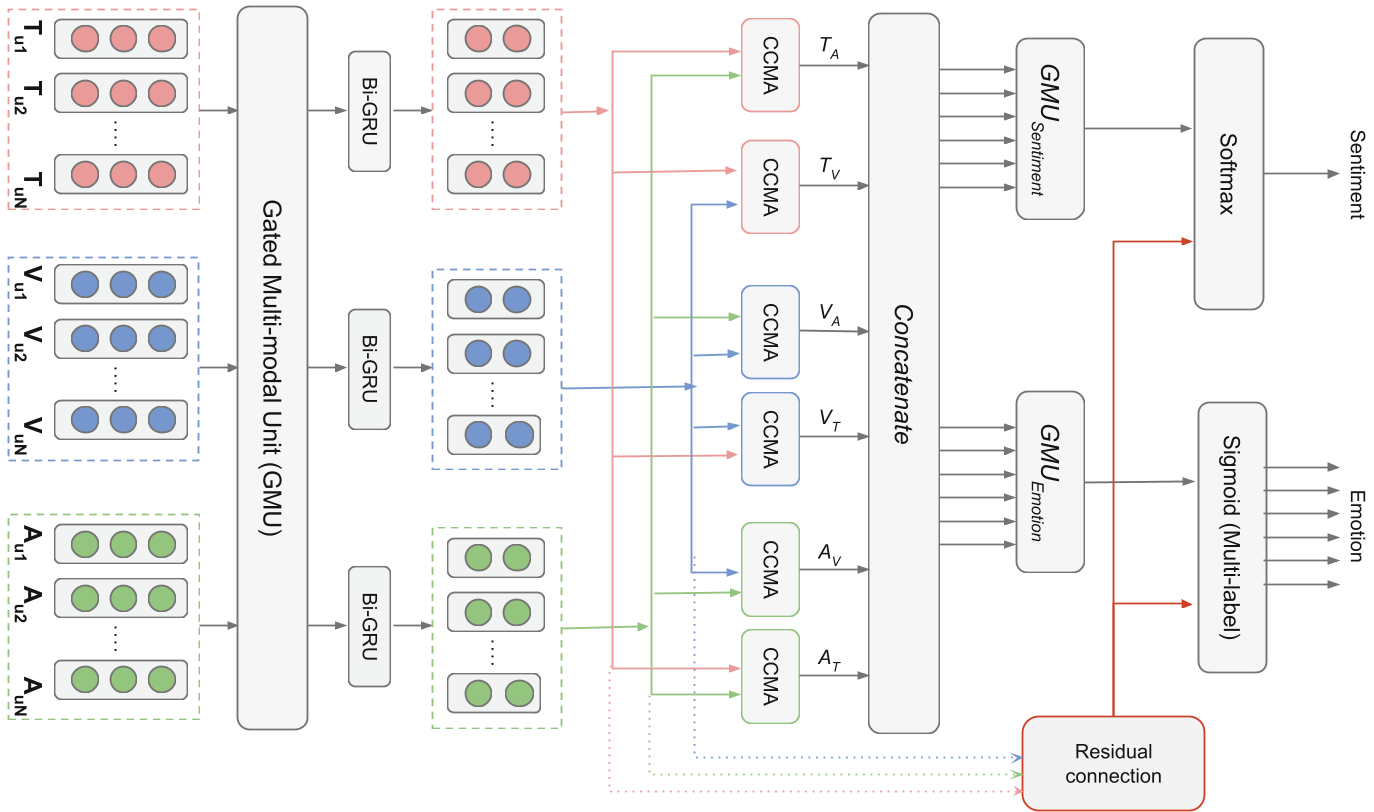
3. Gated Multimodal Units (GMU)
The "secret sauce" is the GMU. It acts like a logic gate (using a Sigmoid function) that decides how much information from each modality should pass through. Crucially, the authors apply this independently for sentiment and emotion branches, allowing the model to favor different clues for different tasks.
Experiments: Dominating the CMU-MOSEI Benchmark
The researchers evaluated their model on the CMU-MOSEI dataset, the gold standard for multimodal language analysis containing over 23,000 utterances.
Key Results:
- Emotion Classification: Achieved an F1-score of 79.06%, significantly higher than the previous SOTA of 76.3%.
- Sentiment Analysis: Reached an Accuracy of 80.15%, shattering the previous record of 76.9%.
- MTL vs. STL: The Multi-task version consistently beat the Single-task versions, proving that sentiment and emotion act as "regularizers" for each other.

Deep Insight: Why Multi-tasking Wins
The paper provides a fascinating error analysis (Table 3). In several cases where a single-task model failed—misclassifying a "positive" sentiment as "negative"—the multi-task model succeeded. Why? Because the emotion branch correctly identified "Happy" or "Surprise," which "corrected" the sentiment branch via the shared hidden representations.
Critical Analysis & Conclusion
Takeaway
This work proves that gating mechanisms are more effective than simple concatenation for multimodal fusion. By filtering noise at both the input and the attention levels, the model mimics human perception—shifting focus between sight, sound, and language depending on the context.
Limitations & Future Work
While the architecture is robust, the current model uses word-level averages for features, which might lose fine-grained temporal nuances within a single word. Future iterations could explore Transformer-based "Cross-Attention" at the frame level to further push the boundaries of "Affective Computing."
Academic Citation: Chauhan, S. D. S. et al. (2026). Multi-task Gated Contextual Cross-Modal Attention Framework for Sentiment and Emotion Analysis. Indian Institute of Technology, Patna.