
Beyond the Surface: Detecting Social Spammers through Multi-View Behavior Consistency
An Investigation on Multi View Based User Behavior Towards Spam Detection in Social Networks
This paper investigates Twitter spam detection by leveraging user behavior consistency across multiple views, specifically "Content Interest" and "Popularity." By applying homophily theory, the authors demonstrate that legitimate users maintain high consistency across these views, whereas spammers exhibit significant inconsistency, providing a robust mechanism for distinguishing malicious accounts.
TL;DR
Detecting social media spammers is an ongoing arms race. While traditional methods look at what a user posts or who they follow, this research shifts the focus to Behavioral Consistency. By analyzing two distinct "views"—what a user discusses (Content Interest) and how the community reacts (Popularity)—the authors find that spammers are fundamentally inconsistent. Benign users show harmony between their interests and their social standing, while spammers exhibit a chaotic, fractured digital footprint.
The Problem: The "Cat-and-Mouse" Game of Feature Engineering
Modern spammers are masters of disguise. They can buy followers to fake authority or use AI to generate human-like text, making traditional single-view classifiers (which focus on specific attributes like URL frequency or account age) increasingly obsolete. This phenomenon, known as Spam Drift, means that as soon as a security model is deployed, spammers adapt their features to bypass it.
The core limitation of previous work is the reliance on "snapshots" of behavior. To build a more resilient system, we need to look at the underlying fabric of human behavior.
The Insight: Homophily and Psychological Consistency
The authors draw from sociology and psychology, specifically the Homophily Theory (the idea that "birds of a feather flock together"). They posit that a legitimate human's behavior is consistent across different contexts. In the digital realm, if you are genuinely interested in a topic (high content similarity with experts/peers), you are likely to be recognized for it (high popularity).
Spammers, however, are driven by external agendas. They jump on trending hashtags (Topics) to spread malicious links without having a genuine interest in the content. This creates a "disconnect" between their views.
Methodology: The Multi-View Framework
The research breaks down user behavior into two orthogonal "views":
1. The Content Interest View (Internal)
The authors use a three-order tensor (User Topic Word).
- Topics are defined by frequent hashtags.
- Content is represented by top frequent words extracted via TF-IDF.
- Similarity is calculated using the Jaccard index between user profiles under specific topics.
2. The Popularity View (External)
Popularity isn't just about follower counts (which can be faked). The authors look at Retweet Percentages. They calculate a "Centroid Average Retweet" for each topic; if a user's posts consistently perform above this average, they are marked as "Popular."
 Eq 1: Using Jaccard Similarity to measure topical interest alignment.
Experimental Evidence
The study utilized three massive datasets: Social Honeypot, HSpam14, and The Fake Project.
Key Finding 1: Similarity Distribution
Legitimate users clustered tightly with high average similarity in their chosen topics. Spammers, conversely, were spread thin. Their usage of hashtags was revealed to be a purely "tactical" embedding to gain visibility, resulting in low similarity to the actual topical communities.
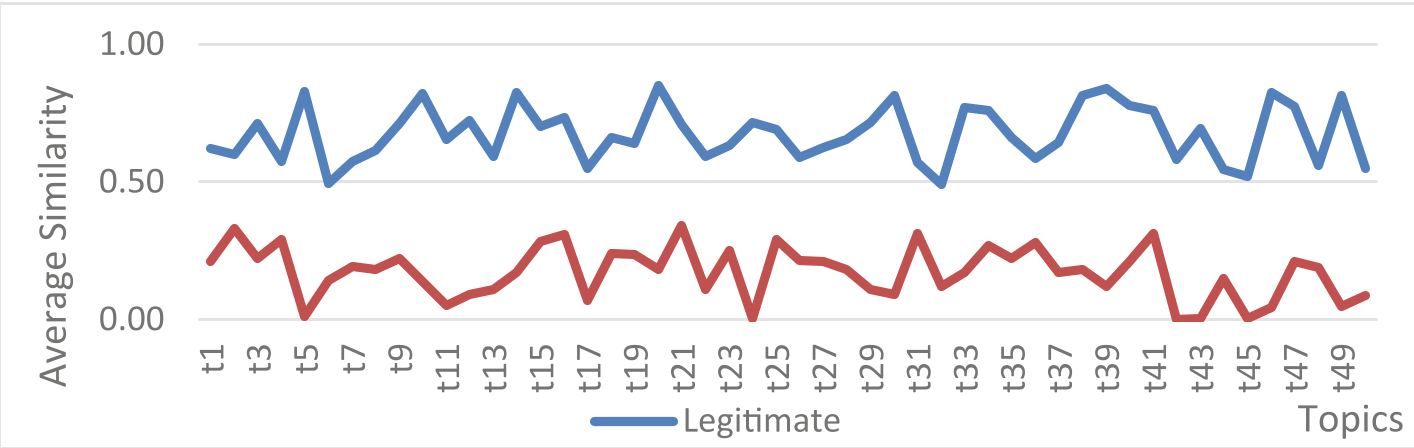 Figure: The clear separation in average similarity between legitimate users and spammers.
Key Finding 2: Consistency is the Smoking Gun
The most striking result came from the cross-view analysis. The authors defined Consistency as having matching "High-High" or "Low-Low" states across Content and Popularity.
- Legitimate Users: Showed 52.4% to 89.1% consistency.
- Spammers: Collapsed to a range of 0.0% to 35.8%.
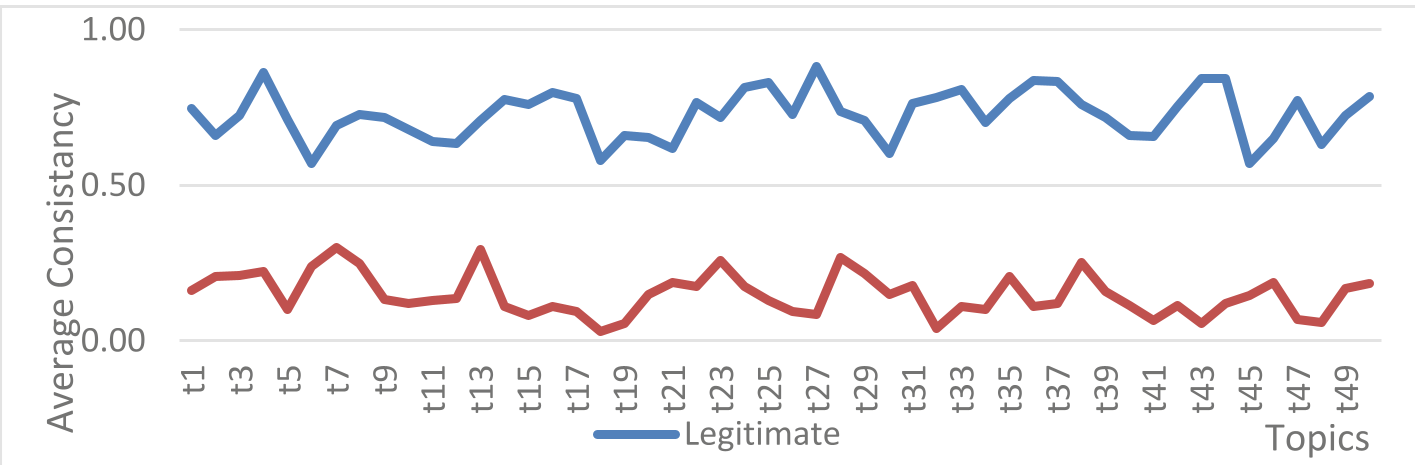 Figure: Average consistency across the top 50 topics shows a massive gap between user types.
Critical Insight & Future Outlook
This work fundamentally proves that integrity is harder to forge than identity. A spammer can buy 10,000 followers, but maintaining a consistent, topically-relevant content profile that earns organic social validation across multiple disparate topics is resource-intensive and likely impossible for automated bots at scale.
Limitations: The current model relies on hashtags as the primary topic anchor. As social media moves toward "hashtag-less" discovery (like TikTok or Facebook's algorithmic feeds), the "Topic" dimension will need to be replaced by Latent Dirichlet Allocation (LDA) or BERT-based embeddings to maintain its edge.
Conclusion: By shifting from "What are you?" to "Are you consistent?", this research provides a powerful new lens for the next generation of trust-based security frameworks in social networks.