
MARS: Revolutionizing Flexible Job Shop Scheduling with IoT and Bargaining Games
Multiagent and Bargaining-Game-Based Real-Time Scheduling for Internet of Things-Enabled Flexible Job Shop
2018-09-20
Summary
Problem
Method
Results
Takeaways
Abstract
This paper proposes a Multiagent-based Real-time Scheduling (MARS) architecture for IoT-enabled flexible job shops, utilizing a bargaining-game-based negotiation mechanism. The system leverages real-time data from auto-ID technologies to optimally assign tasks to machines, achieving significant improvements in makespan and energy efficiency.
## TL;DR
Manufacturing shop floors are notoriously unpredictable. This paper introduces **MARS (Multiagent-based Real-time Scheduling)**, a decentralized architecture that uses **IoT data** and **Bargaining Game Theory** to handle equipment failures and rush orders on the fly. By shifting from a centralized "command-and-control" model to a "negotiation-based" agent model, the researchers achieved over 30% improvement in production speed and a massive 50% cut in energy consumption.
## The Problem: The Inflexibility of Centralization
In a traditional "Flexible Job Shop Scheduling Problem" (FJSSP), a central server decides the schedule for everyone. However, when a machine breaks down or a high-priority "rush order" arrives, the static plan shatters.
Prior multiagent attempts to solve this often relied on the **Contract Net Protocol (CNP)**—essentially an internal auction system. While better than centralization, CNP is "communication-intensive," meaning agents spend more time talking than "thinking," especially in a data-rich **Internet of Manufacturing Things (IoMT)** environment.
## Methodology: Agents that Negotiate Like Humans
The core innovation lies in the **Real-time Scheduling Agent (RSA)** using a **Bargaining Game Model**.
### 1. The Multiagent Architecture
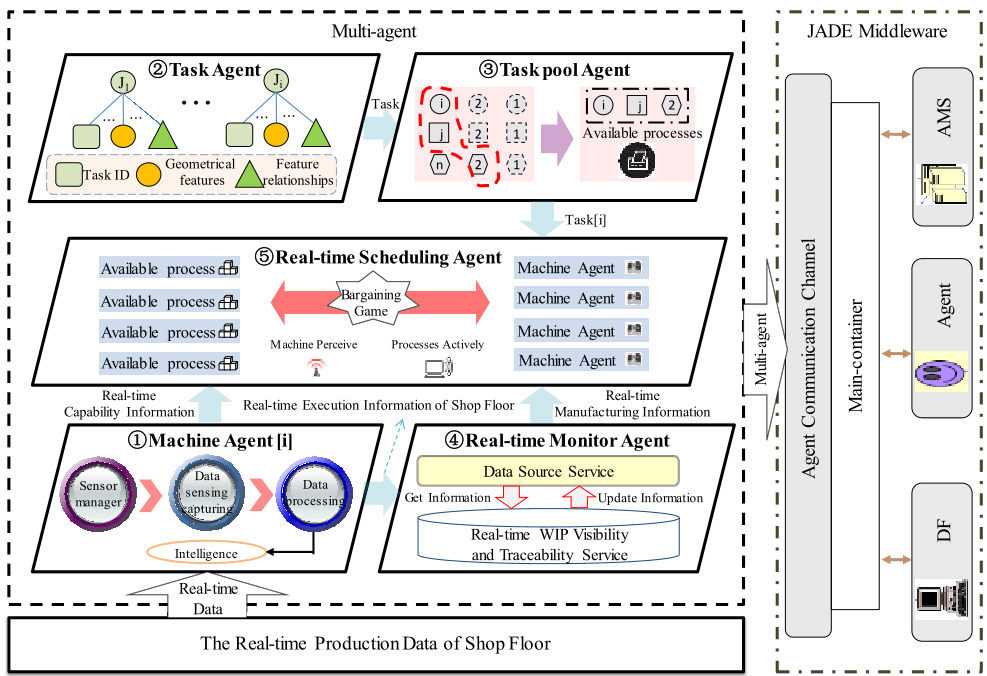
The system is built on the **JADE (Java Agent Development Framework)** and comprises five key players:
* **Machine Agent (MA)**: The "eyes" on the ground, capturing RFID data.
* **Task Agent (TA)**: Manages task specifications.
* **Task Pool Agent (TPA)**: Feeds available operations into the system.
* **Real-time Monitor Agent (RMA)**: Tracks Work-in-Progress (WIP).
* **Real-time Scheduling Agent (RSA)**: The "brain" that solves the game.
### 2. The Bargaining Game Intuition
Instead of a single algorithm trying to balance three conflicting goals—**Makespan (Time)**, **Workload Balance**, and **Energy Consumption**—the authors treat these goals as three different **players in a bargaining game**.
* Each player is rational and seeks to maximize its own payoff.
* They move through a series of negotiation stages to find a **Subgame Perfect Nash Equilibrium (SPNE)**.
* This ensures "Collective Rationality," where the final agreement benefits the entire system more than any single-objective solution could.
## Experimental Evidence: Sashing the Competition
The authors tested their MARS system against standard industry rules like **Shortest Processing Time (SPT)** and **First-In-First-Out (FIFO)** under three stress tests:
1. **Case 1**: Machine breakdown and repair.
2. **Case 2**: Unexpected rush orders inserted mid-process.
3. **Case 3**: Simultaneous machine failure and rush orders.

### Key Findings:
* **Time Efficiency**: In Case 2, MARS completed tasks in **20 hours**, compared to 30-39 hours for traditional methods—a near **50% improvement** in the worst-case scenario.
* **The Green Factor**: Total energy consumption dropped from ~387 kW·h (FIFO) to **191.44 kW·h** (MARS), proving that smarter scheduling is one of the most effective ways to achieve sustainable manufacturing.
## Critical Analysis & Conclusion
The MARS framework successfully bridges the gap between high-level game theory and low-level IoT data. By treating scheduling as a **continuous negotiation** rather than a one-time calculation, the system remains resilient to the "chaos" of a real factory.
**Limitations**: The current model assumes an N-person bargaining game with complete information. In even more complex, multi-site manufacturing scenarios, "Asymmetric Information" (where one agent knows more than others) might require more advanced **Incomplete Information Game** models.
**Future Perspective**: This work sets the stage for "Autonomous Manufacturing," where the shop floor essentially schedules itself without human intervention, reacting to real-time physics and logistics data to maximize both profit and planet-health.