
MWAC: Revolutionizing Skill Discovery via Self-Organizing Multi-Agent Systems
Using Multiagent Self-organization Techniques to Improve Dynamic Skill Searching in Virtual Social Communities
This paper introduces an extended Multi-Wireless-Agent Communication (MWAC) model that leverages self-organizing multi-agent systems (MAS) to optimize skill and service discovery within dynamic social networks. By transitioning from centralized databases to a decentralized, emergent topology, the system achieves a significant reduction in message overhead for large-scale information retrieval.
TL;DR
Finding a specific expert in a massive corporate network shouldn't require broadcasting a message to everyone. This paper proposes a self-organizing multi-agent framework that mimics social structures to build an "emergent" map of skills. By assigning roles based on sociability and workload, the system reduces network traffic by over 60% compared to standard flooding techniques.
Background: The Limits of Centralization
In a modern enterprise, employee skills (internships, certifications, project experience) change daily. Storing this in a centralized database is a maintenance nightmare, while searching for it via "Flooding" (asking everyone's friends) creates massive network congestion. The authors argue that a Multi-Agent System (MAS) approach—where each user is represented by an intelligent agent—can solve this by treating the network as a living, breathing organism.
The Core Insight: From Chaos to Hierarchy
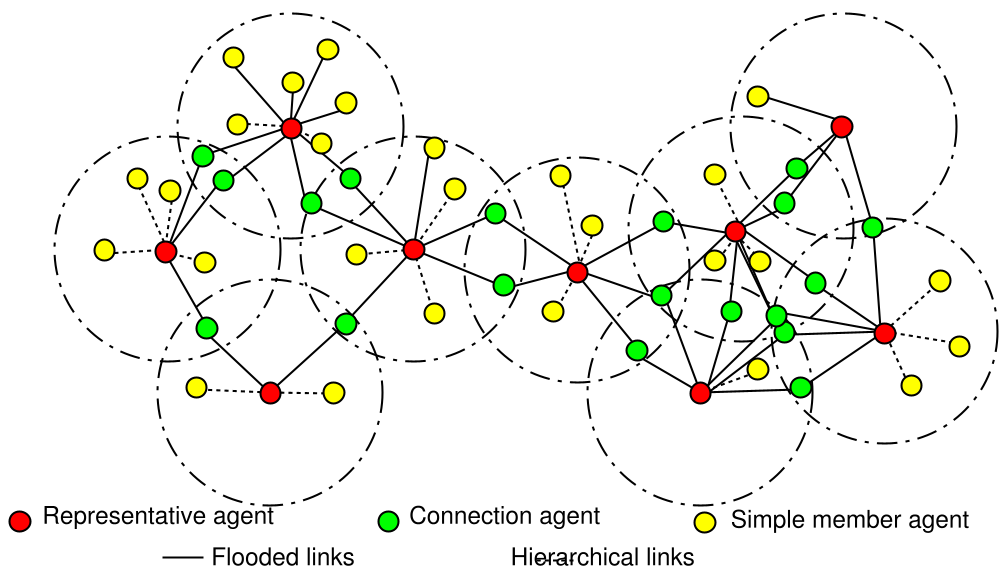
The authors adapt the MWAC (Multi-Wireless-Agent Communication) model. The genius of this approach lies in its Role Attribution Algorithm. Instead of every node being equal, the system dynamically elects leaders:
- Group Representatives: The "super-connectors." They manage long-distance communication and must have high sociability but low workload.
- Connection Agents: The bridges between different groups.
- Simple Members: Standard users who only participate in their own queries to save energy/bandwidth.
Model Architecture
The following structure illustrates how the social graph is "pruned" into an efficient organizational hierarchy.
Methodology: Adaptive Skill Routing
The system calculates a Sociability Score (S) and a Workload (W) for each agent. An agent with many friends but little "free time" (high activity) is a poor candidate for a Representative role because they cannot efficiently relay others' messages.
Once the organization emerges, a "skill search" doesn't flood the network. Instead, it travels from a Simple Member to a Representative, then across Connection Agents to the relevant target group. This distributed database approach ensures that no agent needs a global view of the network; they only need to know their immediate neighbors and their assigned roles.
Experiments & SOTA Comparison
The researchers benchmarked MWAC against the industry-standard TTL (Time To Live) Flooding.
Structural Emergence
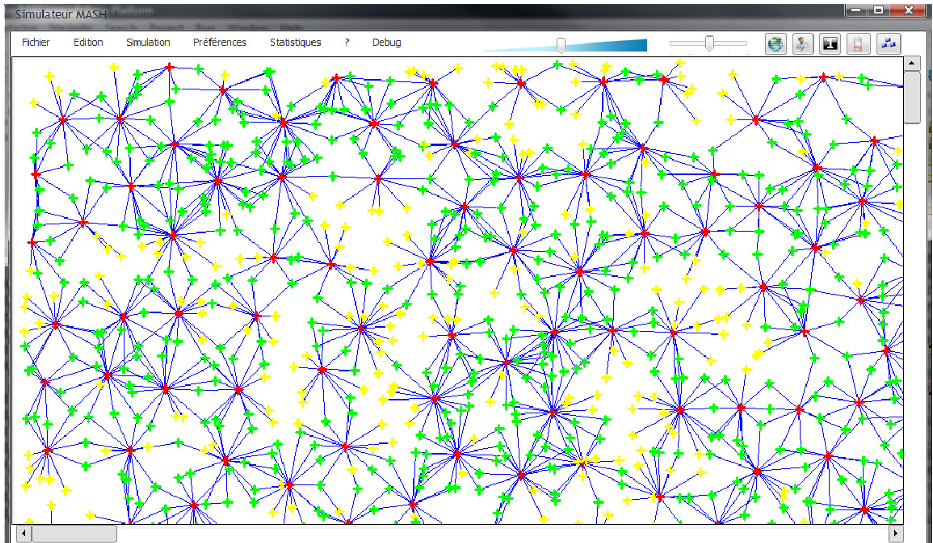
Before the algorithm runs, the network is a dense "hairball" of connections. After self-organization, the system identifies a core topology that uses only 25% of the original links for routing, significantly clearing the "noise."
Performance Gains
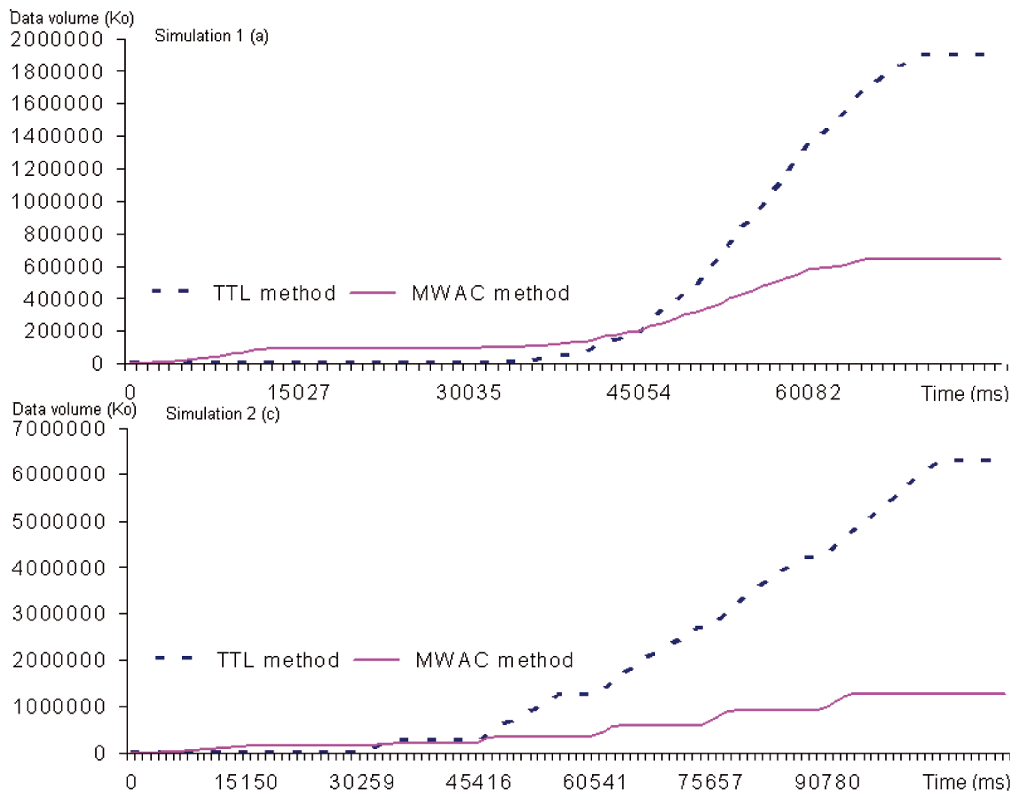
- Data Volume: In a search task with 600 agents, the standard TTL method consumed 6 GB of traffic, while MWAC required only 2 GB.
- Scalability: As the density of services and the number of members increased, MWAC’s efficiency ratio improved (ranging from 3.5x to 6.2x better than TTL).
- Initial Overhead: Interestingly, the authors noted that MWAC is slower at the very beginning because it needs to "spend" messages to organize itself. However, once the roles are established, it quickly outpaces traditional methods.
Critical Analysis & Conclusion
The value of this work lies in its Inductive Bias: it assumes that human social networks naturally have "hubs" and uses that physical reality to optimize digital routing.
Takeaway: By offloading the "search" logic to autonomous agents that negotiate roles locally, companies can build skill-discovery tools that are both privacy-preserving (no central data hub) and highly resilient.
Limitations: While the model handles dynamic changes well, the paper assumes that all agents are "honest" and cooperate. In a real-world social network, malicious nodes could attempt to become Representatives to intercept data OR refuse to relay messages to save their own battery/resources. Future work incorporating "trust metrics" or "incentive mechanisms" would be a natural next step for this lineage of research.