
Decoding Group Dynamics: A Multiagent Approach to Social Influence via Emotion Recognition
Multiagent Social Influence Detection Based on Facial Emotion Recognition
The paper introduces a Multiagent System (MAS) designed to detect and track social influence within small groups by analyzing facial emotion diffusion from video data. It utilizes Active Appearance Models (AAM) and Support Vector Machines (SVM) for emotion recognition, mapping influential correlations into a weighted social graph.
TL;DR
Researchers have developed a multiagent system (MAS) capable of quantifying "who influences whom" in a meeting just by watching their faces. By tracking the diffusion of emotions—like how one person's smile or frown triggers a reaction in others—the system builds a weighted social graph that reveals the hidden power structures within small groups.
Background & Positioning
In the landscape of Social Network Analysis (SNA), we typically focus on the "macro" (who follows whom on Twitter) or the "physical" (who is looking at whom). This paper shifts the focus to the "affective micro-level." It positions itself as a bridge between social psychology (emotion contagion) and computer vision, utilizing a distributed multiagent architecture to ensure the system remains robust and scalable even as group sizes vary.
The Problem: The "Silent" Influence
Why is detecting influence so hard? In an office meeting or a negotiation, the person talking the most isn't always the most influential. Influence is often subtle—expressed through a reaction to a statement or a shared sentiment. Existing SOTA methods often rely on pose detection or speech patterns but miss the emotional resonance that actually drives human consensus and decision-making.
Methodology: From Pixels to Parameters
The system operates through a sophisticated three-step pipeline:
1. The Multiagent Architecture
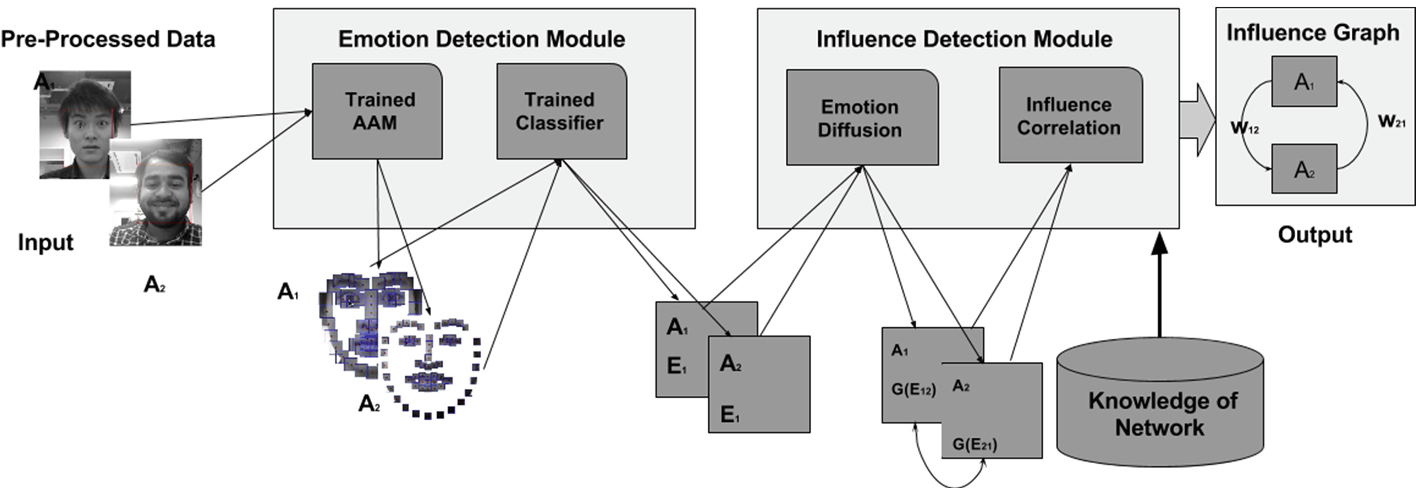
Every participant is assigned an autonomous software agent. These agents process individual video streams to maintain privacy and allow for parallel processing.
2. Emotion Detection Pipeline
The authors use Active Appearance Models (AAM) to track 68 landmark points on the face. From these, they extract:
- Shape features (s-pts)
- Appearance features (c-app)
These features are fed into a bank of Binary SVM Classifiers, each trained to detect specific Facial Action Units (FACS). Together, these units define one of the basic emotions (Happy, Sad, Angry, etc.).
3. Quantifying Diffusion ()
The core innovation is the Emotion Diffusion Parameter. The authors don't just look at a single frame; they look at how Agent A's action (like speaking) or Agent A's emotion (like looking surprised) correlates with a change in Agent B's emotion over time.
Here, represents an agent's "emotion coefficient," which is weighted by their Node Centrality (). This effectively means that a senior manager's smile carries more "weight" in the system than an intern's, reflecting real-world social hierarchies.
Experimental Validation
To test the system, the authors recorded a scripted discussion between three colleagues (Agents A, B, and C). They assigned different seniority and knowledge levels to simulate a real work environment.
Key Findings:
- Accuracy: The facial feature classifiers achieved high precision (up to 95%).
- Influence Mapping: The system successfully identified that Agent B (the "knowledgeable" one) had the highest influence, specifically a positive influence on Agent C and a "negative" influence on Agent A (where Agent A's emotions moved in the opposite direction).
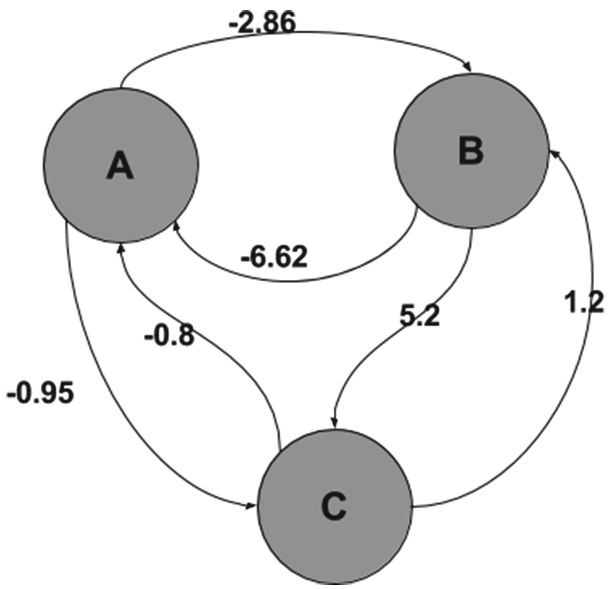 Fig 2: The final output—a weighted graph showing the direction and strength of influence.
Critical Insight & Future Outlook
The brilliance of this work lies in the (Action inducing Emotion) and (Emotion inducing Emotion) distinction. It acknowledges that influence isn't just about what you say, but how the "vibe" of the room shifts when you feel something.
Limitations: The current study relies on scripted data and a relatively small set of 5 emotions. In "the wild," lighting conditions and overlapping speech could present significant challenges for AAM and SVM-based models.
The Road Ahead: The authors plan to integrate voice data—analyzing tone and pitch alongside facial expressions. Imagine a future where a digital assistant could provide a post-meeting report: "You had a strong positive influence on the engineering team, but the marketing lead seemed unconvinced during the budget section." This research brings us one step closer to that reality.