
Multicast-Pushing with Human-in-the-loop: When Social Dynamics Meet Wireless Efficiency
Multicast-pushing with human-in-the-loop: Where social networks meet wireless communications
This paper introduces a "Human-in-the-loop" proactive pushing and caching framework that leverages Social Network analysis to optimize wireless communication. By utilizing a Linear Threshold (LT) model for demand prediction and a joint pushing and caching (JPC) strategy, the system achieves significant gains in Cache-Hit Ratio (CHR) using physical layer multicasting.
Executive Summary
TL;DR: This paper bridges the gap between social science and wireless engineering by proposing a Human-in-the-loop system. By predicting when a user will want a file based on their friends' activities (using a Linear Threshold model), the base station proactively multicasts content to local buffers, drastically increasing the Cache-Hit Ratio (CHR) and reducing perceived latency.
Academic Positioning: This work moves beyond simple popularity-based caching. It positions itself as a "closed-loop" control system where human social behavior is the primary input, and wireless multicast efficiency is the optimization objective.
The Problem: The Reactive Bottleneck
Traditional wireless networks are reactive. They wait for a user to request a file before burning spectrum to deliver it. This leads to two major issues:
- Spectrum Scarcity: Peak traffic hours overwhelm the base station.
- Latency: Users must wait for the full transmission cycle after clicking.
While "proactive caching" exists, most methods treat users as isolated entities. In reality, our digital consumption is socially driven. If your friends are talking about a specific video on WeChat or Facebook, you are significantly more likely to request it soon. Ignoring this social "drift" leads to inefficient cache utilization.
Methodology: Socially-Aware Predictive Caching
The authors propose a system architecture that transforms the base station into a "socially-aware" agent.
1. The LT-Model Prediction
The core "intelligence" lies in the Linear Threshold (LT) Model. Each user has a "threshold" for a specific piece of content. When the "influence" from their active friends (who have already requested the file) exceeds this threshold, the system predicts that the user will become "active" and request the file in a future time slot.
2. The JPC Algorithm
Once the demand is predicted, the Base Station (BS) must decide: What to push, and when to push it? The authors formulate this as a Joint Pushing and Caching (JPC) problem. Since the BS can only push one file per time slot via multicasting, it uses a 0-1 integer program to maximize the expected CHR over a time horizon called the Prediction Window (T).
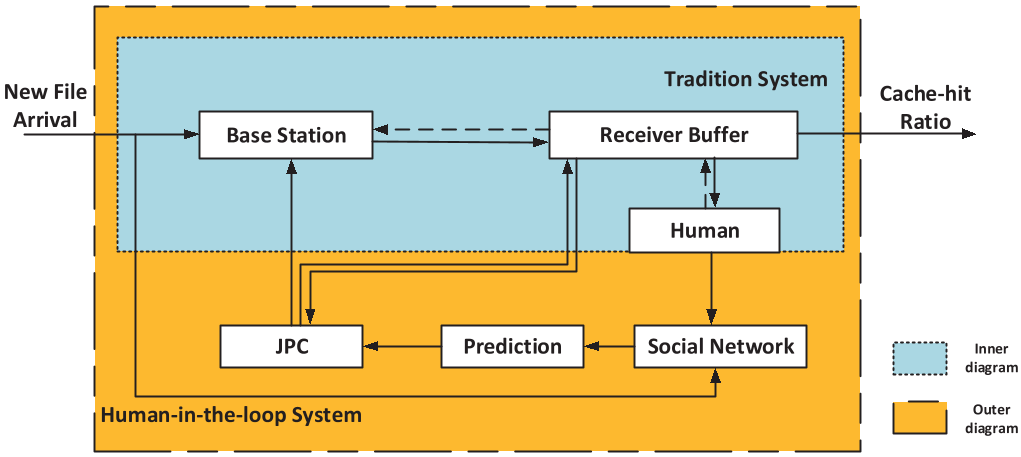 Figure 1: The Human-in-the-loop system framework showing the closed-loop feedback between social networking and wireless pushing.
3. Solving via Maximum Weight Matching
For scenarios with large buffers, the complexity is reduced to a Maximum Weight Matching problem, which is efficiently solved using the Kuhn-Munkras (KM) algorithm, ensuring the strategy is computationally feasible for real-time BS deployment.
Experiments: The Goldilocks Zone of Prediction
Using real Facebook social graph data, the authors highlights a fascinating trade-off regarding the Prediction Window (T).
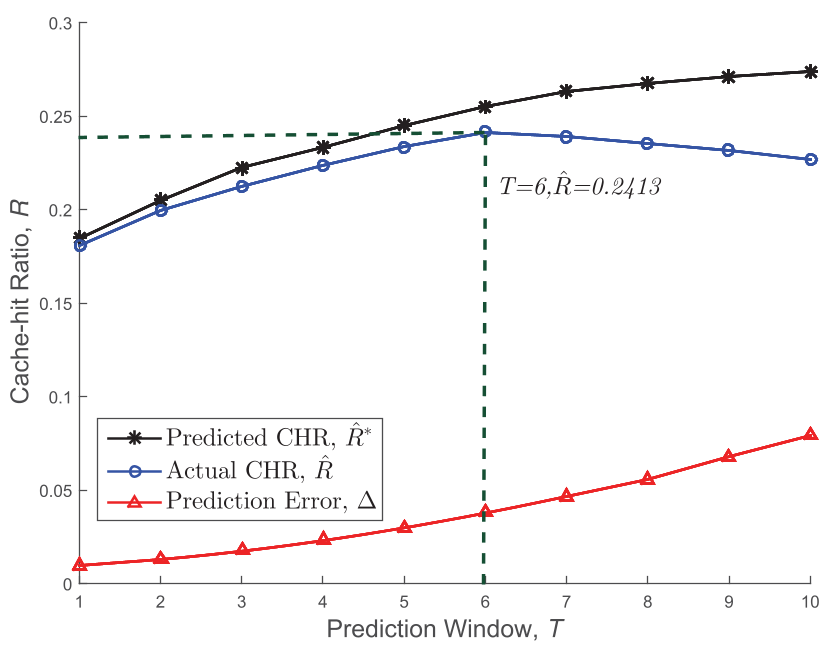 Figure 2: The relationship between the Prediction Window (T) and Cache-Hit Ratio (CHR).
The "Butterfly Effect" in Caching:
- Small T: The system is "short-sighted." It might push a file that is popular now but miss a file that will be requested by a massive multicast group slightly later.
- Large T: Prediction errors accumulate. Because social influence follows a "butterfly effect," a small error in predicting a friend's request time cascades into a massive error for the whole network.
- The Sweet Spot: As shown in the graph, there is an optimal (around 6 in their simulation) where the system maximizes the actual output CHR.
Deep Insight: A Theoretical Safety Net
One of the paper's strongest contributions is Theorem 1, which provides a lower bound for the system performance: Where is the theoretical optimum (perfect foresight) and is the prediction error. This gives engineers a way to bound the "risk" of proactive pushing—if your prediction algorithm is within a certain error margin, your system performance is guaranteed.
Conclusion & Future Outlook
This paper successfully demonstrates that Social Topology is as important as Signal Strength in modern communications. By treating human behavior as a predictable component of the network loop, we can bypass the fundamental limits of reactive spectrum use.
Future Challenges:
- Privacy: How can BS obtain social graph data without violating user privacy?
- Dynamics: Real-world social weights () change hourly. Adaptive weight learning remains an open research frontier.
Takeaway: The future of 6G isn't just about higher frequencies; it's about knowing what the user wants before they even touch the screen.