
SDMR: Leveraging Social Divergence for Efficient Multicast in Delay-Tolerant Networks
A Multicast Routing Scheme Based on Social Differences in Delay-Tolerant Networks
This paper introduces SDMR (Social Differences Multicast Routing), a novel scheme for Delay-Tolerant Networks (DTNs) that leverages social heterogeneity between nodes. By utilizing similarity and centrality differences, SDMR optimizes multicast data delivery across intermittent connections, achieving SOTA performance in transmission efficiency.
TL;DR
In the fragmented world of Delay-Tolerant Networks (DTNs), the standard intuition is to forward data to "popular" nodes. This paper flips that logic: SDMR (Social Differences Multicast Routing) proves that forwarding data to nodes that are different from the current carrier—in terms of both social circles and network reach—can slash transmission costs by 66% while keeping delivery ratios competitive.
The Paradox of Similarity
In DTNs, nodes (like smartphones carried by people) move and connect intermittently. Existing multicast protocols usually try to find the "best" bridge to a destination. However, if you only forward messages to nodes that are similar to you, the data becomes "trapped" within a specific social community.
Imagine a conference where all colleagues from the same lab exchange data. They meet each other often, so their delivery probability to one another is high, but they provide zero value in reaching a different lab on the other side of the building. This leads to redundant retransmissions and wasted buffer space.
Methodology: The Power of Social Difference
The authors define a new metric, SDMetric, based on two core concepts:
- Similarity Difference (SDR): Measures how many new multicast destinations node B can reach that node A cannot.
- Centrality Difference (CDR): Measures node B’s ability to reach the broader network compared to node A’s specific contact history.
The Core Architecture
When two nodes meet, they exchange "Encounter Lists" (LI) and "Encounter Counts" (LN). Instead of looking for a node that is "closer" to the destination, SDMR looks for a node that offers the most incremental coverage.
 The SDMetric formula: Balancing local destination similarity and global network centrality.
By setting a threshold (SDMetric > 1), the protocol ensures that a message is only passed if the new carrier significantly expands the message's horizon.
Experimental Validation: Infocom06 Trace
The authors tested SDMR against Epidemic (flooding-based) and EBMR (probability-based) using real-world mobility data from the IEEE Infocom 2006 conference.
1. Drastic Reduction in Transmission Cost
The most striking result is found in the overhead. While Epidemic routing exhausts bandwidth by flooding, and EBMR struggles with redundant copies, SDMR maintains a lean profile.
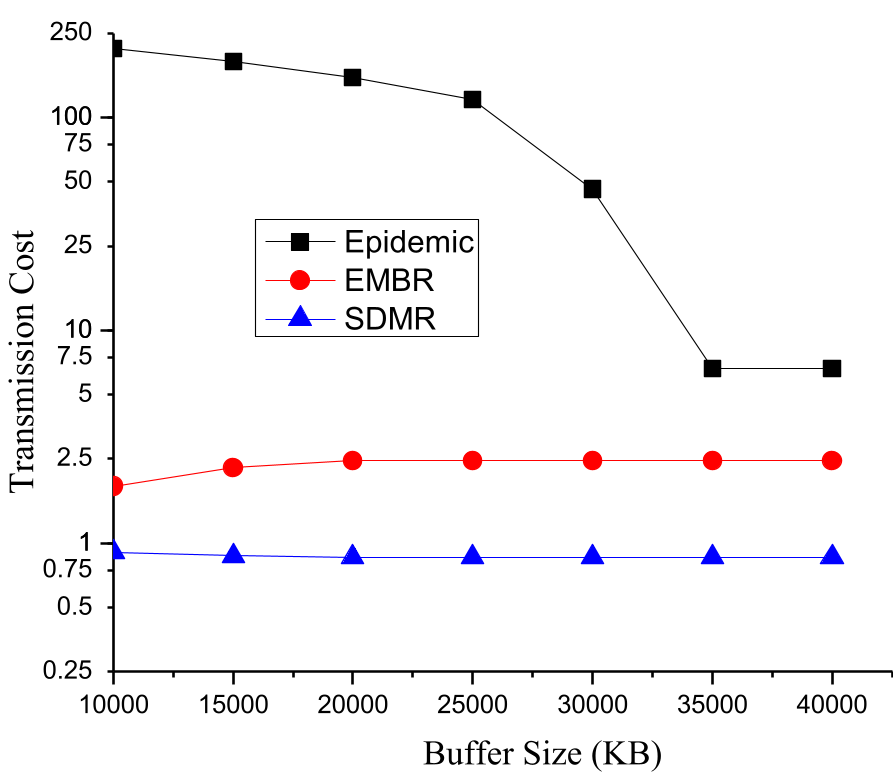 Performance Insight: SDMR achieves high efficiency by avoiding the "social trap" of redundant transmissions.
2. Resilience to Buffer Limits
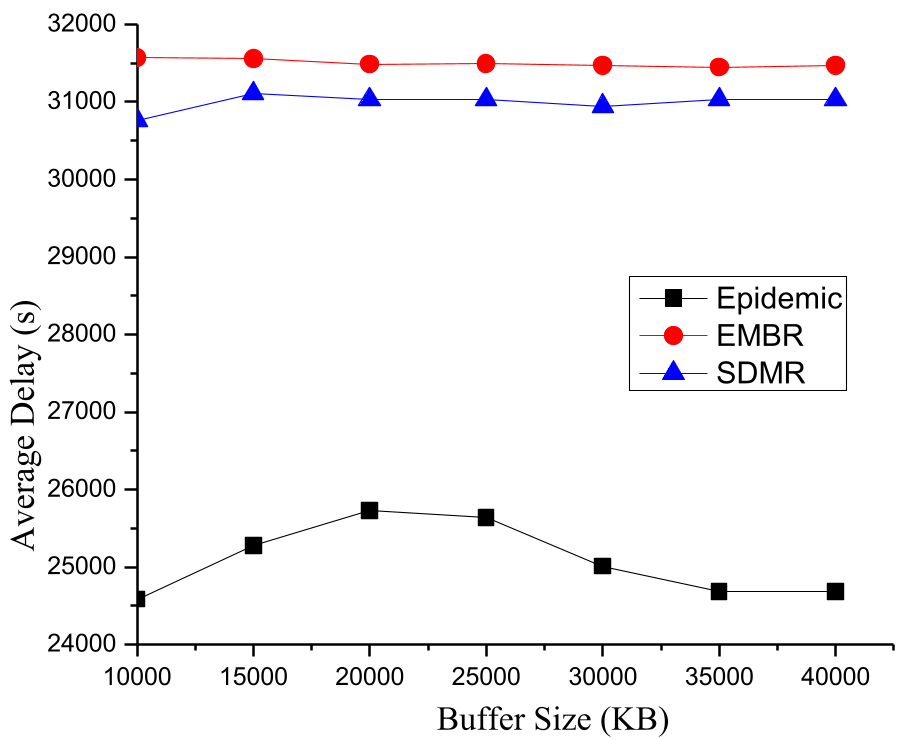
In DTNs, buffer space is gold. As shown in the study, when buffer sizes are small, flooding protocols like Epidemic fail as they constantly drop packets. SDMR remains stable because it only produces copies that are "socially justified," ensuring that each message in the buffer has a high unique value.
Critical Insight & Conclusion
The genius of SDMR lies in its Inductive Bias: it assumes that in human-centric networks, the bottleneck isn't finding a "good" path, but avoiding "local optima" in social clusters.
Takeaways for the Industry:
- Resource Efficiency: For IoT or rescue devices with limited battery, SDMR’s 3x efficiency gain over classic probabilistic routing is a game-changer.
- Scalability: By using a
MaxHopthreshold combined with the SDMetric, the protocol prevents the "infinite loop" problem common in socially-aware routing.
Limitations: The current model relies on an initial "warm-up" period (500s) and assumes nodes are willing to exchange their contact histories (privacy concerns). Future work in Privacy-Preserving Social Routing would be a natural and necessary extension of this work.