
Deciphering the Lens: A Multidimensional Approach to News Bias Detection
A Multidimensional Dataset Based on Crowdsourcing for Analyzing and Detecting News Bias
The paper presents a new multidimensional dataset for news bias detection, moving beyond binary labels to include hidden assumptions, subjectivity, and framing. It utilizes a scalable crowdsourcing methodology to annotate over 2,000 sentences from articles regarding the Ukraine crisis, establishing a significant benchmark for fine-grained bias analysis.
Executive Summary
TL;DR: Researchers from the Karlsruhe Institute of Technology and Kyoto University have developed a robust, crowdsourced dataset that breaks "news bias" down into tangible dimensions: hidden assumptions, subjectivity, and framing. By analyzing over 2,000 sentences from the Ukraine crisis era, the study reveals that bias is not just about what is said, but who is judging it—revealing a massive disparity in bias perception between Western and non-Western readers.
Academic Positioning: This work bridges the gap between communication science theory and computational linguistics. It provides the high-granularity data necessary for training sophisticated NLP models that go beyond simple "fake vs. real" classification.
The Problem: The Ambiguity of "Bias"
Detecting bias is significantly harder than detecting "fake news." While fake news deals with factual veracity, bias deals with slants, omissions, and linguistic framing. Prior work often suffered from:
- Coarse Labels: Annotating a whole news outlet as "Left" or "Right" ignores the nuance of individual articles.
- Small Scale: Expert-labeled datasets are high quality but too small for modern machine learning.
- Single-Dimension: Treating bias as a monolithic concept fails to capture how the bias is achieved (e.g., through subjective adjectives vs. logical fallacies).
Methodology: Deconstructing Bias
The authors propose that bias is a composite of three distinct linguistic dimensions:
- Hidden Assumptions: Statements presented as self-evident truths that actually suppress alternative views.
- Subjectivity: The use of judgmental or opinionated language (e.g., "terrorist" vs. "paramilitary").
- Framing: Evaluating how specific "targets" (governments, in this case) are represented—positively or negatively.
The Pipeline
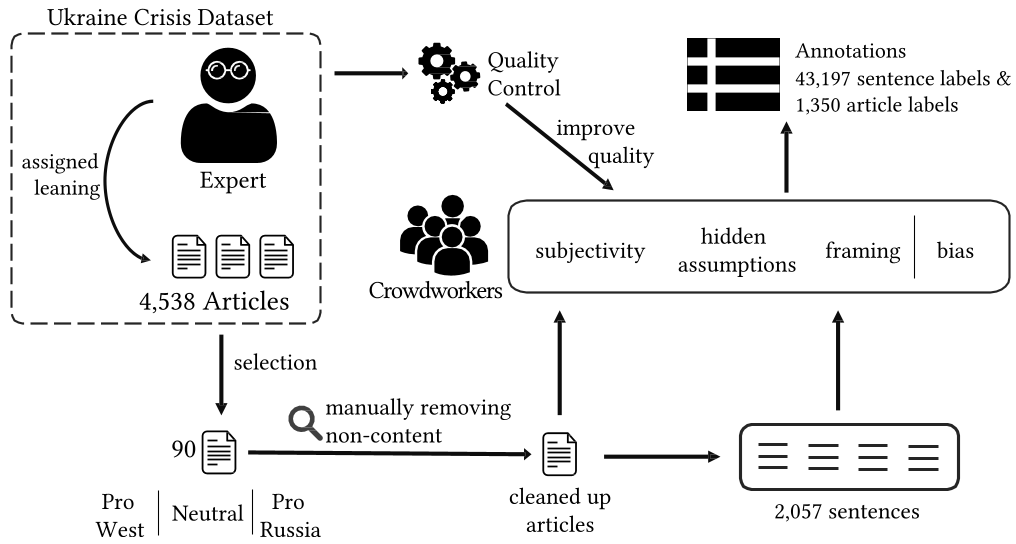
The researchers used a three-step process:
- Collection: 90 articles regarding the Ukraine crisis, balanced between Pro-West, Pro-Russia, and Neutral leanings.
- Crowdsourcing: Deploying tasks on the Appen platform where 570 workers provided over 40k labels.
- Aggregation: Comparing different ways to combine human judgments, finding that Average Vote generally outperformed simple Majority Vote.
Experiments and Key Findings
The study produced several "Aha!" moments for the NLP community:
1. The Sensitivity Gap
One of the most striking results was the influence of the crowdworkers' origin. Non-Western workers were far more sensitive to subjectivity, labeling 21.39% of sentences as subjective, compared to only 4.07% from Western workers. This suggests that "neutrality" is often in the eye of the beholder.

2. Sentence vs. Article Logic
The researchers found that while individual sentence agreement was low (Krippendorff’s Alpha < 0.2 in many cases), the aggregated article labels correlated much more strongly with expert judgments. This suggests that bias is a "diffuse" property—one sentence might look fine, but the cumulative effect of 20 sentences creates a clear slant.
3. Positioning of Bias
Where does bias hide? The data shows a "U-shaped" distribution:
- Direct Bias is most prevalent in the introductory summaries (0-20% mark).
- Framing and Subjectivity peak at the very end of the article (80-100% mark), where journalists often place evaluative conclusions.
Critical Insight & Conclusion
Takeaway
The most significant contribution of this work isn't just the data—it's the validation of multidimensionality. By proving that "Framing" correlates better with experts than "Subjectivity," the authors provide a roadmap for which features AI developers should focus on.
Limitations
A notable limitation is the focus on a single event (Ukraine Crisis). While this provides a controlled environment, it remains to be seen if these correlations hold true for domestic issues like taxation or healthcare. Additionally, the low inter-annotator agreement on "Hidden Assumptions" indicates that some bias dimensions might still be too abstract for non-expert crowdsourcing.
Final Thought
As we move toward "Journalism 3.0," these datasets will power the browser extensions and writing assistants of the future, helping both readers and writers identify the invisible "frames" that shape our world.