
Beyond Topology: Predicting Social Relationships via Multidimensional Opinion Networks
A multidimensional network link prediction algorithm and its application for predicting social relationships
This paper proposes a multidimensional network link prediction algorithm based on superedge similarity to predict social relationships in "We the Media" networks. By integrating four dimensions—social, psychological, viewpoint, and environmental—the method achieves SOTA performance on Weibo datasets compared to traditional structural baselines like SimRank.
TL;DR
Predicting who you will follow next isn't just about "friends of friends." This paper introduces a multidimensional supernetwork model that analyzes your occupational environment, the keywords you use (viewpoints), and your emotional state (psychology) to predict social links. Tested on Weibo data, it proves that who you work with and what you talk about are far more predictive of social ties than structural patterns alone.
The "Blind Spot" in Modern Link Prediction
Most traditional link prediction algorithms (like Jaccard or SimRank) operate on a flat plane. They assume that if Node A and Node B share many neighbors, they are likely to connect. However, in the "We the Media" era, social relationships are driven by "Public Opinion Factors."
The authors argue that existing methods suffer from:
- Information Silos: Ignoring the alignment of user interests and professional backgrounds.
- Static Analysis: Failing to account for the emotional resonance (psychological dimension) between users.
- Dimensionality Loss: Treating heterogeneous attributes as simple node labels rather than interactive sub-layers.
Methodology: The Supernetwork Architecture
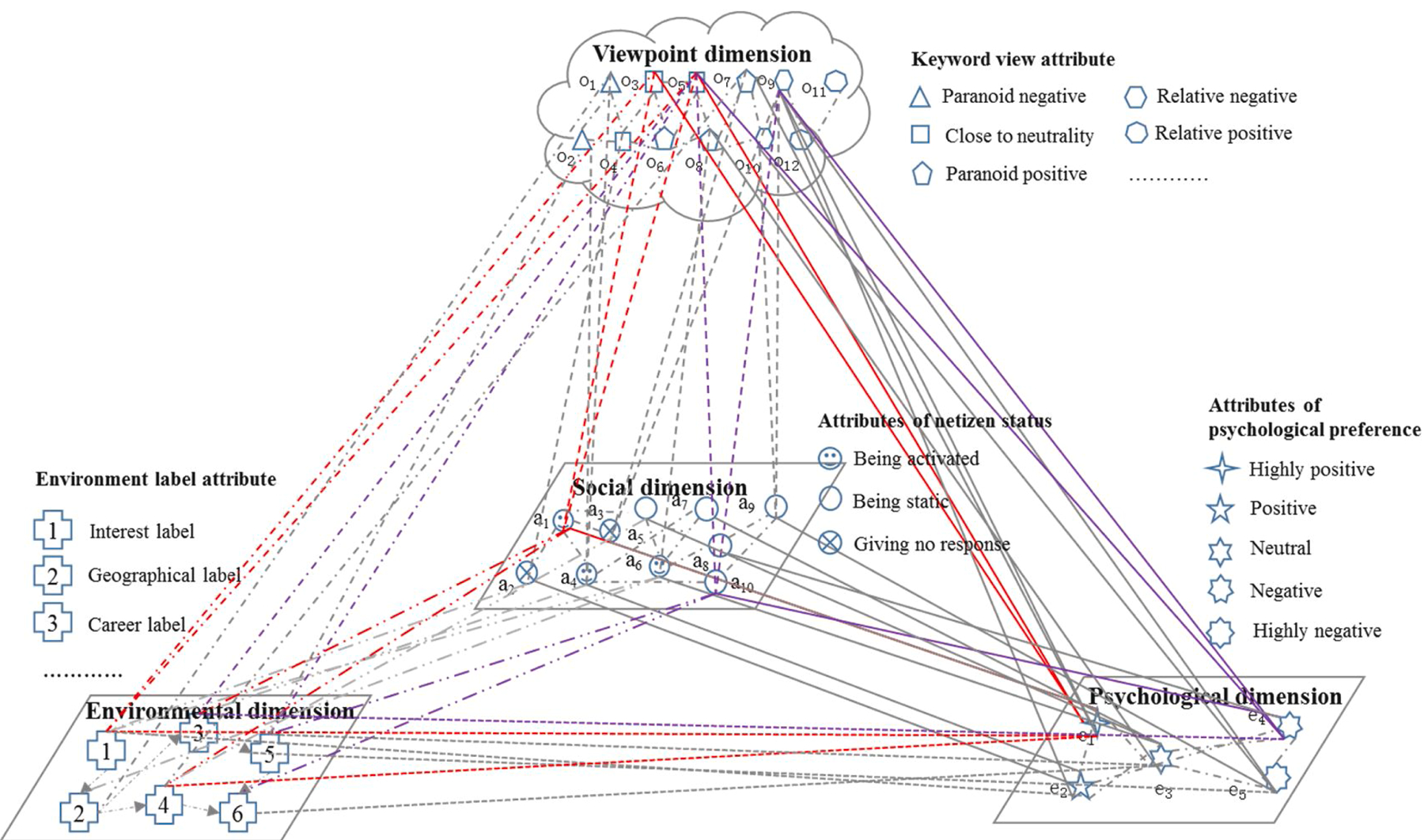
The core innovation is the construction of a four-layered supernetwork. Instead of a single graph, the model maintains four synchronized sub-layers:
- Social Dimension: The "following" network and user activity levels.
- Environmental Dimension: Occupational labels and interest tags (The "Where" and "What").
- Viewpoint Dimension: Co-occurrence of keywords (The "Content").
- Psychological Dimension: Emotional values derived from public posts (The "Sentiment").
Superedge Similarity & The Polygonal Structure
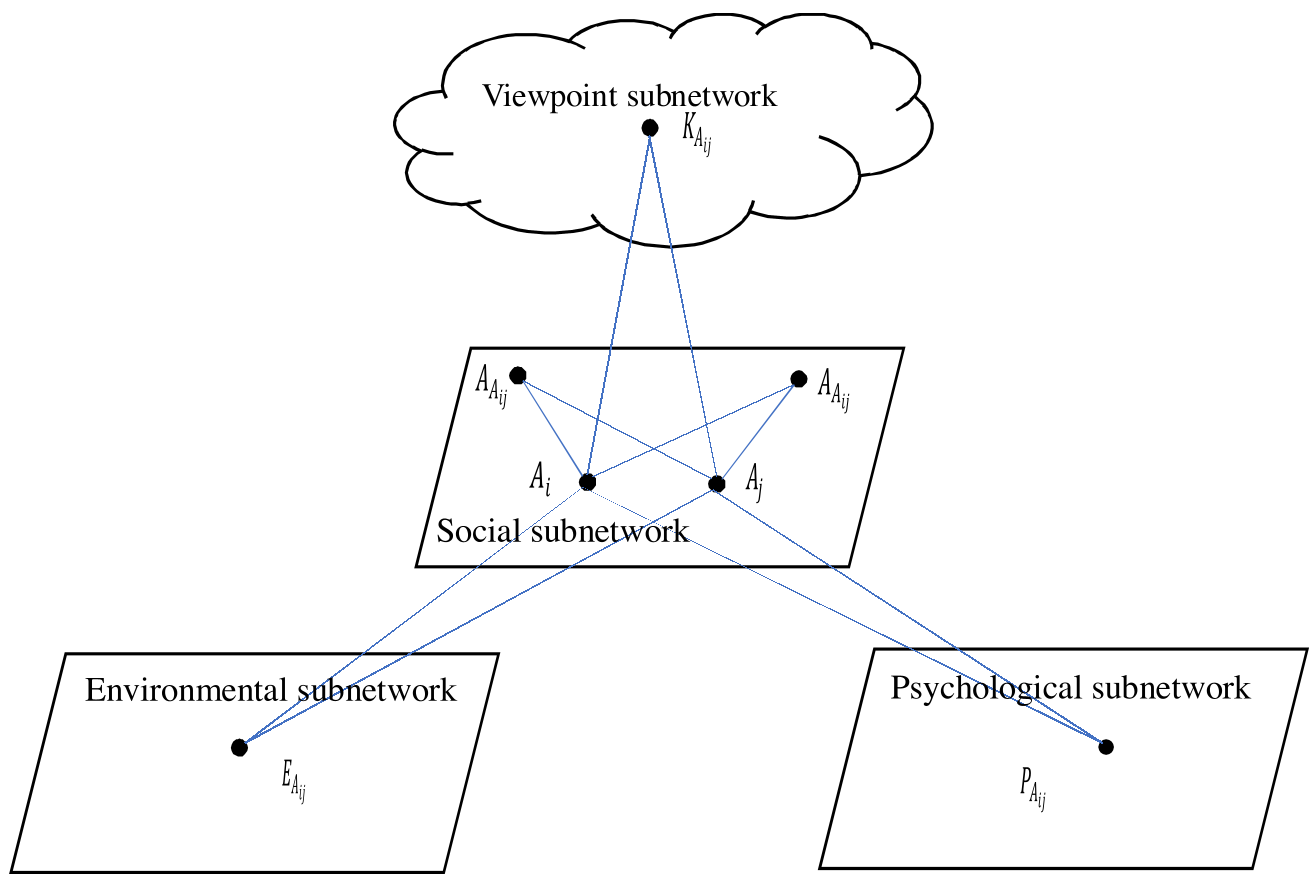
To find the similarity between two unconnected nodes, the algorithm looks for "Polygonal Structures"—complex paths that link two users through common neighbors in different dimensions (e.g., sharing a professional tag and a viewpoint keyword).
Experimental Validation
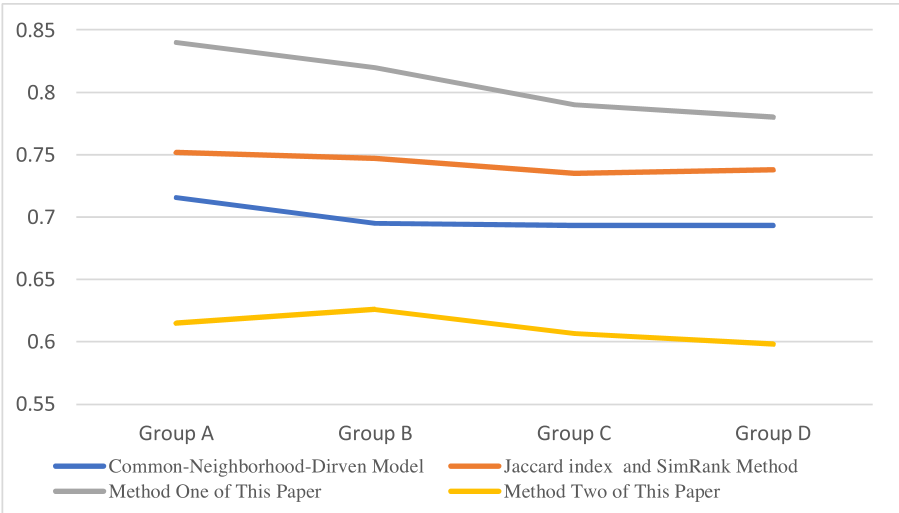
Using a dataset from Weibo covering ten major events (e.g., the G20 Summit, Wang Baoqiang's divorce), the researchers compared their model against standard baselines across four sample groups (60 to 240 users).
Key Findings:
- SOTA Performance: Method One (Social + Environmental + Viewpoint) consistently yielded the highest AUC, outperforming SimRank and Common-Neighbor models.
- The "Occupational" Dominance: Environmental factors (tags like profession) were the strongest predictors. If two people are in the same industry, their likelihood of connecting is significantly higher than if they merely share a common friend.
- The Psychological Paradox: Surprisingly, adding the "Psychological Dimension" (Method Two) actually decreased accuracy. This suggests that emotional states in social media may be too volatile or "noisy" to serve as reliable predictors for long-term social links.
Critical Insight & Conclusion
This work shifts the focus of link prediction from "Who you know" to "Who you are and what you say."
Takeaways for the Industry:
- Recommendation Systems: For platforms like LinkedIn or X (Twitter), prioritizing occupational environment similarity over simple interest-graph matching could yield higher conversion rates for "Friend Suggestions."
- Limitations: The current model struggles with NLP noise (keyword extraction) and specialized datasets. Future iterations will likely need more robust sentiment analysis to turn the "psychological dimension" from a liability into an asset.
By treating social networks as multidimensional systems rather than flat graphs, this research provides a blueprint for the next generation of relationship-aware AI.