
PEx-Graph: Redefining Social Network Analysis through Multidimensional Projections
Multidimensional Projections for Visual Analysis of Social Networks
This paper introduces a novel framework for the visual analysis of social networks by leveraging multidimensional projection techniques. It proposes the PEx-Graph tool, which maps nodes onto a 2D or 3D plane based on attribute similarity and connectivity patterns, significantly enhancing the interpretation of complex heterogeneous networks compared to traditional force-based layouts.
TL;DR
The paper introduces a paradigm shift in social network visualization: instead of relying solely on "spring-and-mass" force models, it proposes using Multidimensional Projections to layout nodes. By transforming connectivity and node attributes into a high-dimensional vector space and then projecting them, the authors achieve layouts that are more physically intuitive, faster to compute, and richer in contextual information.
Problem & Motivation: The "Hairball" Challenge
Most social network analysts are familiar with the "hairball" effect—a cluttered mess of nodes and edges where meaningful structures are buried. Existing tools like Vizster or Gephi primarily use force-directed layouts. While intuitive, these methods have three major flaws:
- Context Blindness: They ignore rich node attributes (like occupation or age) during the layout phase.
- Local Minima: They often get "stuck," causing global structures to be misinterpreted.
- Scalability: For large graphs, calculating forces iteratively is computationally expensive and slow to converge.
The authors argue that similarity—both in terms of who you know (connectivity) and who you are (attributes)—should drive the physical distance on the screen.
Methodology: The Core Mechanism
The innovation lies in treating network data as multidimensional points.
1. Connectivity-Based Projection
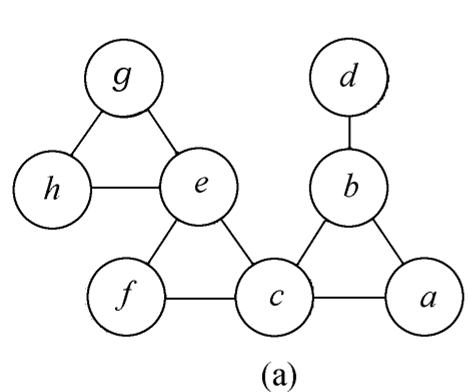
Instead of starting with random positions, the authors calculate a Relationship Matrix. This can be based on the shortest path between nodes or a modified adjacency matrix. By applying techniques like IDMAP or LSP, they create an initial placement where nodes with similar "neighbor profiles" are naturally grouped.
2. Attribute-Based Projection
To handle non-numerical data (like names or interests), the paper employs:
- Levenshtein Distance for strings.
- Normalized Compression Distance for text.
- Vector Space Models for Larger documents.
These are combined into a global similarity matrix, allowing the visualization of "camps" of users who share similar profiles regardless of their actual connections.
Experiments & Results: Statistical Evidence
The authors validated their approach using real-world datasets from Orkut, Netlog, and academic bibtex files.
Quantifiable Gains
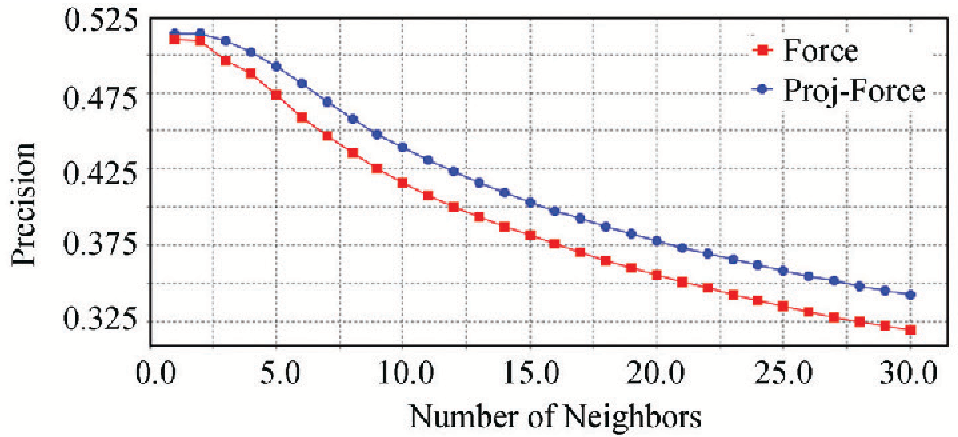
The "Proj-Force" (Projection followed by Force) method was tested against conventional force-directed layouts. The results were striking:
- Edge Crossings: In the "Agric" dataset (6k+ nodes), the projection method halved the number of crossings.
- Neighborhood Preservation: The plots below show that the projection-based approach (red lines) consistently outperforms the random-initialization approach (blue lines) in maintaining the structural integrity of clusters.
Exploratory Power: The Orkut Case Study
In an analysis of Orkut communities, the tool allowed users to see that "Volkswagen" communities were almost exclusively male and focused on material interests, whereas "Peugeot" communities had mixed genders and more romantic/lifestyle-oriented attributes. This was discovered through Coordinated Views, where selecting a community in one panel highlighted its members' attribute clusters in another.
Deep Insight & Conclusion
The true value of this work is the realization that Layout is a Data Mining Task. By using multidimensional projection as a "pre-processor" for graph layout, we solve the initialization problem of force-directed algorithms.
Takeaway: If you are dealing with complex networks where the identity of the nodes matters as much as the edges between them, traditional graph drawing is no longer enough. The hybrid approach of projection + coordination offered by PEx-Graph provides a clearer lens into the social fabric.
Limitations
- While the projection significantly improves the starting point, the initial similarity matrix calculation is , which may still pose challenges for networks with millions of nodes without further approximation or GPU acceleration.