
Decoding the Social Engine: How Multidimensional Social Capital Drives Crowdfunding in the US and China
The role of multidimensional social capital in crowdfunding: A comparative study in China and US
This paper presents a comparative study of reward-based crowdfunding performance in China and the U.S. through the lens of Multidimensional Social Capital Theory. By analyzing data from Demohour and Kickstarter, the researchers demonstrate that structural, relational, and cognitive social capital significantly predict fundraising success across different cultural contexts.
TL;DR
Why do some crowdfunding projects explode while others fail to launch? This research proves that an entrepreneur's Social Capital—the resources embedded in their networks—is the primary engine of success. By comparing the US (Kickstarter) and China (Demohour), the study reveals that while social ties matter everywhere, the power of reciprocal obligation is nearly three times stronger in China, highlighting the profound impact of culture on digital finance.
Background: Beyond the Platform
Crowdfunding is often seen as a democratic "open call" for funds. However, this paper argues it is deeply rooted in Social Capital Theory. It moves beyond simple "friend counts" to examine the quality and shared understanding of relationships. It positions itself as one of the first confirmatory, cross-cultural studies to apply the structural, relational, and cognitive dimensions of capital to the crowdfunding phenomenon.
The Problem: The Theory Gap in Crowdfunding
Early research into crowdfunding was mostly descriptive: "projects with videos do better" or "smaller goals are hit faster." But it failed to answer why. Specifically:
- Theoretical Absence: Lack of a rigorous framework to quantify social influences.
- Cultural Blindness: An assumption that what works on Kickstarter in San Francisco will work identically on Demohour in Beijing.
Methodology: The Three Pillars of Social Capital
The authors utilize the Multidimensional Social Capital framework to dissect the entrepreneur's influence:
- Structural (Network Ties): Measured by the number of Facebook friends (US) or Weibo followers (China). This represents the "reach" or the infrastructure of the network.
- Relational (Obligation): Measured by the number of other projects the entrepreneur has funded. This creates a "credit slip" or a sense of duty for others to reciprocate.
- Cognitive (Shared Meaning): Measured by the length and depth of the project description, representing the ability to create a shared narrative with potential sponsors.
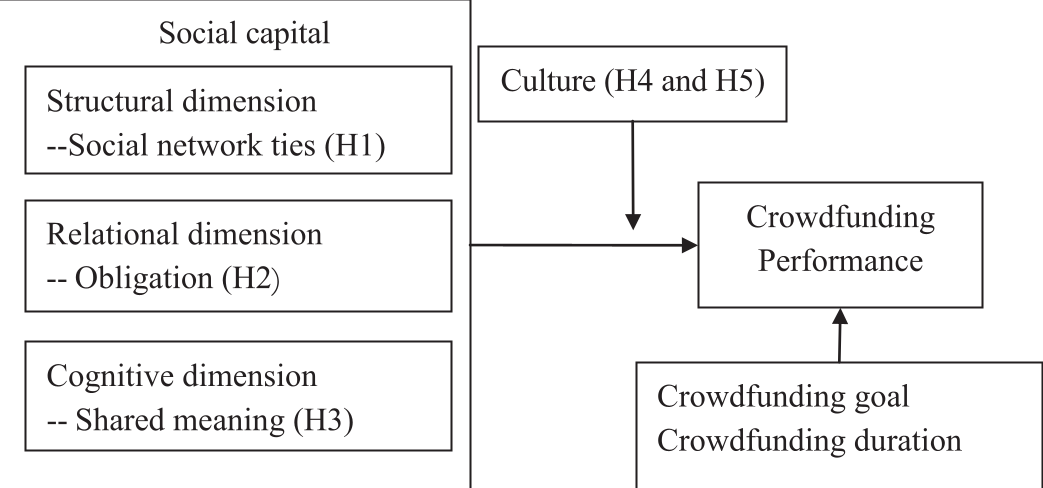 Figure 1: The Research Model illustrating the three dimensions of Social Capital and the moderating role of Culture.
Experiments & Results: The "Guanxi" Factor
The study analyzed 785 projects across both nations. The findings were striking:
- The Power of Reciprocity: In China, the Relational dimension (Obligation) was a massive predictor of success. If a Chinese entrepreneur supports others, the community feels a strong cultural duty to return the favor—a digital manifestation of Guanxi.
- Predictive Strength: The models performed better in the Chinese context ( of 0.316 vs 0.108), suggesting that Chinese crowdfunding is more socially driven and less "transactional" than its US counterpart.
- Universal vs. Specific: Network ties and shared meaning were beneficial in both countries, but the intensity of the impact was culturally dependent.
 Table 2: Regression results showing "Obligation" having a significantly stronger coefficient in China (0.18**) than the U.S. (0.06**).*
Critical Analysis & Conclusion
The Takeaway
Social capital is the "secret sauce" of crowdfunding. However, the study teaches us that Network Ties (quantity) are less important than Obligations (quality) in certain cultures. In China, crowdfunding is not just about pitching to strangers; it's about activating a web of mutual favors.
Limitations
The study primarily uses text length as a proxy for cognitive capital, which is a simplification. Modern projects rely heavily on video and real-time updates (social media engagement), which were not fully captured in this 2014-era data.
Future Outlook
As crowdfunding evolves into decentralized finance (DeFi) and DAOs, the "Relational" dimension—trust and obligation—will likely become even more critical. Researchers should look at how smart contracts can codify these "obligations" that were previously governed only by social norms like Guanxi.