
Deciphering the Multidimensional Social Fabric: A New Era for Social Recommenders
15177_Multidimensional Social Network in the Social Reco
This paper introduces a Multidimensional Social Network (MSN) framework for Multimedia Sharing Systems (MSS) like Flickr, which extracts eleven distinct relation layers (e.g., tags, comments, contacts). It proposes a social recommender system that leverages these varied links, achieving an 8% improvement in recommendation quality through a personalized weight adaptation mechanism.
TL;DR
Researchers have moved beyond simple "friend lists" to model social networks as complex, multi-layered structures. By analyzing 11 different types of interactions on Flickr—from shared tags to "favoriting" an author’s work—this paper presents a Multidimensional Social Network (MSN) framework. The result? A personalized recommender system that adapts to your behavior, proving that who you interact with is just as important as what you look at.
Background: Beyond the Flat Network
In the early days of the web, social networks were "flat"—you were either someone's friend or you weren't. Today’s Multimedia Sharing Systems (MSS) are far more nuanced. On Flickr, you might follow a photographer (Social), use the same "blackandwhite" tag (Semantic), or comment on a photo that 50 other people also liked (Collaborative).
The authors argue that treating all these interactions as a single "link" loses vital context. Instead, they propose a Multi-layered approach that distinguishes between direct intentional relations (adding a friend) and object-based relations (meeting via a shared photo).
Methodology: The 11 Layers of Interaction
The core of this research lies in the decomposition of user behavior into eleven specialized layers. These are broadly categorized into:
- Direct Links: Contact lists and "friends of friends" (Rcoc).
- Equal-Role Semantic Links: Users who use the same tags (Rt) or join the same groups (Rg).
- Different-Role Social Links: Interactions between authors and commentators (Roa, Rao).
The Architecture of Recommendation
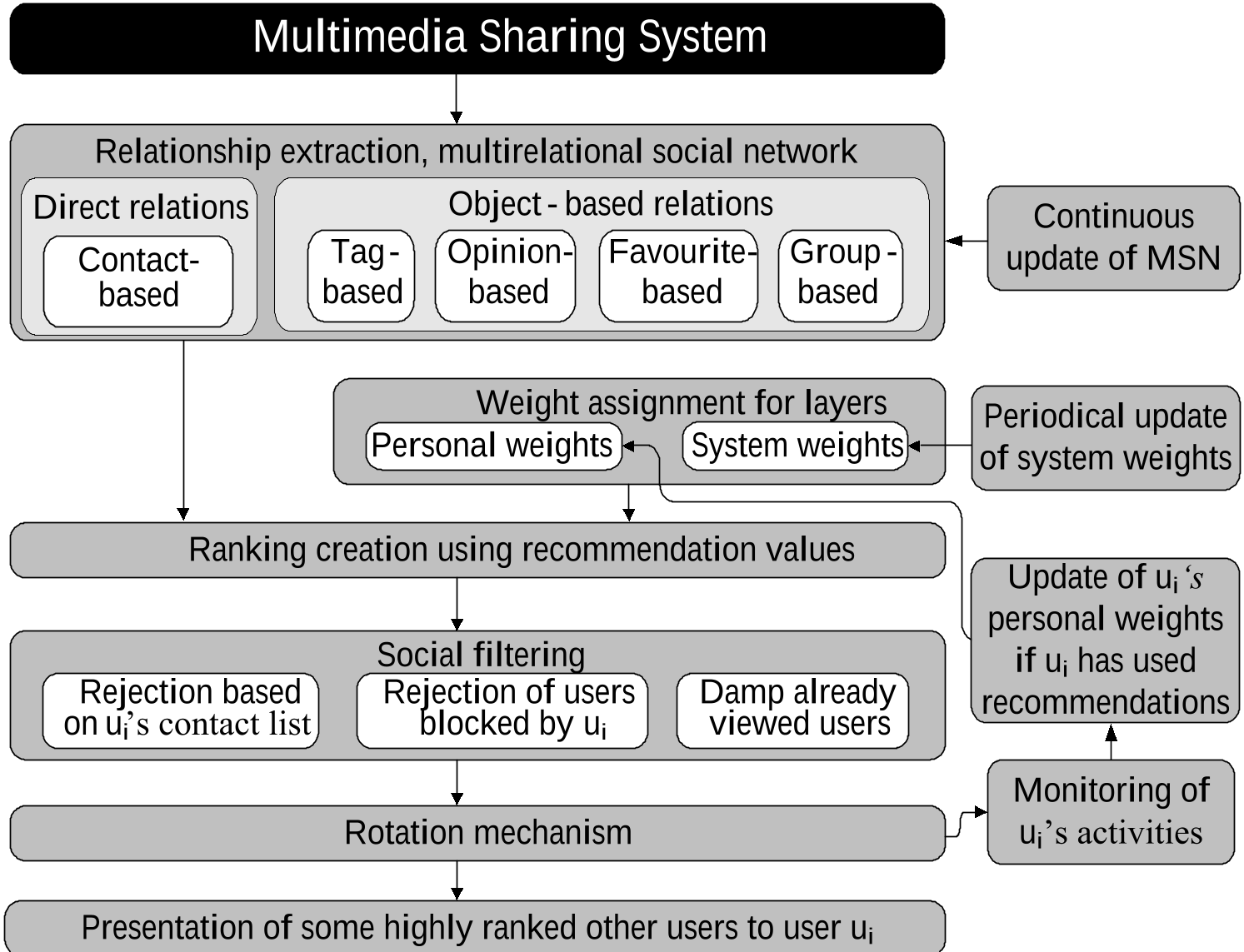
The system doesn't just calculate a static similarity score. It uses a Personal Weight Adaptation mechanism. Every time a user interacts with a recommendation—say, by clicking a suggested profile—the system updates the "weight" of the layer that produced that suggestion.
The strength of a linkage () is an aggregation of all layers, adjusted by both global system weights and individual user preferences:
Experiments: The Rise of the Folksonomy
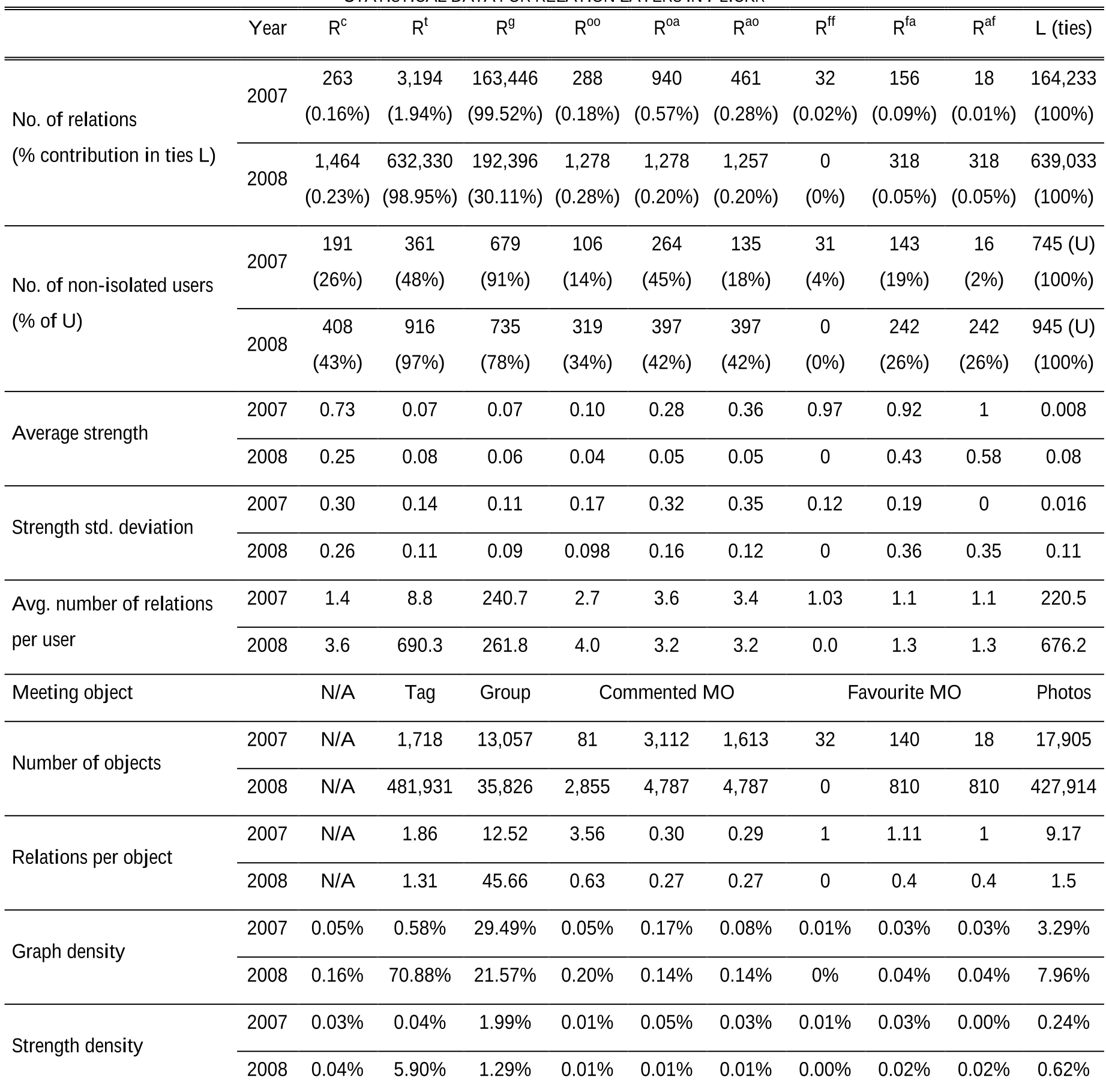
The researchers conducted a longitudinal study comparing Flickr data from 2007 and 2008. The findings were startling:
- Tag Dominance: Tag-based relations (folksonomy) exploded, becoming the most dense layer in the network.
- Reciprocity: If you comment on my photo (Rao), I am highly likely to check out yours (Roa). The system found that these "author-commentator" layers are far more effective for recommendations than just shared interests.
Deep Insight: Why Adaptation Matters
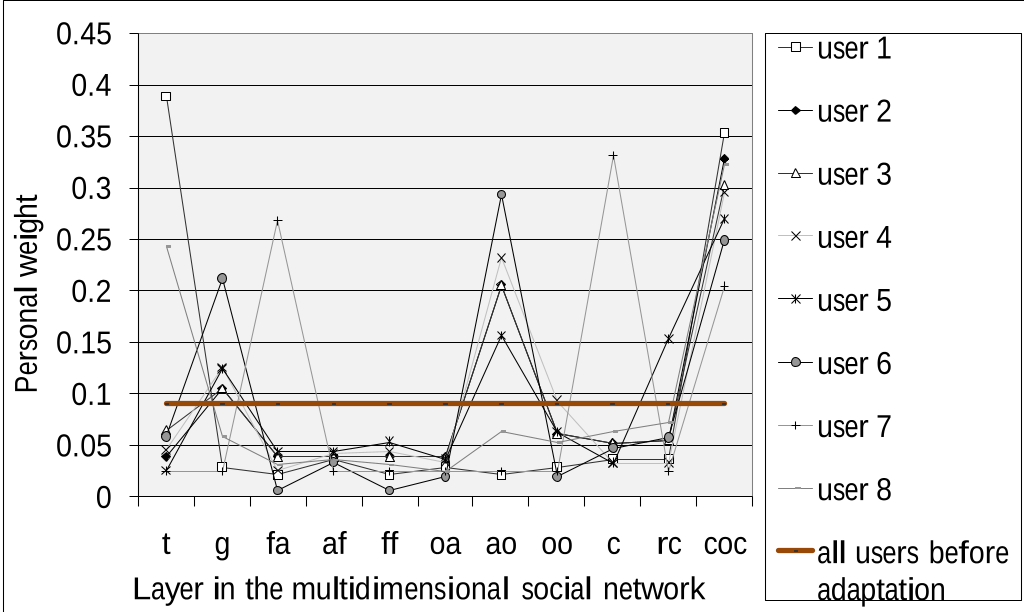
The most significant takeaway from the experimental phase was the shift in weights. After the "adaptation" period, the importance of the Contact-of-Contact (Rcoc) layer surged by 220%. This suggests that while we discover people through tags, we connect with people through existing social proximity—the digital version of "a friend of a friend."
Critical Analysis & Conclusion
Takeaway
The paper successfully demonstrates that human-centric recommendation is not a one-size-fits-all problem. By dynamically shifting focus between semantic layers (for discovery) and social layers (for trust), the system achieves a measurable boost in user satisfaction.
Limitations
- Computational Complexity: Calculating real-time updates for 11 layers across millions of users is a massive "Big Data" challenge that the paper acknowledges but doesn't fully solve for real-time production environments.
- Privacy: The model relies on "non-anonymous" data, which raises questions about how such systems should handle increasingly strict privacy regulations like GDPR.
Future Outlook
As we move toward a "Metaverse" or more immersive MSS, the number of layers will likely grow to include spatial and temporal dimensions. This paper provides the mathematical foundation for managing that complexity.