
Beyond Keywords: Leveraging Multidimensional Data Warehousing for Precision Web Service Selection
Multidimensional user profile construction for Web services selection: social networks case study
The paper proposes a multidimensional user profile construction method using a Data Warehouse (Snowflake Schema) to enhance Web service selection in social networks. The core contribution is a systematic modeling of user personal data, interest centers, and security preferences to achieve more precise and faster recommendation results.
TL;DR
Information discovery on the modern Web is hampered by the "vocabulary problem"—where the words users use don't match the results they need. This paper introduces a multidimensional user profile architecture built on a Data Warehouse Snowflake Schema. By categorizing users through personal data, interest centers, and security constraints, the system achieves a 77% precision rate in Web service selection, significantly outperforming traditional relational methods.
The "Cold Start" and Contextual Blindness
The fundamental motivation behind this research is the failure of traditional keyword-based engines to understand who is searching. Standard methods often ignore selection history and the broader context of the user. Two users searching for "house" should receive different results if one is a real estate agent and the other is a home-décor enthusiast. The authors identify that existing solutions lack:
- Integration of selection history.
- Support for query reformulation based on specific profile traits.
- Efficiency in handling heterogeneous and massive social network data.
Methodology: The Multidimensional Architecture
The researchers shift away from simple flat tables to a Snowflake Schema within a Data Warehouse. This allows for complex, hierarchical data storage without redundancy.
The Three Pillars of a Profile
- Personal Data: Static attributes like demographics and professional contacts.
- Interest Center: The dynamic core, consisting of keywords, areas of expertise, and logical query expressions.
- Security: A unique dimension that dictates access rights and filters result content based on safety/privacy levels.
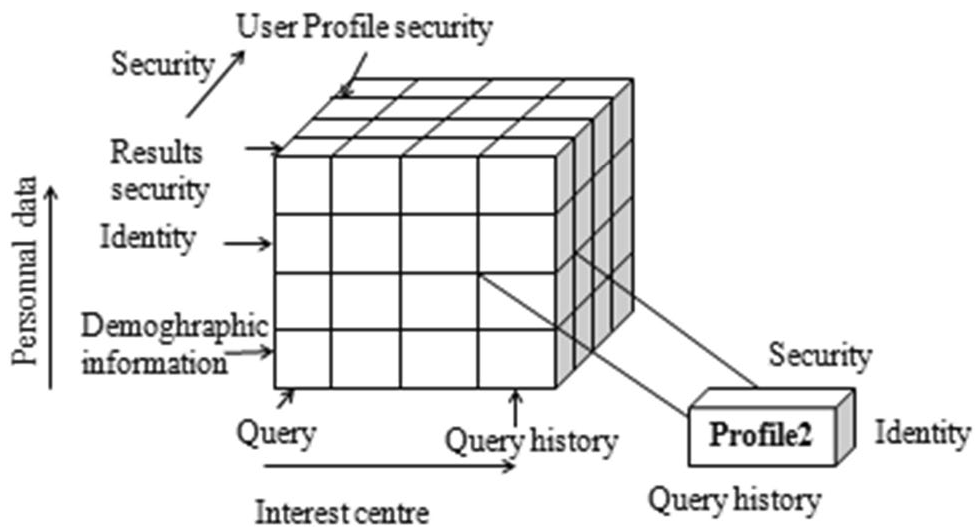 Figure: The Snowflake Schema used to normalize user identity and demographic information for better query performance.
Query Reformulation & Grouping
The system doesn't just passively wait for queries. It uses Automatic Reformulation, comparing service titles to query terms, and Manual Reformulation, where the user chooses from system-suggested terms. Furthermore, the User Grouping module clusters users with similar interest profiles, allowing the system to recommend services based on the "wisdom of the crowd."
Experimental Validation: Efficiency Meets Precision
The approach was tested in a social network case study (simulating environments like Facebook). The system tracks everything from publication history (text, photos) to specific interests (e.g., specific animal breeds).
Performance Metrics
- Precision: The multidimensional approach reached a 77% precision rate, a notable jump compared to traditional relational database models.
- Speed: For small to medium query batches (sub-50), the system responds in under 1000ms, proving that the complexity of a Snowflake Schema does not inherently destroy real-time performance.
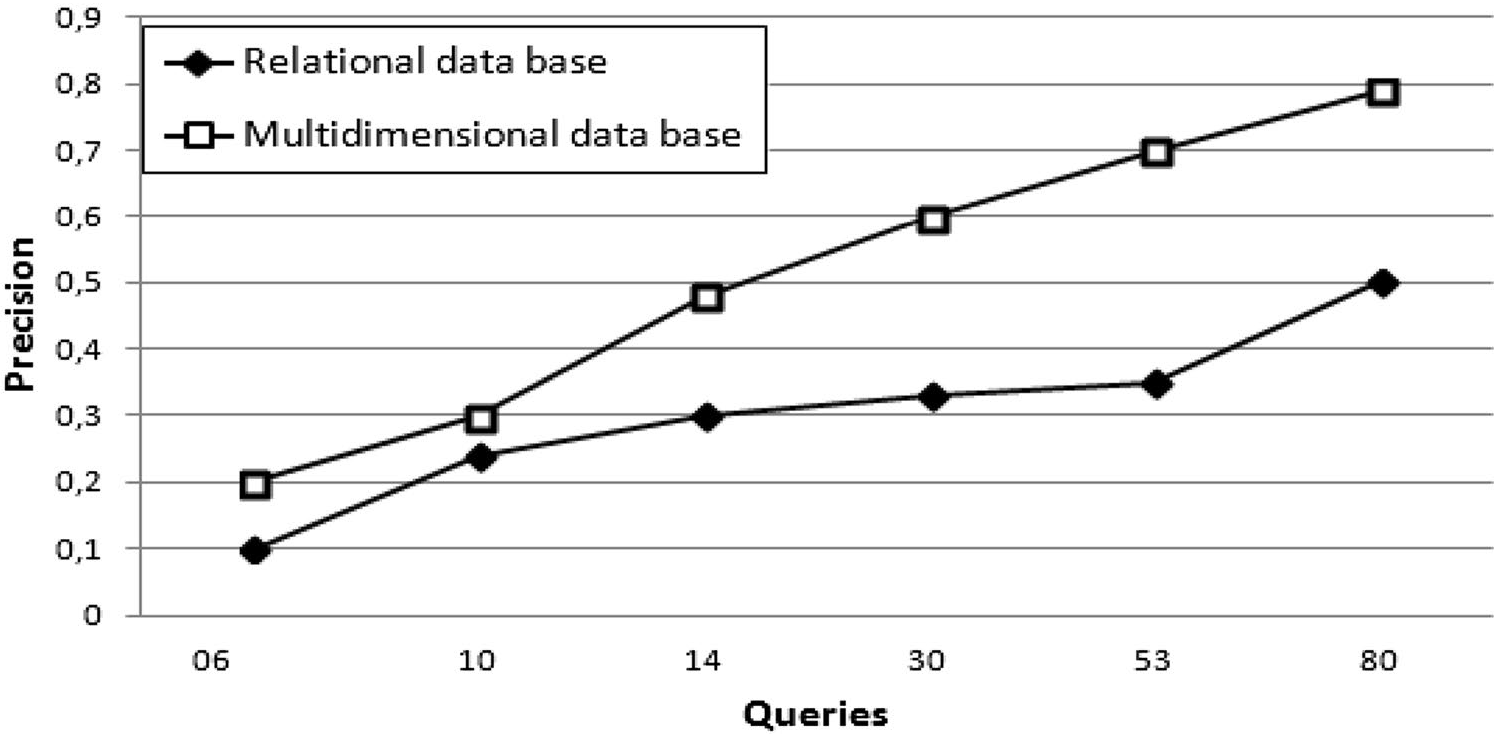 Figure: Precision comparison showing the proposed multidimensional approach (solid line) consistently outperforming traditional relational models.
Critical Analysis & Future Outlook
While the transition to a Data Warehouse structure solved the precision bottleneck, the authors acknowledge that this is just the beginning. The reliance on explicit data acquisition (forms) still faces the "cold start" hurdle for new visitors.
Future Work will target the integration of Quality of Service (QoS) metrics and Collaborative Filtering. By merging the structural advantages of a Data Warehouse with the predictive power of filtering algorithms, the authors aim to create a truly predictive search environment where the service finds the user before the user even completes their query.
Conclusion
This study proves that the way we store user data is just as important as the algorithms we use to process it. By adopting a multidimensional view, social platforms can move away from generic results toward a truly personalized digital experience.