
Multigraph Sampling: Navigating the Fragmented Social Universe
13392_Multigraph Sampling of Online Social Networks.
This paper introduces Multigraph Sampling, a novel random walk technique for Online Social Networks (OSNs) that exploits multiple user relations (e.g., friendship, group membership, events). By performing a two-stage random walk on a union multigraph, the method achieves representative sampling even in fragmented or highly clustered networks, outperforming traditional single-graph crawling.
TL;DR
Online Social Networks (OSNs) are often too fragmented for traditional "friendship-only" crawlers to navigate. This paper introduces a Multigraph Sampling approach that combines multiple relations—groups, events, and neighbors—to ensure the crawler reach isolated users. By using a clever two-stage selection process, it achieves "Ground Truth" accuracy on Last.fm while remaining bandwidth-efficient.
Problem & Motivation: The "Island" Phenomenon
Most academic studies of OSNs assume the network is a single, massive "Global Village." In reality, they are more like archipelagos. In Last.fm, for example, a staggering 88% of members have zero friends; they are "isolates" who simply use the site to track music.
Traditional Random Walks (the industry standard for sampling without an API-provided user list) get stuck on these "islands." If you start a crawl on the friendship graph, you will never see the 88% of the population that lacks social ties. This leads to a massive selection bias, favoring highly active or "social" users while ignoring the silent majority.
Methodology: The Two-Stage Multigraph Walk
The authors' core insight is that while a user might have no friends, they might still belong to a group or attend an event. By treating these different relations as layers of a union multigraph, the crawler can "jump" between layers to find paths that don't exist in the friendship graph alone.
The Two-Stage Efficiency Trick
Walking a "Union Graph" (where all edges are merged) is computationally expensive because you have to fetch every single neighbor from every relation at every step. To solve this, the authors proposed Algorithm 1:
- Stage 1 (Selection): Calculate the degrees () of the current node in each relation. Pick a relation with probability .
- Stage 2 (Step): Pick a random neighbor only within that chosen relation.
This ensures the walk converges to the same stationary distribution as the full union graph but uses significantly less bandwidth—a critical factor when dealing with restrictive OSN APIs.
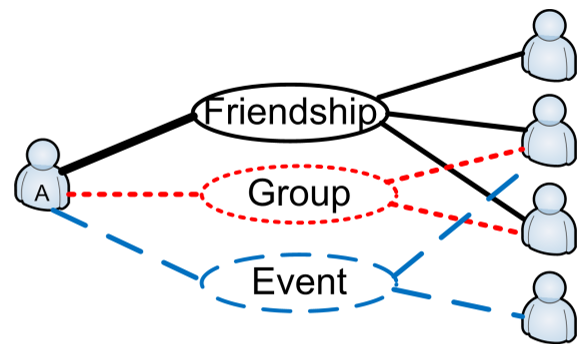 Figure 1: Comparison of individual relation graphs (a-c) and the resulting union multigraph (f) which provides better connectivity.
Experiments: Validating on Last.fm
The researchers tested their method against a rare "Ground Truth" (a uniform ID-based sample) and official Last.fm weekly charts.
Key Findings:
- Connectivity: While individual graphs (Friends, Events, Groups) were highly fragmented, the multigraph was almost fully connected.
- Accuracy: Single-graph crawls (like "Friends" only) drastically overestimated the activity of users. The multigraph crawl (Friends+Events+Groups+Neighbors) was the only one that closely tracked the actual population statistics.
- Convergence: Although the multigraph requires more iterations to "burn-in" (approx. 10k-12k steps), the resulting sample is far more representative.
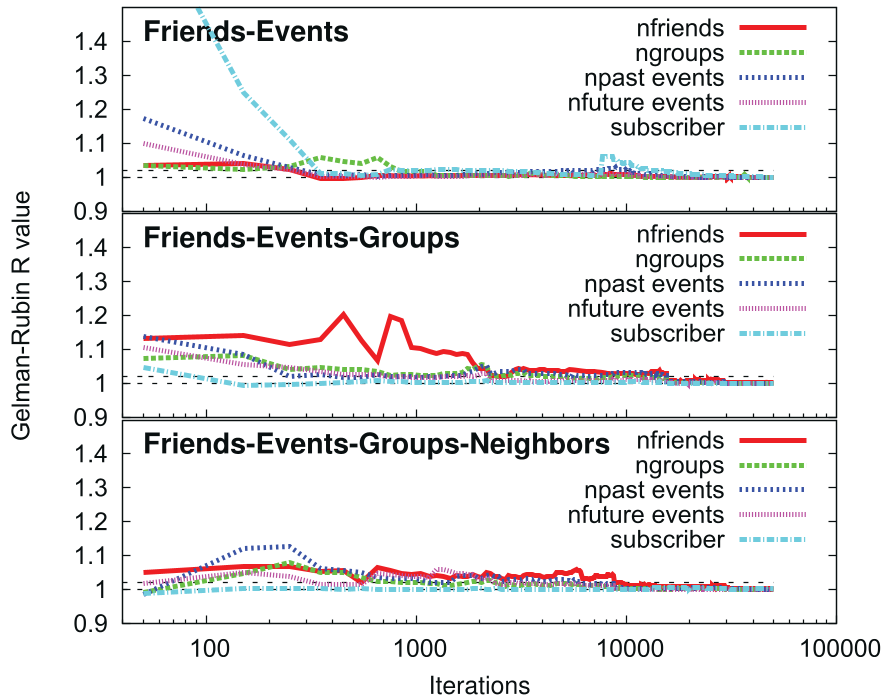 Table: The Multigraph approach successfully estimated the percentage of isolates, whereas single-layer crawls (diagonal zeros) were blind to them.
Critical Analysis & Conclusion
Takeaway
This work shifts the paradigm of OSN measurement from "Social Graph Analysis" to "Multigraph Analysis." It proves that the "dark matter" of social networks—the isolated and less active users—can be captured if we stop looking exclusively at friendship ties and start looking at functional ties (groups/events).
Limitations & Future Work
- Cost vs. Reward: Some relations are harder to scrape than others (e.g., Groups required data scraping while Friends had an API).
- Optimal Weighting: The authors suggest that future work should focus on how to weight different relations to maximize convergence speed.
In conclusion, Multigraph Sampling is a vital tool for any researcher or data scientist needing to build an unbiased profile of a complex, layered digital community.
 Figure 2: The multigraph estimate (stars) aligns almost perfectly with the official Last.fm weekly charts, unlike individual relation crawls.