
Beyond Friendship: Unbiased OSN Sampling via Union Multigraphs
18393_Multigraph Sampling of Online Social Networks.
This paper introduces Multigraph Sampling, a novel random walk technique for Online Social Networks (OSNs) that leverages multiple relations (e.g., friendship, groups, events) simultaneously. By treating the union of these relations as a multigraph, the method achieves representative sampling and faster convergence in fragmented or highly clustered networks where single-relation walks typically fail.
TL;DR
Researchers have developed a "Multigraph Sampling" technique that overcomes the limitations of traditional random walks on social networks. By combining multiple types of user relationships (friendship, group membership, event attendance), they can navigate through disconnected "islands" of a network, reaching users that were previously invisible to researchers.
The "Isolate" Problem in OSNs
Most social network measurements rely on a single link type: Friendship. However, users aren't just friends; they are group members, event attendees, and neighbors. Relying solely on the friendship graph is dangerous because many users are "isolates" in that specific graph—they might listen to music or join groups but never "friend" anyone. In the case of Last.fm, an astonishing 88% of users are isolates in the friendship graph. If your crawler only walks via friends, you lose nearly 90% of the population instantly.
Methodology: The Efficiency of Multigraphs
The authors define two structures: Union Simple Graphs and Union Multigraphs. While a simple graph merges all edges, a multigraph preserves the distinct identities of multiple relations between the same nodes.
The core innovation is a Two-Stage Algorithm (Algorithm 1) that solves the bandwidth problem. Walking a union graph normally requires querying every relation at every step—a nightmare for API limits. Instead, this paper suggests:
- Selection: Ask for the degrees (count) of all relations for the current node. Select one relation with probability proportional to its degree.
- Step: Only fetch the actual neighbors for that one selected relation.
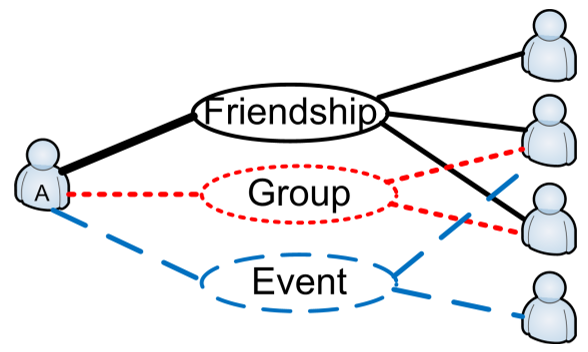 Figure: The transition from individual sparse relation graphs to a well-connected Union Multigraph (f).
Experimental Validation: Last.fm Case Study
The researchers crawled Last.fm using several methods and compared them against a "Ground Truth" uniform sample (UNI) obtained via userID rejection sampling.
Connectivity Breakthrough
Individual relations like "Events" or "Groups" are highly fragmented. However, when combined into a multigraph, the fraction of users in the Largest Connected Component (LCC) jumps dramatically. This allows the random walk to "leak" out of tight clusters and explore the wider network.
Performance vs. Reality
The multigraph method (combining Friends-Events-Groups-Neighbors) tracked the true population distribution of "Number of Groups" and "% of Paid Subscribers" much more accurately than any single-relation walk.
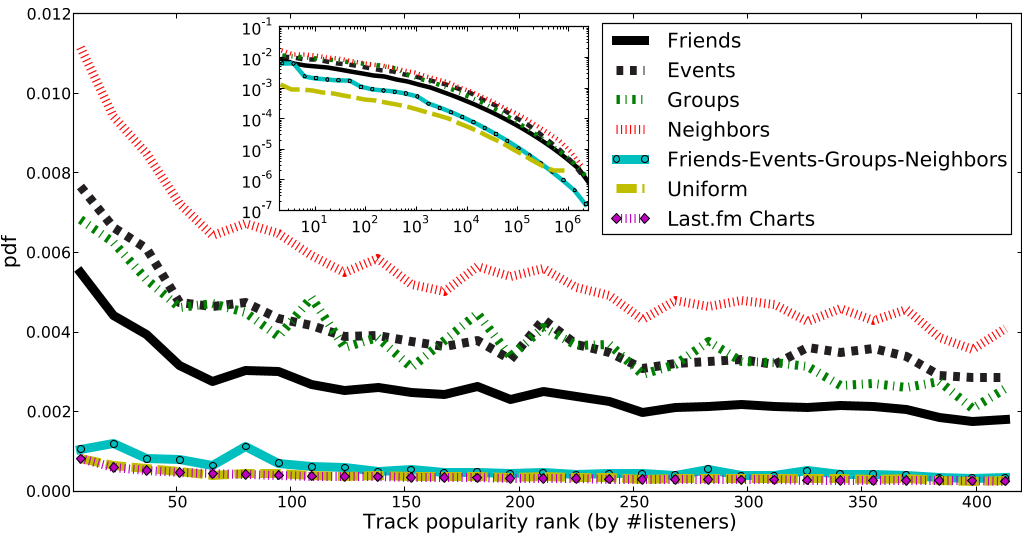 Figure: Popularity of music tracks. The Multigraph estimate (squares) aligns closely with the actual Last.fm Weekly Charts, whereas single-relation walks (triangles/dots) diverge significantly.
Critical Analysis & Conclusion
Takeaway
The value of this work lies in its Inductive Bias shift: it moves from viewing OSNs as a single graph to a multiplex structure. This is technically significant because it utilizes the Hansen-Hurwitz estimator to correct for the inherent bias toward high-degree nodes in multigraphs.
Limitations
- Relation Choice: The paper doesn't provide a rigorous mathematical framework for choosing which relations to add. Adding highly correlated relations might not improve mixing time.
- Dynamic Change: While the authors argue OSN growth is slow, in hyper-viral platforms (like modern TikTok or X), the graph might change faster than the walk converges.
Future Outlook
This methodology paves the way for smarter API-based crawlers. Future research into Adaptive Multigraph Sampling—where the crawler dynamically weights relations based on discovered connectivity—could further reduce the time required to achieve a representative sample.