
Multilevel Agent-Based Trust: A New Paradigm for Service Selection in Social Networks
A Multilevel Agent-Based Approach for Trustworthy Service Selection in Social Networks
The paper proposes a multilevel agent-based approach for trustworthy service selection within Multi-Relation Social Networks (MRSN). It introduces a multi-aspect trust model (Sociability, Expertise, Recommendation) coupled with a decentralized referral system to navigate complex social graphs and identify optimal service providers.
TL;DR
In an era where social applications are saturated with service providers, finding a "good" service is no longer just about matching keywords. This paper introduces a sophisticated Multi-Agent System (MAS) that evaluates trust across three dimensions—Sociability, Expertise, and Recommendation—to help users select the most reliable services through their social connections.
Background Positioning: Beyond the Registry
Standard service discovery has long relied on static registries. However, these lack "intuition"—they don't know if a provider is reliable or if their friends have had a bad experience. This work moves service selection into the realm of Multi-Relation Social Networks (MRSN), treating social links (friend, family, colleague) as vital data points for calculating trust.
The Problem: The Trust Gap in Social Services
Existing methods face several hurdles:
- Subjectivity: QoS ratings alone are often biased.
- Simplification: Most models assume only one type of relationship between users.
- Scalability: Centralized trust scores are hard to maintain in massive, distributed social graphs.
The authors argue that trust is not just a single number but a "multi-aspect concept." You might trust your friend as a person (Sociability) but not as a source for technical advice (Expertise).
Methodology: The Three Pillars of Trust
The core of the approach is a deliberative agent architecture that calculates an aggregate trust score using three distinct modules.
1. Trust in Sociability (ST)
This measures the "social power" of a provider using graph metrics:
- Social Position: How central is the agent in the network?
- Social Proximity: How "far" is the requester from the provider?
- Neighborhood Similarity: Do the requester and provider share common reliable acquaintances?
2. Trust in Expertise (ET)
Social standing isn't enough; the service must actually work. ET is calculated based on:
- Usability: Successful completions vs. total executions.
- Reliability: Successful executions vs. total invocations.
- Quality Rating: Direct feedback from previous uses.
3. Trust in Recommendation (RT)
This addresses the "referral" problem. If Agent A recommends Agent B, does Agent A have a history of making good recommendations?
Agent Architecture
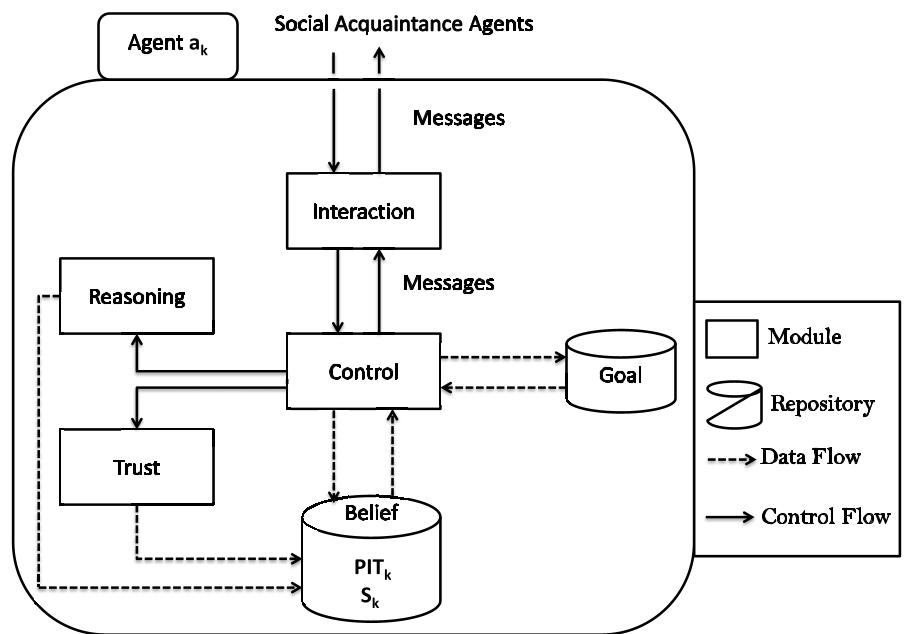 The architecture includes Reasoning, Trust, Control, and Interaction modules to handle decentralized decision-making.
The Workflow: Search and Propagation
The selection process follows a rigorous three-step algorithm:
- Distributed Search: The requester agent sends a query to its most "sociable" neighbors. If they don't have the service, they act as "recommenders" and propagate the query further.
- Trust Aggregation (STA): As the query moves through the chain, trust values are aggregated using transitivity. The requester eventually builds a Requester-Centered Social Network (RCSN).
- Ranking: Finally, providers are filtered by a trust threshold and ranked by their Expertise to find the best match.
Deep Insight: Why This Works
The brilliance of this approach lies in the Provider-Recommender Chain. By propagating the search through a referral system, the model mimics human behavior—we ask friends, who ask their experts. By mathematicalizing the "cost" of different social relations (friendship vs. business), the model ensures that the trust propagation is semantically accurate.
Conclusion and Future Outlook
This paper provides a robust framework for moving away from cold, registry-based searches toward a human-centric, multi-layered trust model. While the current model focuses on symmetric relationships, the authors highlight future work in multiplex networks and service composition, where multiple trusted services are combined to solve complex tasks.
Takeaway for Tech Leaders: In decentralized ecosystems (like Web3 or Distributed Edge), trust cannot be a single global variable. It must be computed dynamically through local social neighborhoods and multi-dimensional performance metrics.
Note: This analysis is based on the paper "A Multilevel Agent-based Approach for Trustworthy Service Selection in Social Networks" by Louati et al.