
IWM: Solving Hierarchical Inconsistency in Social Network Attribute Inference
A Multilevel Inference Mechanism for User Attributes over Social Networks
This paper introduces IWM (Inference with Multilevel Mechanism), a novel cross-level attribute inference model for social networks. It combines a maximum entropy-based random walk for global information propagation with a semantic tree-driven correction method to resolve inconsistencies in hierarchical user labels.
TL;DR
Inferring user attributes (like research interests or demographics) in social networks is rarely a "flat" problem. Interests follow hierarchies. This paper presents IWM, a model that leverages Maximum Entropy to propagate information through a social graph and a Semantic Tree to correct logical errors between different levels of attributes, achieving over 35% improvement in F1-score over traditional methods.
Executive Summary
In modern social networks, user labels—such as professional skills or content categories—are inherently hierarchical. However, most SOTA methods treat these labels as independent units. This paper identifies a critical gap: Semantic Inconsistency. When you treat "Machine Learning" and "Deep Learning" as unrelated tags, a model might predict a user belongs to the latter but not the former, which is logically impossible. IWM addresses this by integrating the graph's topology with a predefined semantic structure.
Problem & Motivation: The Hierarchy Trap
Existing approaches (SVMs, Community Detection, or standard Random Walks) fail in multilevel tasks because:
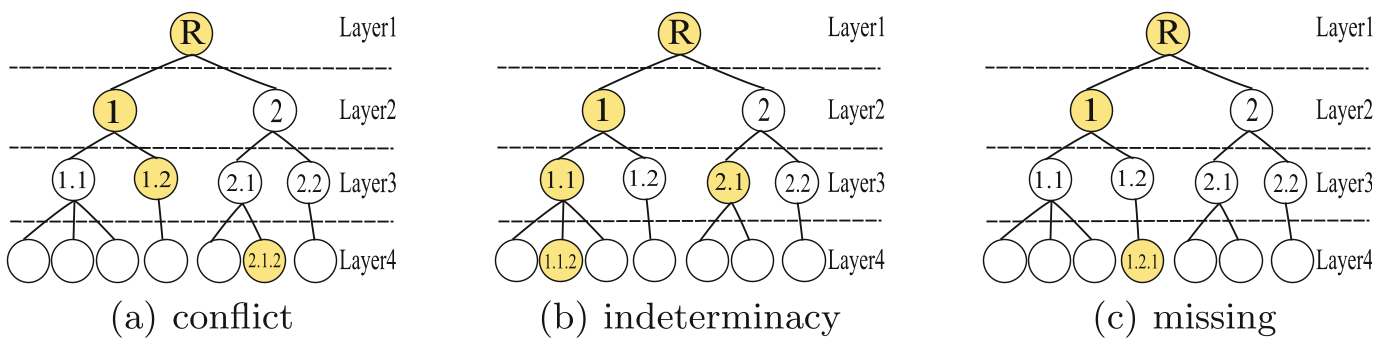
- Conflict: Different levels produce contradictory results for the same user.
- Indeterminacy: Lack of information at one level makes the entire branch uncertain.
- Data Scarcity: Users often omit "parent" attributes, focusing only on specific "leaf" nodes.
The authors' insight is that if we know the Semantic Tree (the hierarchical roadmap of attributes), we can use the certainty of a child node to "correct" or "fill in" a parent node, and vice versa.
Methodology: Propagation meets Correction
The IWM model operates in two distinct phases:
1. Maximum Entropy Information Propagation
Instead of a simple random walk, IWM uses Maximum Entropy. The core intuition is: The higher the entropy (uncertainty) of a node, the more information it should collect from its neighbors.
The transition probability is proportional to the entropy of the receiving node, ensuring that information flows where it is most needed to reduce local uncertainty.
2. The Correction Mechanism
This is where the semantic hierarchy is enforced. The probability of an attribute is updated using its parent’s weight and its descendants' weights:
- (Correction Strength): Balances raw propagation data with the logical structure of the tree.
- This ensures that if a user is likely a "Database" expert (Level 3), the probability of them being a "Data" professional (Level 2) is boosted accordingly.
Experiments & Results
The authors validated IWM on the DBLP dataset (co-author network), defining a 4-layer semantic tree of research fields.
Performance Gains
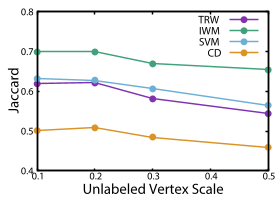
In comparisons across various network sizes (5k to 40k nodes), IWM consistently outperformed SVM, Community Detection (CD), and Traditional Random Walk (TRW).
- Precision: Significant lead, especially in deeper layers of the tree.
- F1-Score: Improvements of up to 35.1% over TRW.
- Robustness: Even when 50% of the nodes were unlabeled, IWM maintained an Accuracy of ~64%, whereas baseline performance plummeted.
Real-world Case Study
A look at the DBLP results (Table 2 in the paper) shows that IWM correctly identified missing labels for authors like Chris Stolte where the parent level "Data" was missing in the baseline but recovered by IWM's cross-level correction.
Critical Analysis & Conclusion
Takeaway
IWM proves that inductive bias provided by a semantic hierarchy is a powerful tool for graph inference. By moving away from flat labels, we gain both logical consistency and higher accuracy.
Limitations & Future Work
While IWM is robust, it relies on a predefined semantic tree. In highly dynamic environments where new categories emerge daily, manually maintaining this tree is a bottleneck. The authors suggest that moving toward multi-category attributes and optimizing computational efficiency to handle even larger graphs are the next frontiers.
In summary, IWM is a significant step toward "common sense" AI in social networks—ensuring that predicted user attributes don't just look right statistically, but make sense hierarchically.