
Beyond the Screen: How Social Networks and ICT Drive Our Travel Demand
A multilevel path analysis of contact frequency between social network members
This paper investigates the determinants of social contact frequency across different communication modes (Face-to-Face, Telephone, E-mail, and SMS) using a Multilevel Path Analysis. Based on egocentric social network data from the Netherlands, it demonstrates how individual traits and relationship characteristics interact to drive social interaction and travel demand.
TL;DR
Why do we still travel so much despite having instant digital access to anyone? This study reveals that digital communication acts as a catalyst, not a replacement, for physical meetings. Using a multilevel path analysis, the researchers show that social network strength and ICT use (phone, e-mail, SMS) are tightly coupled with face-to-face interactions, signaling a future of increasing social travel demand.
Background: The Neglected Social Trip
In urban planning, work and shopping trips have traditionally been the focus. However, social activities are the fastest-growing segment of travel. The "Social Network Approach" posits that trip-making isn't just about utility; it's about maintaining human connections. The core tension in this research is whether ICT substitutes for travel (the "death of distance") or complements it.
Problem & Motivation: The Hierarchy of Interaction
Previous studies often failed to account for the structure of social life. An individual (the ego) has many contacts (alters) with varying degrees of closeness and distance.
- Prior Work Limitations: Most models treated all contacts as independent observations, ignoring that one person's personality affects all their relationships.
- The Insight: The authors realized that to truly understand travel, we must model the interdependence of communication modes across different levels of social hierarchy.
Methodology: Multilevel Path Analysis
The researchers analyzed data from 116 respondents in the Eindhoven region, tracking 2,696 social links. They used a multilevel path model to distinguish between:
- Between-level: Individual traits like age and education.
- Within-level: Relationship traits like geographical distance and tie strength.
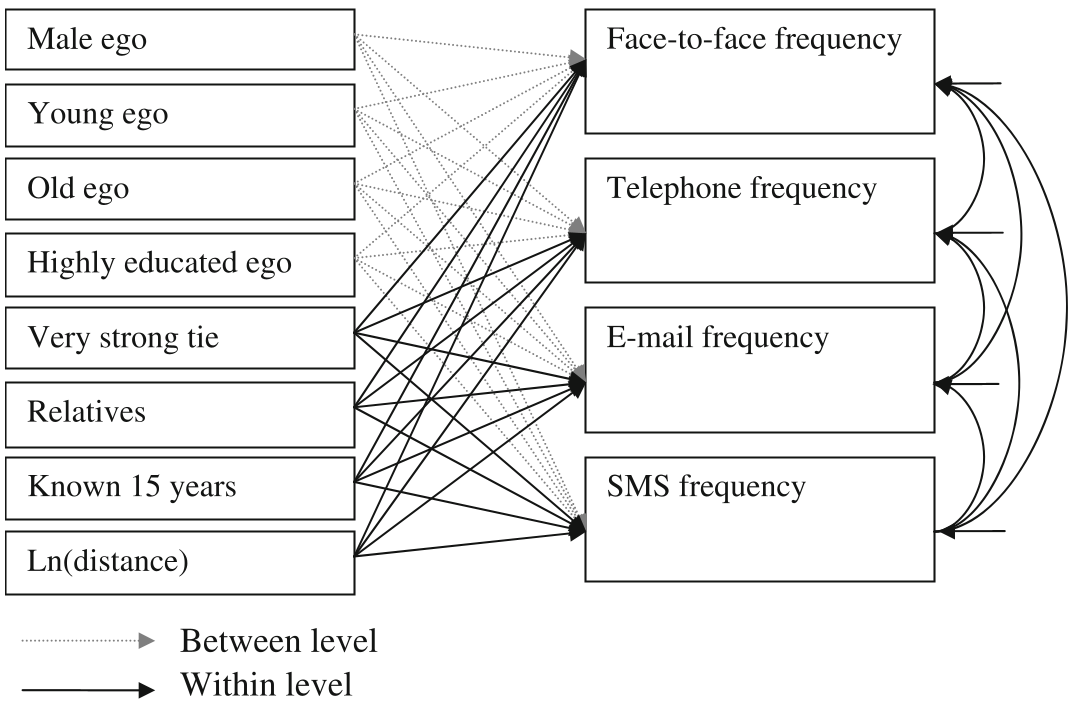
The model treats F2F, Telephone, E-mail, and SMS frequencies as endogenous variables, allowing them to influence one another.
Key Findings: The Distant Friend and the Family Caller
The results confirm several critical "Social Physics" laws:
1. The Complementarity Effect
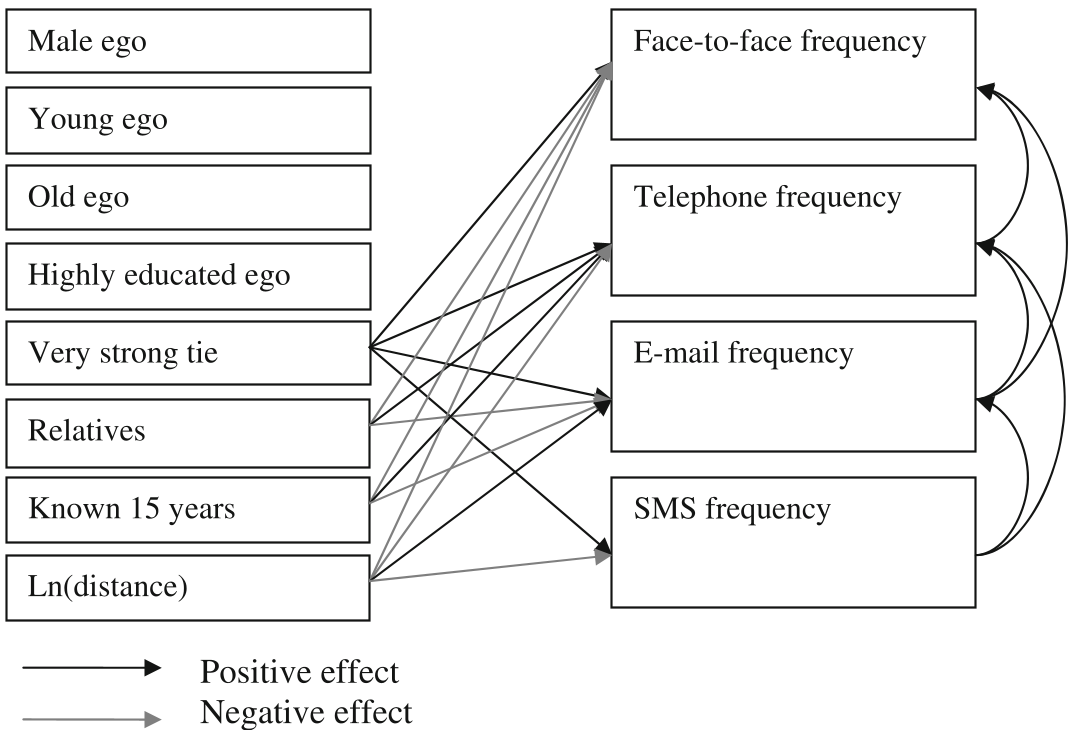
Contrary to the substitution hypothesis, digital and physical contacts are positively correlated. If you text someone more, you are more likely to see them in person.
2. The Distance Decay
Distance is the "enemy" of the physical meeting, but it has a different relationship with ICT:
- F2F: Decreases sharply as distance increases.
- E-mail: Actually shows a positive correlation with distance, acting as the bridge for far-flung relationships.
3. Demographic Forerunners
Higher education is a massive predictor of communication frequency across all digital modes. Age also plays a distinct role: the younger generation adopts SMS, while the oldest generation stays loyal to the telephone—yet both groups show higher-than-average frequencies for F2F meetings due to available time or social needs.
Critical Analysis & Conclusion
Takeaway
For policy makers, the message is clear: ICT will not solve traffic congestion. In fact, as we become more digitally connected and as our population ages (senior citizens having high social travel needs), the demand for "social infrastructure" and transport will only grow.
Limitations & Future Work
The study’s sample size (116 respondents) is a limitation, forcing the researchers to simplify complex categorical variables. Furthermore, the 2008 data predates the "Smartphone Revolution" and the rise of instant messaging apps like WhatsApp/Messenger. Modern research should look at how homophily (similarity between people) and social network dynamics (how ties break or form over time) further alter these paths.
Future Outlook
As social networks become more geographically dispersed, we may see a shift from frequent local trips to less frequent but longer-distance social travel, facilitated by the digital "glue" that keeps distant ties alive.
Note: Tables and diagrams extracted from Van den Berg et al. (2010), "A multilevel path analysis of contact frequency between social network members".