
Multilevel Predictive Modeling: Reframing Depression Detection Through the Lens of Life Satisfaction
A Multilevel Predictive Model for Detecting Social Network Users with Depression
The paper introduces a multilevel predictive framework for depression detection using Facebook user data. By leveraging the negative correlation between life satisfaction and depressive symptoms, the authors first predict a "Life Satisfaction" label and then use it as an auxiliary feature to significantly enhance a secondary depression classifier.
TL;DR
Researchers at King’s College London have developed a "multilevel" machine learning approach that doesn't just look for signs of depression, but first assesses a user's Life Satisfaction. By treating life satisfaction as a foundational layer, the model achieves an impressive 81.67% accuracy in identifying depressed users on Facebook, proving that what we don't say about being happy is just as revealing as what we do say about being sad.
Problem & Motivation: The Missing Context of Well-being
Most AI models for mental health are "single-lane" thinkers: they look for keywords associated with depression and label the user accordingly. However, psychology tells us that mental health is a spectrum. A critical missing piece in automated detection is Life Satisfaction (LS).
The authors observed that while many people express depressive symptoms, the degree of their overall life satisfaction acts as a significant moderator. Existing models often miss this nuance, leading to lower precision. The challenge was to prove that "Life Satisfaction" and "Depression" are two sides of the same coin and that knowing one can drastically improve the prediction of the other.
Methodology: Building the Hierarchical Model
The core innovation is the Multilevel Predictive Model. Instead of a flat classifier, the authors created a two-stage pipeline:
- Stage 1 (The LS Model): Trained on the Satisfaction with Life Scale (SWLS), this model uses demographics, Facebook activity (likes, tags, friends), and linguistic styles (via LIWC) to categorize users as "Life-Satisfied" or "Life-Dissatisfied."
- Stage 2 (The Multilevel Model): The output label from Stage 1 is fed into a second classifier as a primary input, alongside raw linguistic features, to determine the final "Depressed" or "Non-Depressed" status.
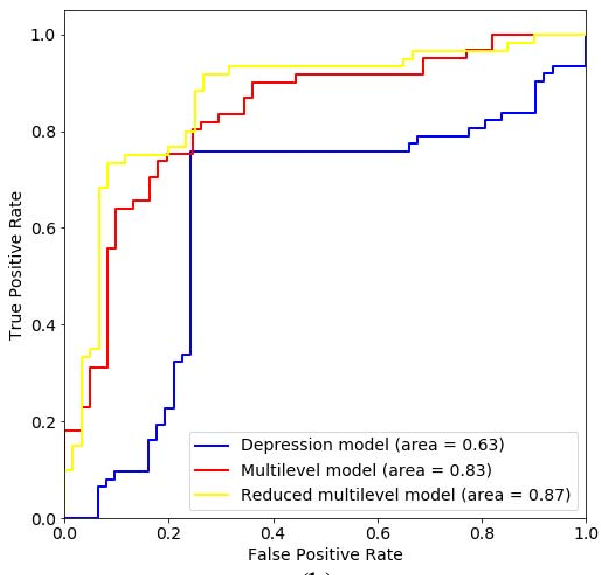 The ROC curves demonstrate the performance gain when moving from a basic model to the multilevel framework (Red line).
The Linguistic Fingerprint
Why does this work? The study highlighted fascinating linguistic contrasts:
- Life-Satisfied Users: Frequently used "We" (social connection), "Positive Emotion" words, and had larger friend networks.
- Depressed Users: Demonstrated a high "Self-Attentional Focus," evidenced by a significantly higher usage of the word "I" and religion-related terms, possibly reflecting a search for coping mechanisms.
Experiments & Results: Accuracy Boost
The researchers utilized the myPersonality dataset, analyzing thousands of participants. By applying Principal Component Analysis (PCA) to reduce noise and focusing on the multilevel structure, the results were clear:
| Model Architecture | Accuracy | F1-Score |
|---|---|---|
| Basic Depression Model | 77.42% | 0.79 |
| Multilevel (LS + Depression) | 78.69% | 0.79 |
| Reduced Multilevel (PCA-enhanced) | 81.67% | 0.82 |
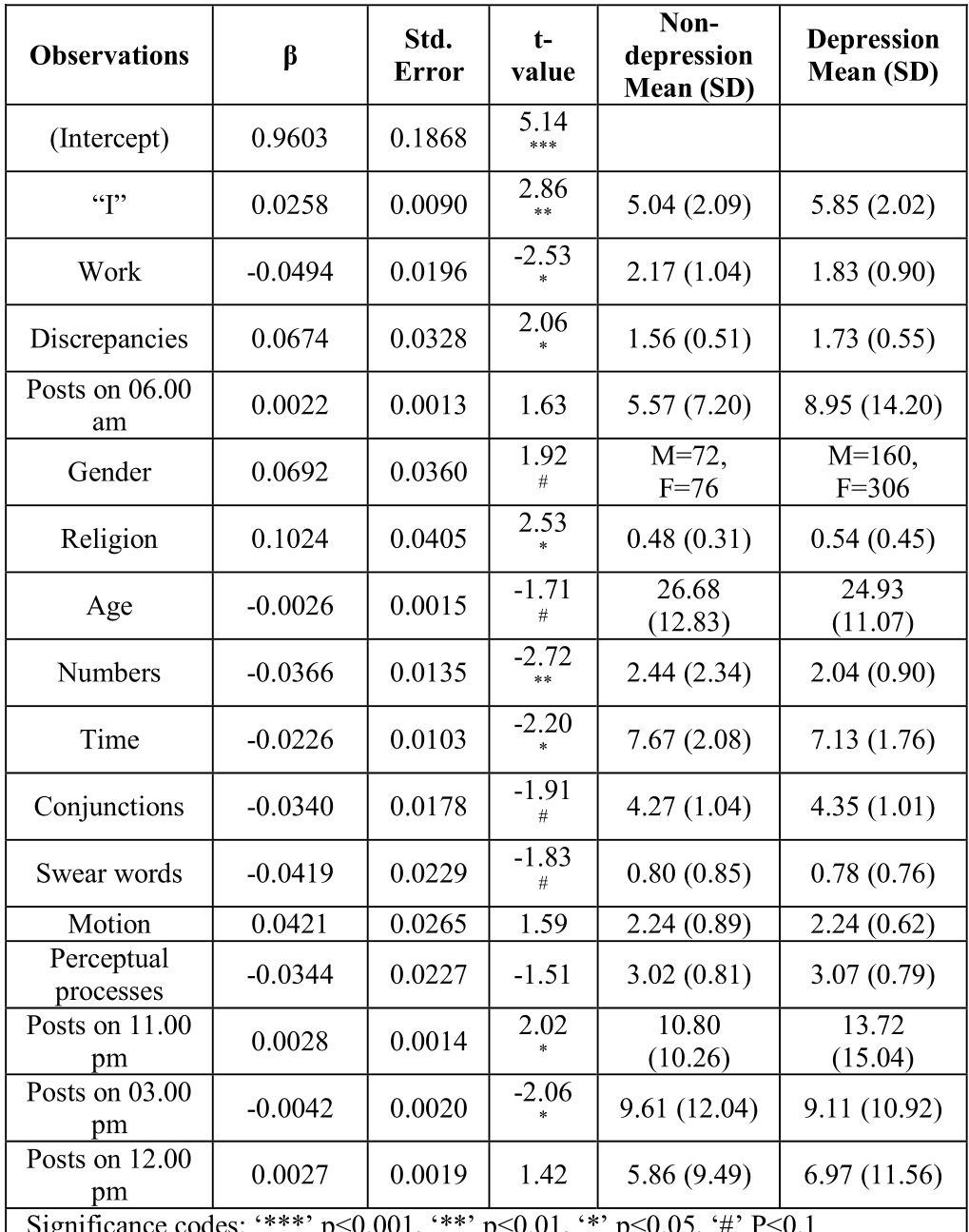 The regression table shows how factors like 'I' usage (positive beta) and 'Work' focus (negative beta) distinguish depressed from non-depressed users.
Critical Analysis & Conclusion
Takeaway
The success of this multilevel approach suggests that contextual psychological proxies (like satisfaction) are just as important as the target symptom (depression) in social media analytics. This opens the door for "Digital Phenotyping" tools that can provide doctors with more frequent, passive data points between clinical visits.
Limitations & Future Work
While successful, the study acknowledges a few hurdles:
- Data Bias: The dataset had a high prevalence of depression (50%+), which doesn't reflect the general population's baseline.
- Feature Depth: The study relied heavily on LIWC (dictionary-based). The authors suggest that future work should incorporate Topic Modeling and Image Analysis to capture non-verbal cues.
Final Thought: If AI can learn to read between the lines of our social media posts to gauge our satisfaction with life, it may soon become a vital "early warning system" for the global mental health crisis.