
The Digital Filter: How Culture and "Imagined Audiences" Shape Multilingual Expression
Culture, Imagined Audience, and Language Choices of Multilingual Chinese and Korean Students on Facebook
This paper investigates the language choices (native L1 vs. English) of multilingual Chinese and Korean international students on Facebook. Utilizing a mixed-method approach including surveys, scenario-based experiments, and data visualization, it identifies how cultural values and "imagined audiences" dictate linguistic behavior in a context-collapsed digital environment.
TL;DR
Why do international students switch between their native language and English on Facebook? This study reveals that it isn't just about proficiency. It is a calculated social dance. By analyzing Chinese and Korean students in the US, researchers found that language acts as a "filter" to manage Context Collapse—using native tongues to hide sensitive emotions or maintain cultural politeness, while using English to "promote" culture to a global audience.
The Problem: When Worlds Collide (Context Collapse)
In a physical conversation, you know exactly who is listening. You wouldn't speak a language your friend doesn't understand because it's rude. However, on Facebook, your high school friend from Seoul, your American professor, and your local landlord are all in the same "room." This is Context Collapse.
For multilingual users, this creates a dilemma:
- Do I post in my native language (L1) and risk alienating my English-speaking friends?
- Do I post in English and lose the "emotional nuance" or "cultural respect" embedded in my native tongue?
Methodology: Seeing Through the User's Eyes
The authors didn't just look at data; they wanted the logic behind the data. They used a unique "Exploratory Visualization" tool (Fig 2) to show participants their own posting history, which triggered deeper memories during interviews.
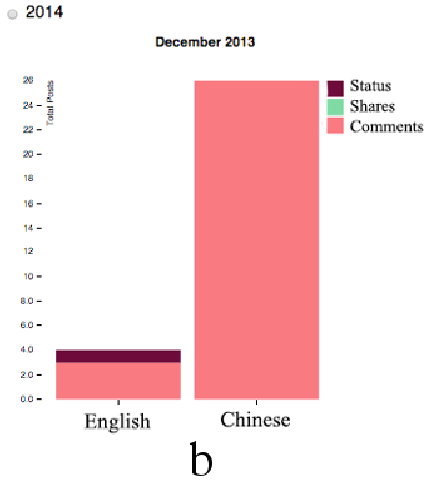 Fig 2: The visualization tool helped participants identify trends in their language choices over time.
Key Insights: Why They Switch
1. The "Language Barrier" as a Shield
One of the most profound findings was that users intentionally use their native language to exclude certain people for their own protection.
- Negative Emotions: Participants felt that "complaining" is more acceptable in collectivistic cultures (like China and Korea) but feels "out of place" in the "stay positive" vibe of Western Facebook.
- Taboo Topics: Using L1 allowed users to discuss sensitive topics (like race or politics) that might be misunderstood or cause conflict if translated into English.
2. The Respect Factor (Honorifics)
English is largely "flat" in its hierarchy. For Korean students, addressing an elder in English can feel disrespectful because English lacks the complex honorific systems (like eonni or oppa). To maintain social harmony, they switch to L1 to ensure they aren't perceived as rude by their elders.
3. Sharing vs. Hiding
Interestingly, culture played two contrasting roles:
- Sharing: In scenarios like "Chinese New Year," many participants actually used English. Why? Because they felt a sense of pride and wanted to "introduce" their culture to their international friends.
- Hiding: For personal trips or group work, they used L1 to signal that the content was "only for the inner circle."
Experimental Evidence
The researchers tested 8 scenarios to see if their hypotheses held true. While most matched, the "Car Sale" scenario provided a surprise.
 Table 2: Most users chose English for Western holidays (Christmas) and L1 for cultural events (New Year), but "Ambiguous" scenarios like a NYC Trip leaned heavily toward L1.
Critical Analysis: Is it Exclusion?
The paper shifts the narrative. Usually, we think of speaking a foreign language in a group as a "cold" act of exclusion. This study argues it is an act of consideration. Users are "filtering" their feed so that only the relevant audience sees the relevant content.
Limitations: The study was conducted in a university with a very high density of international students. In a more isolated environment, the pressure to "assimilate" into English-only posting might be much higher.
Conclusion: Building Better Social Spaces
This research suggests that social media platforms should not just be about "connecting everyone." They need to recognize the Identity Work involved in being multilingual. Features that allow for easier audience segmenting (like "Close Friends" lists or language-based visibility) are not just "privacy tools"—they are essential cultural survival kits for the modern international student.