
Beyond Localization: Decoding the Behavioral Patterns of Multilingual Search Users
Multilingual Search User Behaviors -- Exploring Multilingual Querying and Result Selection Through Crowdsourcing
This paper investigates multilingual search user behaviors through large-scale crowdsourcing experiments (1,670 participants) across three studies. Using an analysis of query formulation and result selection, it identifies that while users prefer their primary language (L1) for querying, they frequently select secondary language (L2) results, especially when English is used as a second language.
TL;DR
Is a single-language search interface enough for a global audience? This paper argues "no." Through a large-scale study of over 1,600 users, researchers discovered a "proficiency gap": users often struggle to write queries in their second language (L2) but frequently prefer results in that language when they are provided. The study highlights that factors like task type (e.g., Fact-Finding) and domain (e.g., Science) dramatically shift which language a user chooses.
The Problem: The "Unilingual" Fallacy
Most search engines operate on the principle of localization—if you are in France, you get a French interface. However, in the EU, nearly 95% of secondary students learn English. Traditional systems ignore this cognitive flexibility. Previous research was often "attitudinal" (what users say they do); this paper provides the "behavioral" evidence of what users actually do when presented with multilingual choices.
The core challenge is the querying bottleneck. A user might be able to read an English medical paper perfectly but struggle to type the complex medical terminology required to find it.
Methodology: Crowdsourcing Human Behavior
The researchers conducted three distinct studies to isolate different parts of the search journey:
- Study 1 (Query Construction): Users wrote their own queries in response to prompts.
- Study 2 (Query Selection): Users chose from a list of pre-written queries in different languages.
- Study 3 (Result Selection): Users chose between two side-by-side result lists (e.g., German vs. English).
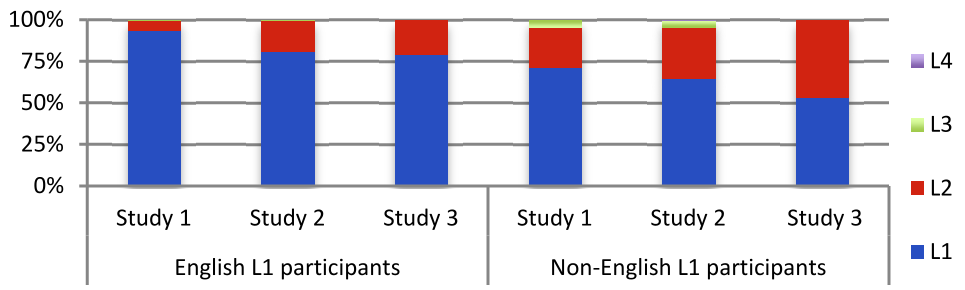 Figure 1: Comparison between Native English (L1) and Non-Native English search behaviors.
Key Insights: Why Users Switch Languages
The study unearthed several "Inductive Biases" in human search behavior:
1. The Power of English as L2
Native English speakers rarely bother with their L2. However, for non-native speakers, English is the "Trustworthy" and "International" source. As shown in the study, non-English L1 users gravitate toward English results for higher perceived relevance and variety.
2. The Proficiency Disparity
Proficiency deeply affects writing, but not necessarily selecting. Even users with low L2 proficiency (rated 2/5) chose L2 results over 35% of the time, whereas they almost never wrote L2 queries at that level.
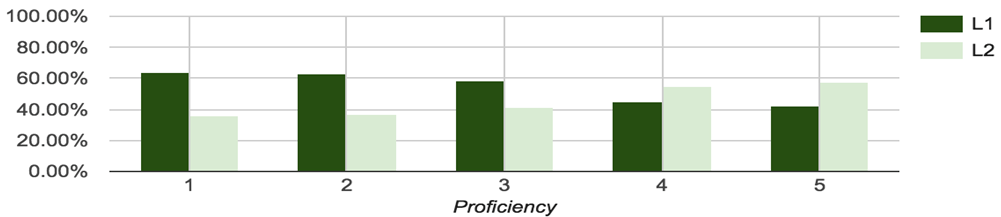 Figure 2: How L2 proficiency influences the willingness to select search results in a secondary language.
3. Task Matters: Fact-Finding vs. Doing
If a user is looking for a specific fact (Fact-Finding), they are likely to hunt across languages. If they are looking for a local service (Doing), they stick to their primary language. Domains like Science, Entertainment, and World Politics see the highest L2 engagement.
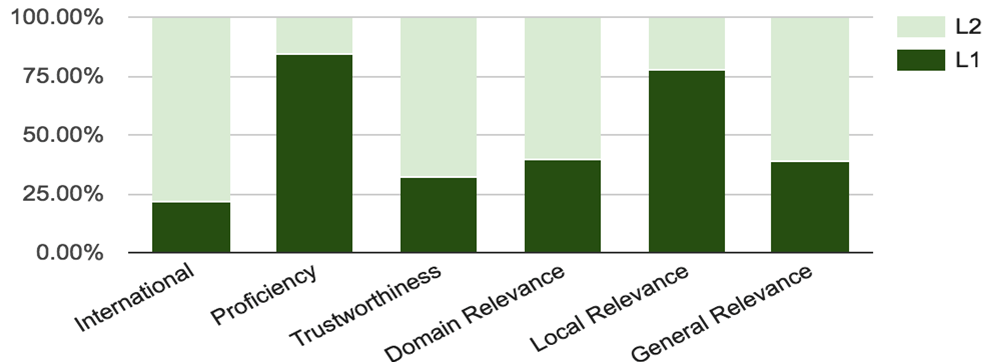 Figure 3: Impact of topic domain on language selection.
Future Implications: Adaptive Multilingual Search
The study concludes that search engines should stop being unilingual and start being adaptive.
- Multilingual Query Suggestions: Help users bridge the "writing gap" by suggesting queries in their L2.
- Aggregated Results: Integrate top results from multiple languages into a single page, much like how Google integrates "Images" or "News" today.
- Domain-Aware Adaptation: Automatically trigger multilingual results when a user searches for scientific or international news topics.
Critical Analysis
While the study is a landmark in quantitative analysis of multilingual users, its reliance on crowdsourcing (Crowdflower) presents some noise, despite strict quality controls. Additionally, the study focuses on a 7-language subset. How these behaviors scale to "low-resource" languages where English content vastly outweighs local content remains an open question.
Ultimately, this work serves as a foundational call to action for the HCI and IR communities: Language is not a static setting; it is a dynamic user characteristic that changes with the task at hand.