
Gossip in the Pocket: Decentralized Multimedia Sharing in Mobile Social Networks
Multimedia contents dissemination with gossip algorithms in distributed social networks
The paper presents a decentralized framework for multimedia content dissemination in distributed social networks (DSNs) using randomized gossip algorithms. By leveraging Device-to-Device (D2D) communication among smart handsets, the method achieves full content synchronization across the network with low communication overhead and high robustness.
TL;DR
This paper explores a future where your smartphone doesn't need a base station to get the latest viral video. By using Gossip Algorithms within a Distributed Social Network (DSN), the researchers prove that smart devices can "talk" to their neighbors to spread multimedia content. The system is incredibly efficient: in a typical setup, a user only needs ~12 interactions to receive 100% of the network's content, and moving around actually makes the process twice as fast.
Background: The Infrastructure Bottleneck
We usually think of social media as "The Cloud," but the physical reality is base stations and Wi-Fi Access Points (APs). In crowded areas like shopping malls or inside high-speed trains, these central points become bottlenecks.
- Collision: Too many users on one AP leads to frequent data collisions.
- Penetration Loss: Signals struggle to enter metal-heavy environments like train carriages.
The authors propose a "flat" architecture where devices communicate directly via Device-to-Device (D2D) technology, turning the crowd into the network itself.
The Logic of Gossip: How it Works
The core mechanism is a randomized exchange. Each handset acts as a "node" in a Randomized Geographic Graph (RGG).
- Selection: A device's clock "ticks," and it picks a random neighbor.
- Push-Pull: They compare what content they have (S_i vs S_j).
- Update: They swap the missing pieces.
The beauty of this approach is its Simplicity and Robustness. There is no "master" node. If one person leaves the room, the gossip just continues through others.
 Conceptual view of devices forming a distributed web.
Mathematical Insight: The Convergence Bound
The authors didn't just simulate; they proved the performance using the theory of Conductance (). They established an upper bound for the spread time ():
This formula suggests that the time to spread information is tied to the "loading" of the edges and the number of contents (). Crucially, their simulations revealed that the communication cost per user stays constant even as the total number of users () grows. This is a vital property for scalability.
Experimental Proof: Efficiency and Mobility
The researchers ran simulations with 200 users and 100 distinct content items.
- Fixed Topology: It takes about 2,400 total iterations for the whole network to sync. For an individual, that’s just 12 chats with neighbors.
- Mobility Bonus: When users move (as they naturally do in a mall or train), the network topology reshuffles. This "shuffling" allows information to hop across the network faster.
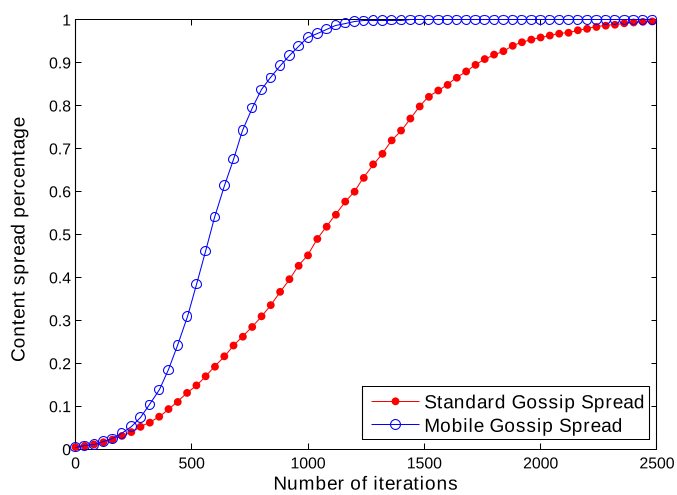 Figure 1: Percentage of content spread vs. iterations. Note the rapid convergence.
As shown in their mobility tests, the average iterations per user dropped from 12 down to 6 when nodes were moving. In the world of gossip, a "moving target" is actually easier to reach.
Deep Insight & Conclusion
The most significant takeaway here is the counter-intuitive benefit of Mobility. In traditional wireless networking, mobility is a headache—it causes dropped calls and handoff issues. Here, in a distributed gossip model, mobility acts as a "mixer" that improves the graph's conductance, effectively turning a sparse local graph into a high-capacity complete graph over time.
While the paper acknowledges that using Random Linear Codes could further optimize the data exchange, it argues that the overhead of coding/decoding might be too heavy for simple handsets, favoring the simplicity of the set-union approach.
For future D2D and 6G applications, this research provides a robust theoretical foundation for "off-grid" social media and local content delivery.
Final Takeaway: Decentralized gossip is not just a fallback; for high-density mobile environments, it is a highly scalable and efficient primary distribution strategy.