
SMART: Bridging the Gap Between Social Networks and Physical Multimedia Sensors
Multimedia Search over Integrated Social and Sensor Networks www.smartfp7.eu
This paper introduces SMART, a multimedia search engine framework designed to index and query real-time environment-generated content (audio/video) from integrated sensor and social networks. It leverages cutting-edge signal processing and the Terrier retrieval platform to enable context-aware search over physical-world streams.
TL;DR
As the Internet of Things (IoT) matures, we are no longer just connecting devices; we are connecting the physical experiences they capture. This paper introduces the SMART (Search engine for MultimediA enviRonment generat-ed contenT) project, a framework that allows users to query the physical world in real-time. By merging sensor networks (cameras/microphones) with social networks, SMART enables "social queries" over live environment-generated content.
Problem & Motivation: The Static Metadata BottleNeck
Traditional sensor searching suffers from a "textual gap." Most systems rely on pre-defined, static tags (e.g., "Location: Peania, Sensor: Camera"). However, the physical world is dynamic. If a riot breaks out or a street performance begins, static metadata remains silent.
The authors identify three critical pain points:
- Lack of Multimedia Support: Current tools focus on scalar data (temperature, GPS) rather than AV (audio/visual) streams.
- Island Architectures: Participatory sensing (crowdsourcing) is often "single-focus" and cannot be repurposed across different application domains.
- Disconnected Context: Sensor data lacks the human nuance of social trends—what is happening in the physical world is often reflected first in social media.
Methodology: How SMART Orchestrates the Physical World
The core innovation of SMART lies in its Search Engine Architecture, which moves beyond simple keyword matching to Dynamic Sensor Selection.
1. The Multi-Layered Architecture
The engine is built upon the Terrier retrieval platform, extended to handle high-velocity sensor streams.
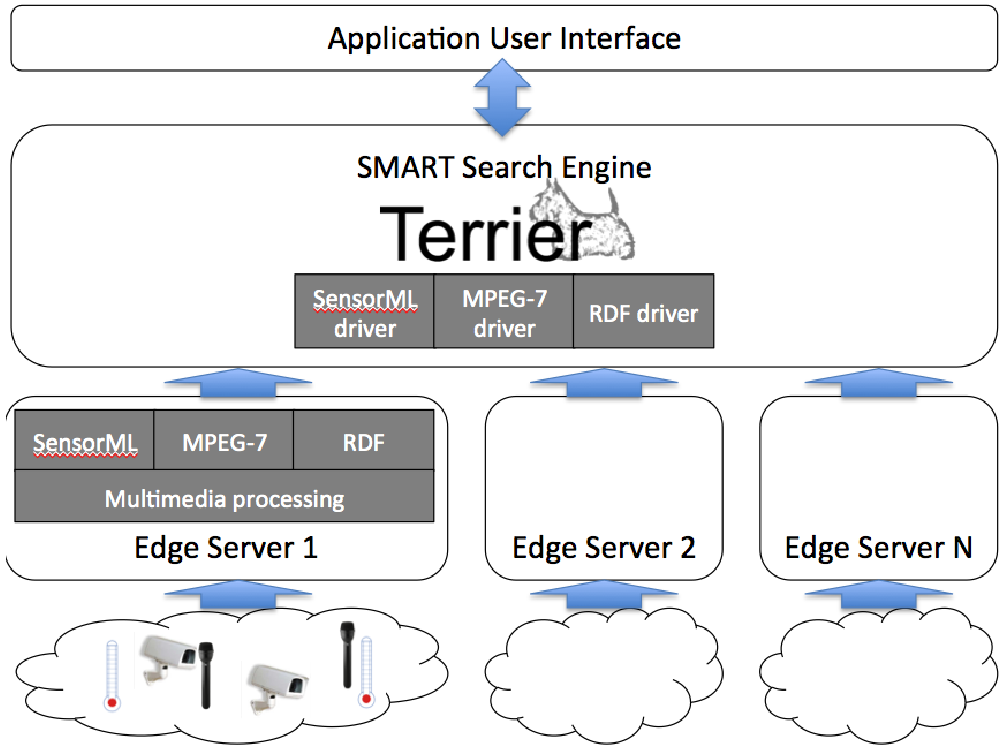
2. Intelligent Synthesis
- Low-Latency Indexing: Using Yahoo's S4 framework, the system processes environment-generated content (EGC) in near real-time.
- Context-Aware Orchestration: Instead of searching all sensors, the system performs "Sensor Selection." It identifies which cameras or microphones are most relevant to a specific user's task based on spatial and social metadata.
- Social-Sensor Blending: By tapping into platforms like ESKUP, the engine uses social "trending topics" to anticipate what users might want to search for in the physical world.
Experiments & Real-World Use Cases
Rather than traditional laboratory benchmarks, the paper validates its methodology through two high-stakes urban scenarios:
- Live News Portal: Modern news agencies can query the engine for "Where are riots happening?" or "What are the specific trends in the city?" The engine responds with integrated multimedia streams and social sentiment, creating a "Personalized Social News Portal."
- Smart Security: In sensor-saturated cities, manual monitoring of all cameras is impossible. SMART uses AV processing algorithms (visual scene analysis and acoustic event classification) to trigger alarms based on specific query conditions.
Critical Analysis & Conclusion
Takeaways
The paper effectively argues that the next evolution of search is anticipatory and multi-modal. By making the physical world searchable, SMART shifts sensors from being "passive loggers" to "active responders."
Limitations
While the architecture is robust, there are significant hurdles:
- Privacy & Trust: Monitoring urban environments raises massive privacy concerns (though the authors mention AnonySense as a potential integration).
- High Complexity: Managing real-time AV indexing at a city-wide scale requires immense computational overhead at the "Edge."
Future Outlook
The legacy of SMART is its focus on Open Source and Extensibility. By building on the Terrier engine and using standard formats like SensorML and RDF, it paves the way for a "Web of Things" where human social activity and physical sensor data are a single, searchable entity.