
Beyond the Screen: Decoding Suicidal Intent through Multimodal Social Media Analysis
Multimodal Behavioral Markers Exploring Suicidal Intent in Social Media Videos
This paper presents the first systematic study of multimodal behavioral markers (verbal, acoustic, and visual) for suicidal intent in social media videos, proposing a new annotated dataset for screening individuals at high risk. By employing XGBoost and statistical testing, the authors identify key indicators such as slouched shoulders, rapid hand movements, and profanity that distinguish suicidal intent from general psychological distress.
TL;DR
Researchers from Carnegie Mellon University have pioneered a method to detect suicidal intent in unconstrained social media videos by analyzing the synergy between speech, sound, and body language. By identifying "signatures" such as specific patterns of silence, shoulder posture, and death-related vocabulary, their model can significantly differentiate between general psychological distress and active suicidal ideation, reaching peak accuracy with just 60 seconds of video data.
Context: Moving from the Clinic to the Web
Traditionally, identifying suicidal risk happened in the clinician's office through semi-structured interviews. However, the digital age has shifted the expression of intent to platforms like YouTube and Twitter. The core challenge is generalization: can markers found in a quiet clinic work in a shaky, poorly-lit, or raw social media video? This paper bridges that gap by moving away from controlled environments to "in-the-wild" social media data.
The "Signature" of Intent: Methodology
The authors breakdown the human expression into three critical streams of data:
- Verbal (The "What"): Using LIWC (Linguistic Inquiry and Word Count) and BERT, they analyzed over 16 categories of psychological processes. They found that individuals with intent don't just use "sad" words; they use "stronger" language, including profanity and specific death-related clusters.
- Acoustic (The "How it Sounds"): Beyond what is said, the rhythm of speech matters. The team used OpenSmile to track pitch variations (F0) and, crucially, the duration of unvoiced segments (silences).
- Visual (The "Body Language"): Using OpenPose and OpenFace, they tracked 25 body keypoints and facial Action Units. The research focused on "agitated" mental states manifested through rapid hand movements and "social alienation" manifested through gaze aversion.
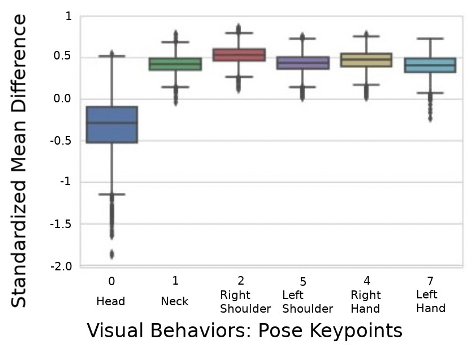 Figure 1: Locations of body keypoints (left) and the standardized mean difference test for pose features (right).
Key Insights: What Truly Matters?
The study utilized XGBoost for classification not just for its performance, but for its interpretability. Since XGBoost is an ensemble of decision trees, the authors could extract "Feature Importance Scores" to see which markers actually move the needle.
- The Power of Language: Verbal features were the most dominant predictors. Specifically, "Death" related vocabulary and "Swear" words showed the highest importance.
- The Sound of Silence: In the acoustic domain, the "length of unvoiced segments" (pauses) was more telling than the actual pitch. This suggests that the hesitation or "heaviness" of speech is a major behavioral marker.
- Physical Manifestation: The visual analysis confirmed that movement in the neck, shoulders, and hands (indicating agitation or slouching) were statistically significant markers that differentiated suicidal intent from general depression.
 Table 1: Top behavioral markers ranked by their Importance Scores across Verbal, Acoustic, and Visual modalities.
Efficiency for Intervention
One of the most practical findings of this research is the temporal analysis. For a screening tool to be effective, it must work fast. The study found that model performance saturates at approximately 60 seconds. This implies that the most critical behavioral markers are "leakage" that happens almost immediately when an individual begins to tell their story.
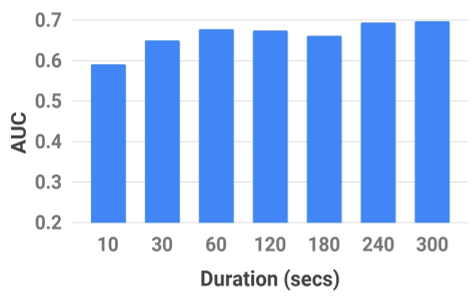 Figure 2: Model performance (AUC) vs. duration of video context. Intelligence can be gathered effectively within the first minute.
Critical Analysis & Future Outlook
While this work is a landmark in social media healthcare analysis, it carries its own set of limitations. The dataset (90 videos) is relatively small for deep learning standards, though the high inter-annotator agreement () provides a strong foundation.
Future Impact: This research underscores that suicide prevention modernizes when we treat "digital behavior" as a clinical signal. By integrating these multimodal markers into social media "red-flag" systems, platforms could potentially offer help resources or alert human moderators with much higher precision than current text-only keyword filters.
Conclusion
The study proves that suicidal intent is not just an internal state; it is a multimodal display. Whether it is the specific choice of a swear word, a long pause between sentences, or the anxious movement of a hand, these markers offer a digital footprint for intervention in an increasingly virtual world.