
Going Beyond Traits: Why Your AI Needs to Understand Your "Personality States"
Going beyond traits: multimodal classification of personality states in the wild
This paper introduces a novel framework for the multimodal classification of "personality states" (actual behavioral episodes) rather than static traits. Using Sociometric Badges and email logs from 54 subjects over six weeks, the authors utilize SVM classifiers to achieve SOTA-level accuracy (up to 71% for Emotional Stability) in detecting Big Five state expressions in real-world environments.
Executive Summary
TL;DR: Personality isn't just who you are; it's how you act in the moment. This paper breaks away from the traditional goal of classifying static personality traits and instead focuses on classifying personality states—the specific, transient behavioral episodes of the Big Five. By monitoring 54 employees using "Sociometric Badges" and email data, researchers proved that machines can identify whether you are behaving "extravertedly" or "conscientiously" in real-time with up to 71% accuracy.
Academic Context: This work represents a significant pivot in computational psychology, moving from Trait-based Trajectory to State-based Density Distributions, effectively treating behavioral variability as a signal rather than noise.
Problem & Motivation: The Stability Paradox
In naive psychology, we label a friend as "Extraverted." However, that friend is not loud and sociable 100% of the time; they might be quiet at a funeral and boisterous at a party.
The pain point in current AI models is the assumption of a static relationship between trait and behavior. Most models attempt to categorize a user into a bucket (e.g., "Introvert") based on thin slices of data. This paper argues that within-person variability (the fact that your behavior changes throughout the day) is a goldmine of information. By ignoring the "situation," traditional models lose the nuance required for truly proactive and human-like AI.
Methodology: Mining the "Social Fabric"
The researchers deployed Sociometric Badges—wearable devices equipped with infrared, Bluetooth, and microphones—to capture four layers of social behavior:
- Face-to-Face (F2F): Captured via Infrared (IR) when two people are directly looking at each other.
- Proximity: Bluetooth RSSI signals mapped to physical distance (e.g., <3 meters for conversations).
- Speech Dynamics: Energy and amplitude measured via microphones (excluding privacy-sensitive content).
- Digital Footprint: Email frequency, length, and recipient counts.
The "State" Architecture
The "Ground Truth" was captured using Experience Sampling (TIPI questionnaires) three times a day. The model then looks at a 30-minute window of sensor data preceding the questionnaire to classify the behavior into "Low," "Medium," or "High" expressions of a trait.
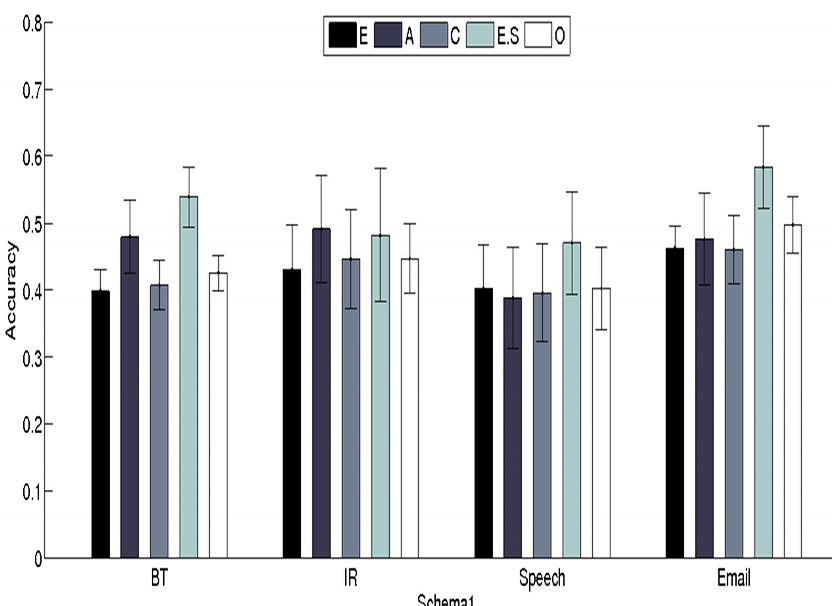 Figure 1: Performance of unimodal features. Note how Email data (EM) surprisingly excels in detecting Emotional Stability.
Key Feature Insights
The researchers used Sequential Floating Forward Selection (SFFS) to find the most "telling" features for each personality state. Some findings were counter-intuitive:
- Extraversion: While traits are usually linked to speech, states of extraversion were best identified through a combination of IR (F2F interaction) and Email behavior.
- Agreeableness: Heavily linked to "Social Context" features, such as the number of friends present in a given situation.
- Emotional Stability: Best predicted by digital communication patterns (Email) and Bluetooth proximity data.
Experiments & Results: The Social Context Multiplier
The study tested four schemas, moving from simple unimodal data to complex multimodal fusion including social context (the behavior of the people the subject was interacting with).
| Personality State | Highest Accuracy | Best Modality Combination | Improvement over Baseline |
|---|---|---|---|
| Emotional Stability | 71% | IR + Email (with Context) | +38% |
| Extraversion | 60% | IR + Email (with Context) | +27% |
| Conscientiousness | 59% | IR + Email (with Context) | +26% |
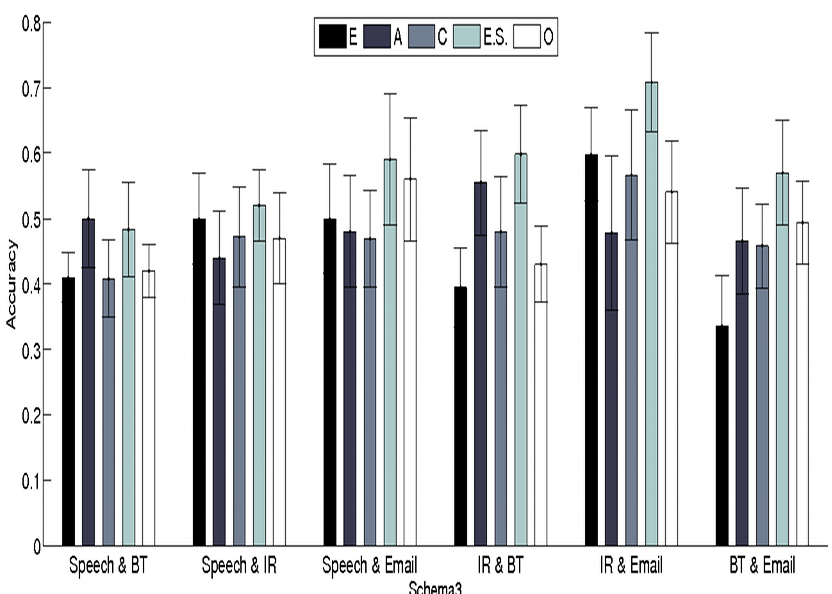 Figure 2: Performance gains via Multimodal Fusion. Speech + Email combinations (SP-EM) provided a significant boost for Openness and Extraversion.
Why Context Matters
The research highlights that for traits like Conscientiousness, knowing "where" the person is (Canteen vs. Meeting Room) and "who" they are with is vital. A conscientious "state" is often triggered by professional environments.
Critical Analysis & Conclusion
Takeaway
The "State-based" approach is the future of Human-Computer Interaction (HCI). Instead of an AI "knowing" you are an introvert, it "senses" you are currently in an introverted state and adapts its interface or tone accordingly.
Limitations
- Sample Bias: The study used 54 employees in a research institution, which is a specific social ecosystem.
- Model Simplicity: Utilizing SVMs was a robust first step, but deep temporal models (like RNNs or Transformers) could likely capture the "flow" of states more effectively.
- Gender Imbalance: The sample was 90.8% male, which may skew behavioral manifestations of certain Big Five traits.
Future Outlook
The shift from "What you are" to "How you are behaving now" opens doors for Smart Offices that can detect burnout (Emotional Stability drops) or Team Dynamics tools that can flag when a leader is failing to engage in an "Extraverted" state during critical phases.
The Bottom Line: Personality is a density distribution of moments. This paper gives us the mathematical tools to start measuring those moments.