
PMCFM: Decoding Social Media Popularity via Multimodal Context-Aware Recommendation
Multimodal Context-Aware Recommender for Post Popularity Prediction in Social Media
The paper introduces a Multimodal Context-Aware Recommender system for predicting the popularity (likes) of social media posts. By viewing popularity through a user-item-context popularity tensor and utilizing Factorization Machines (FM), the method effectively captures the interactions between specific users, items (topics/places), and multimodal content (visual and textual features).
TL;DR
Predicting the "viral" potential of a social media post has traditionally been treated as a content analysis problem. However, this paper shifts the paradigm by treating popularity as a recommendation task. By introducing the Multimodal Context-Aware Factorization Machine (PMCFM), the researchers from the University of Amsterdam demonstrate that popularity is a complex interaction between the user, the item (e.g., a tourist spot), and the multimodal context (image + text), outperforming standard regression models by over 14%.
Problem & Motivation: Beyond "One-Size-Fits-All" Models
Why does a picture of the Rijksmuseum get 2000 likes when posted by one user but only 20 when posted by another?
Existing SOTA methods often treat all posts as a flat dataset. They focus on what makes an image popular—like high contrast or specific tags—but ignore who is posting it and what item it represents. The researchers noticed three critical gaps:
- User Dependency: Different users have different follower bases and "styles."
- Item Context: A post about a popular brand or landmark has a different baseline popularity than a generic post.
- Multimodal Synergy: Textual sentiment and visual concepts work together to trigger engagement.
Methodology: The Popularity Tensor
The core innovation lies in the User-Item-Context Representation. Instead of a simple feature vector, the authors construct a Popularity Tensor.
1. The Interaction Model
The authors utilize Factorization Machines (FM) to model not just the linear impact of features, but the pairwise interactions between them. This allows the model to capture nuances like: "How does this specific user's style interact with this specific visual concept?"
The math behind it models the predicted popularity as: Where captures the latent interaction between any two components of the (User, Item, Context) triplet.
2. Multimodal Context
The "Context" isn't just a label; it's a rich representation:
- Visual: CNN-Pool5 features for global context, plus 15k+ ImageNet concepts and Adjective-Noun Pairs (ANP) for visual sentiment.
- Textual: Word2Vec (W2V) embeddings for tags and SentiStrength for textual sentiment.
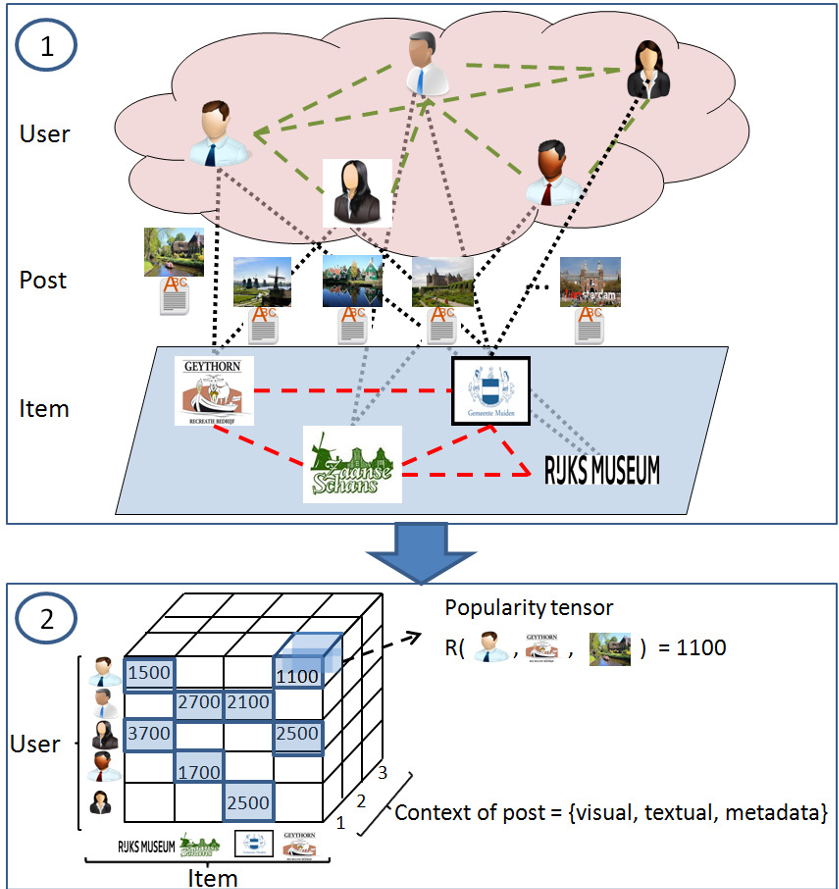 Figure 1: Transformation of user-item interactions into a popularity tensor for prediction.
Experiments & Results
The researchers crawled 600,000 Instagram posts related to tourism in the Netherlands. They tested two scenarios: User-Specific (predicting for a single user across many items) and Item-Specific (predicting across many users for a single place).
SOTA Comparison
The results were clear: the multimodal context-aware approach (PCFM/PMCFM) consistently beat baselines like SVR and Bipartite Graphs.
| Method | User-Specific (Rank Corr.) | Item-Specific (Rank Corr.) |
|---|---|---|
| Matrix Factorization (PFM) | 0.410 | 0.466 |
| Multimodal Context FM (PMCFM) | 0.592 | 0.610 |
Strategic Image Selection
Beyond just predicting a number, the model was used to select the best photo to share from a user's gallery. The PMCFM could accurately pick the top 10 most "likeable" images with 60-70% matching accuracy against the ground truth.
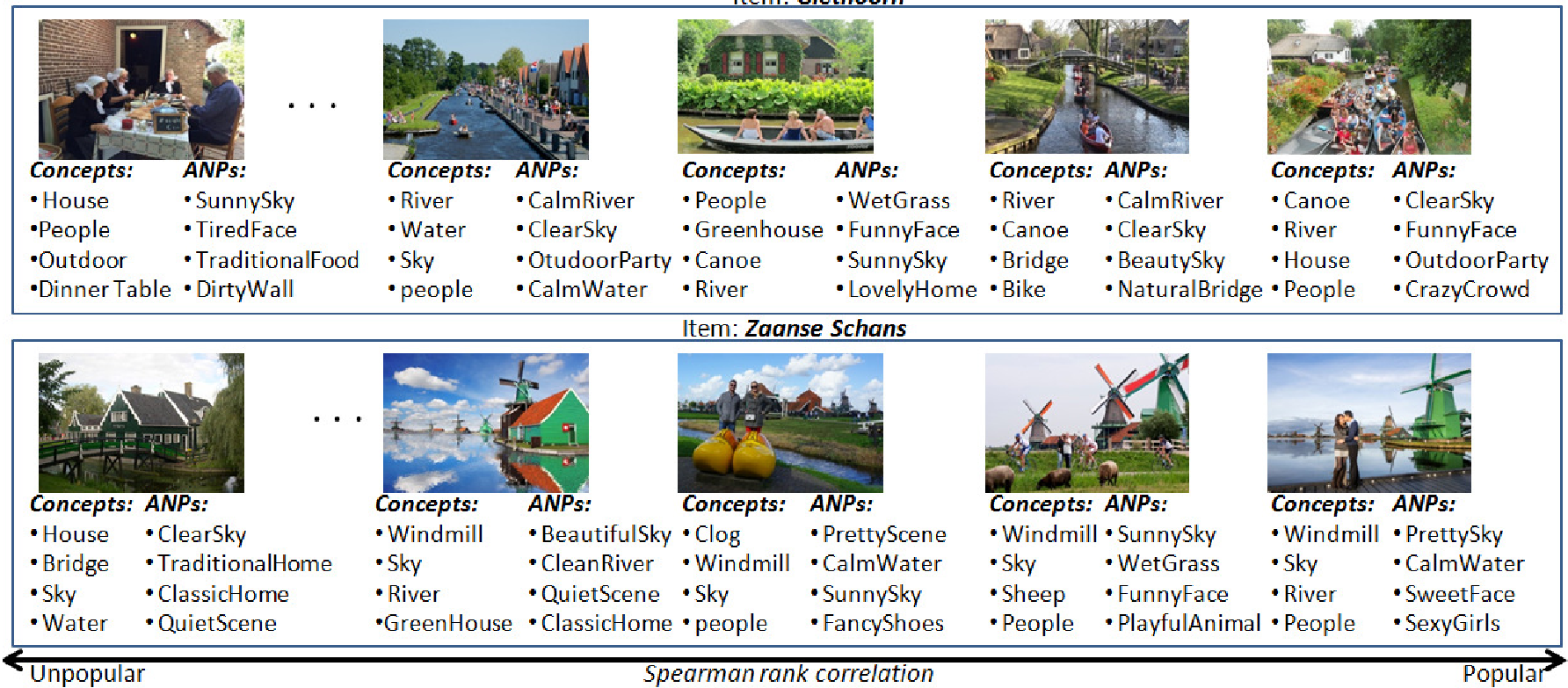 Figure 2: Top selected "Popular" vs "Unpopular" images for the item Giethoorn. Popular images correctly highlight key concepts like 'Canoe' and 'Bridge'.
Critical Insight & Conclusion
The main takeaway of this work is that Context is King, but Interaction is Queen. Simply knowing that "canoes" are popular isn't enough; you need to know how a specific user's audience reacts to canoes in the context of a specific location.
Limitations & Future Work
- Temporal Dynamics: The paper doesn't heavily account for time-of-day or seasonal trends (e.g., tulip photos in spring).
- Scalability: While FM is efficient, the cold-start problem for new users or items remains a challenge in tensor-based models.
This research provides a solid foundation for the next generation of social media marketing tools and personalized content recommendation engines.