
CNFN: Bridging the Gap Between Deep Learning Power and Fuzzy Logic Interpretability in Emotion AI
A multimodal convolutional neuro-fuzzy network for emotion understanding of movie clips
The paper introduces a Multimodal Convolutional Neuro-Fuzzy Network (M-CNFN) specifically designed for emotion understanding in movie clips. By integrating fuzzy logic into a deep learning framework, the authors fuse text, audio, and visual modalities to classify emotions while providing human-interpretable causal explanations for the model's decisions.
TL;DR
Researchers have developed a Multimodal Convolutional Neuro-Fuzzy Network (M-CNFN) that combines the feature-learning prowess of CNNs with the uncertainty-handling capabilities of Fuzzy Logic. By processing movie clips through text, audio, and visual streams, the model not only hits SOTA accuracy (83.2%) but also explains its logic through human-readable fuzzy rules and causal analysis.
The Problem: The "Black Box" vs. Emotional Ambiguity
Deep Learning has mastered many tasks, but it has a "certainty" problem. Standard CNNs are deterministic—they assign a hard value to a feature even if the data is vague. Emotions in movies are notoriously ambiguous: a smile could be happy or sarcastic (textual/visual conflict), and background music might contradict the dialogue.
The authors argue that current models lack:
- Ambiguity Representation: The inability to model "vague" inputs.
- Interpretability: CNNs don't tell us why they think a scene is "sad."
Methodology: Fuzzifying the Convolution
The core innovation is the Convolutional Neuro-Fuzzy Network (CNFN). Unlike a standard CNN, the CNFN includes:
- Fuzzification Layer: Converts crisp input values into fuzzy sets using Gaussian membership functions.
- Fuzzy Convolutional Layers: Instead of simple matrix multiplication, it uses min-max compositions of fuzzified kernels. This allows the network to extract high-level features while maintaining fuzzy logic's ability to handle imprecision.
- Direct LiNGAM & RFE: To prevent the model from becoming overwhelming, the authors use Causality Analysis (Direct LiNGAM) to find which hidden features actually cause the result, discarding the noise.
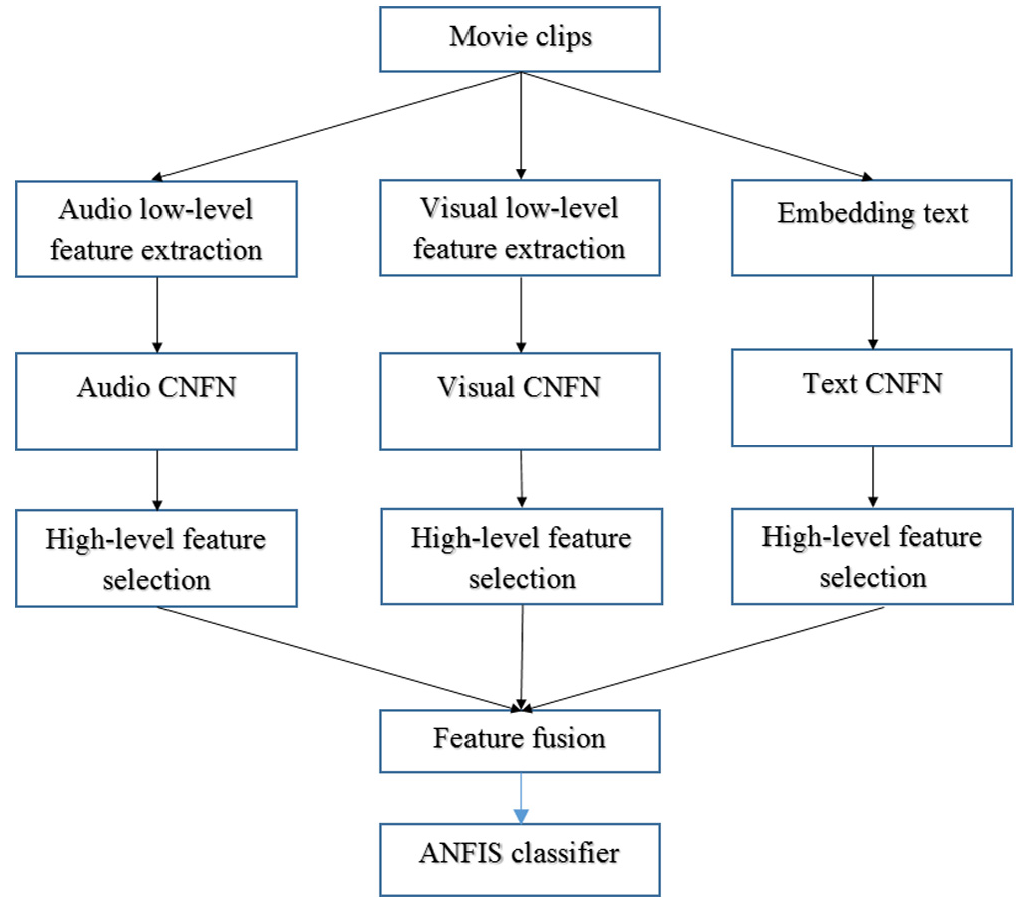 Figure 1: The proposed multimodal framework fusing Audio, Visual, and Textual streams through CNFN and ANFIS.
Experiments: Superior Performance and Visualization
The authors tested the model on the COGNIMUSE dataset. The CNFN consistently outperformed standard CNNs across all modalities:
| Modality | CNN Accuracy | CNFN Accuracy |
|---|---|---|
| Audio | 77.6% | 80.5% |
| Text | 63.4% | 65.1% |
| Visual | 78.9% | 82.8% |
| Multimodal | 79.7% | 83.2% |
Why does it work?
Using t-SNE visualization, the paper demonstrates that CNFN creates much cleaner clusters than CNN. The fuzzy operators allow the model to identify hidden patterns that deterministic filters miss.
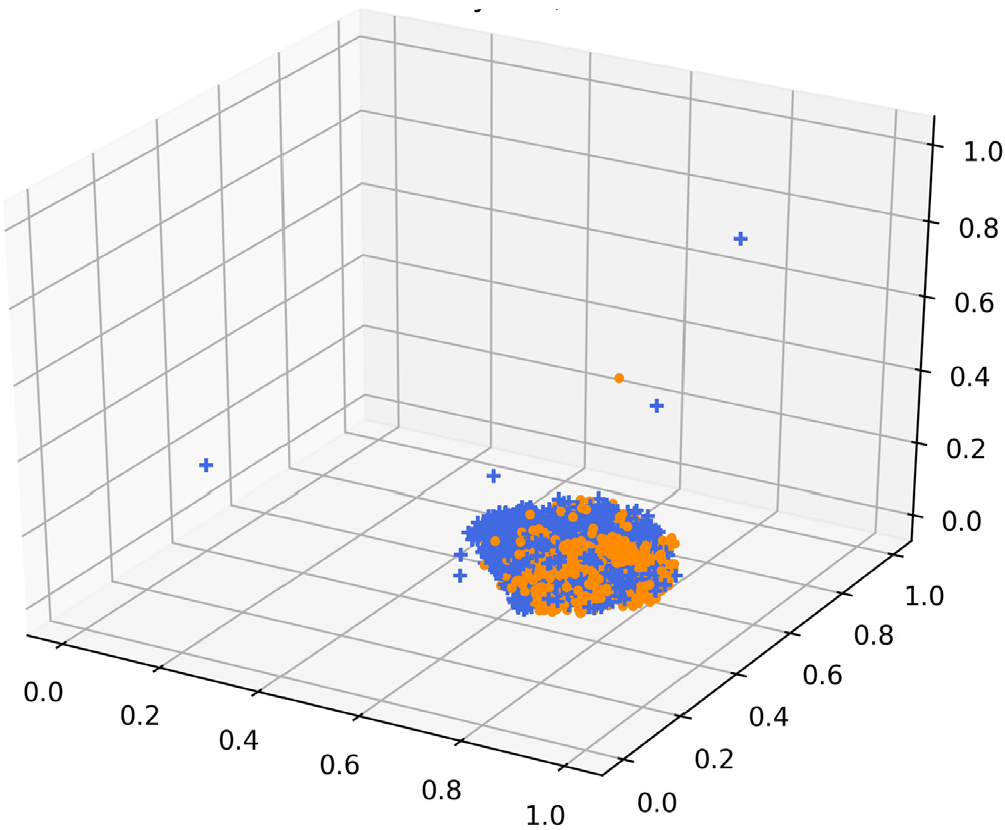 Figure 2: t-SNE distribution comparing CNN (left) and CNFN (right) features, showing superior class separation for the fuzzy approach.
Interpretable AI: Decoding the Decision
The standout feature of this research is its commitment to Interpretable AI (XAI).
- Causal Selection: The model identifies that for Visuals, Hue and 0-degree orientations trigger "Positive" emotions, while high Saturation often signals "Negative" emotions.
- Linguistic Rules: Using ANFIS, the model generates "If-Then" rules. For example: IF Audio Feature 1 is high AND Text Feature 8 is low THEN sentiment is Positive.
 Figure 3: Examples where CNFN correctly identified emotions in ambiguous clips where CNN failed (e.g., sarcastic subtitles).
Conclusion and Future Outlook
The CNFN marks a significant step toward Affective Computing that we can actually trust. By merging the structural power of Neural Networks with the reasoning power of Fuzzy Logic, the authors have created a framework that survives the "noise" of real-world cinema.
Future Work: The team plans to extend this into Deep Recurrent Neuro-Fuzzy Networks to better capture the temporal flow of emotions over longer sequences.