
MDDA: Breaking the Domain Barrier in Multimodal Social Media Rumor Detection
13097_Multimodal Disentangled Domain Adaption for Social Media Event Rumor Detection.
The paper introduces Multimodal Disentangled Domain Adaptation (MDDA), a novel framework for social media event rumor detection that utilizes disentangled representation learning and unsupervised domain adaptation to identify rumors in emerging events without labeled data.
TL;DR
Detecting rumors in "breaking news" is a race against time where labeled data is non-existent. The Multimodal Disentangled Domain Adaptation (MDDA) framework solves this by stripping away the "subject matter" of an event and isolating the "DNA" of a rumor—its writing style and visual patterns. By combining Disentangled Representation Learning with Unsupervised Domain Adaptation, MDDA achieves state-of-the-art results on emerging events where traditional models fail.
The Problem: The Content Entanglement Trap
Most rumor detection models are content-dependent. If a model is trained on rumors about a "Terrorist Attack," it learns keywords like police, attack, and shooting. When a new rumor emerges about a "Celebrity Scandal," the model is lost because the vocabulary and imagery have shifted entirely.
There are two core challenges:
- Entanglement: Rumor indicators (style) are buried within the specific topic (content).
- Domain Gap: Newly emerged events have zero labels, and the distribution of features varies wildly from historical data.
Methodology: Stylistic DNA Extraction
The MDDA framework operates on a brilliant intuition: Content varies, but the "flavor" of a rumor is invariant.
1. Multimodal Disentanglement
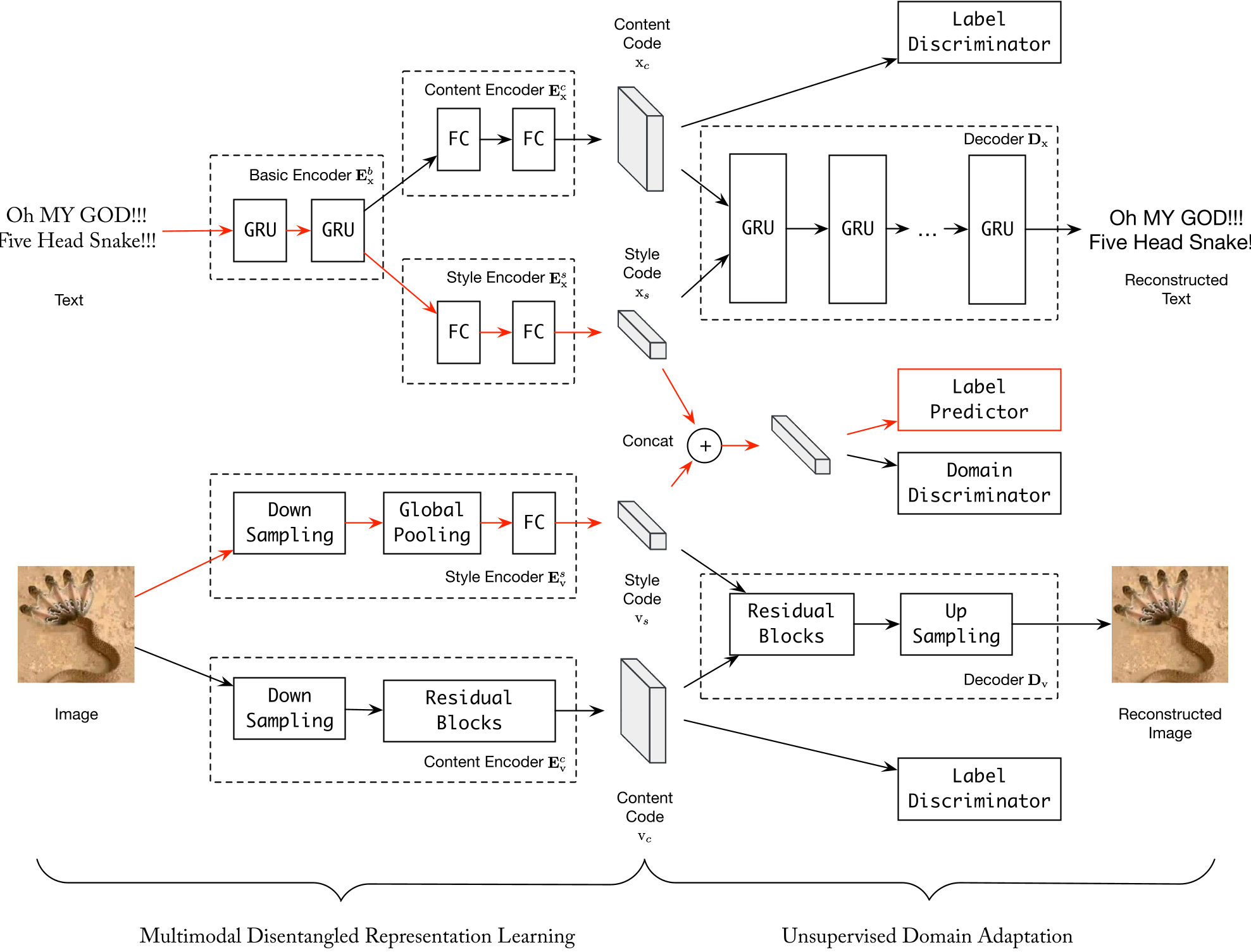
MDDA uses specialized encoders for both text (GRU-based VAE) and images (CNN with Instance Normalization). It splits the representation into two distinct latent spaces:
- Content Space: Captures what the post is about (e.g., "Paris," "Election").
- Style Space: Captures how it is presented (e.g., sensationalist language, specific visual filters).
To ensure this separation, the authors employ Adversarial Classifiers. A "style discriminator" tries to detect rumors from the content code; if it fails, it proves the content code is "clean" of label-related style info.
2. Domain Adaptation via Adversarial Games
To handle unlabeled target events, MDDA uses a Domain Adversarial Neural Network (DANN). A domain discriminator tries to guess whether a style feature came from the "Source Event" or the "Target Event." The encoders are trained to "fool" this discriminator, effectively forcing the model to ignore event-specific quirks and focus only on event-invariant rumor signatures.
Experiments & Results: Proving Robustness
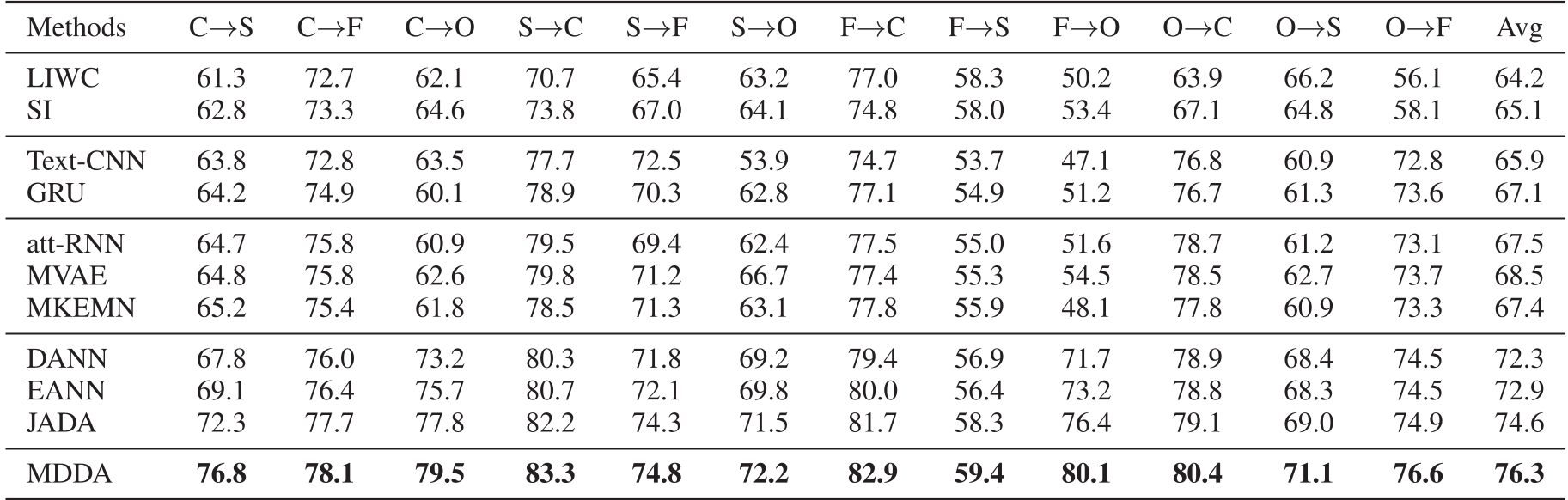
The researchers tested MDDA on 9 major events (e.g., Charlie Hebdo, Germanwings Crash).
Key Findings:
- Superiority over SOTA: MDDA outperformed traditional CNNs/GRUs and even advanced multimodal models like MVAE and EANN.
- The Power of Disentanglement: Even a version of MDDA without visual features (MDDA w/o V) outperformed some multimodal baselines, proving that how you represent data matters more than just how much data you have.
- Visualizing the Latent Space: Using t-SNE, the authors showed that rumors and non-rumors were clearly separated in the "Style Space" but mixed in the "Content Space"—a visual proof that style is the true signal.
Critical Insight: Why This Matters
The breakthrough here isn't just "higher accuracy." It is the shift from Recognition (recognizing known rumors) to Generalization (detecting the form of a rumor).
Limitations
- Data Scarcity: Performance drops slightly on "tiny" events (e.g., the Michael Essien Ebola rumor) where the style might be too unique.
- Modality Bias: Since not all tweets have images, the visual style space is naturally less discriminative than text.
Conclusion
MDDA represents a shift toward "zero-shot" style detection in social media forensic analysis. By treating rumor detection as a cross-domain adaptation problem rather than a simple classification task, we can finally keep up with the rapid, "entangled" nature of misinformation in the digital age.