
Multimodal Emotion Classification: Emojis are the Key to Human Affect
Multimodal Emotion Classification
This paper presents a multimodal framework for emotion classification on Instagram, leveraging the synergy between text, emojis, and images. By utilizing ResNet-152 for visual features and a Bi-LSTM with an attention mechanism for textual/emoji content, the authors achieve a state-of-the-art accuracy of 71.98%.
TL;DR
Researchers from IIT Kharagpur and Wright State University have developed a deep learning framework that treats Instagram posts as a tripartite data source: Text, Images, and Emojis. By leveraging EmojiNet to decode the "senses" of emojis and fusing them with visual ResNet features, they achieved a high accuracy of 71.98% in classifying seven distinct emotions, proving that emojis are not just decorations—they are a linguistic modality of their own.
Problem & Motivation: The Ambiguity of Social Media
Most Natural Language Processing (NLP) and Computer Vision (CV) tasks suffer from a common bottleneck: the lack of high-quality labeled data. In the wild world of social media, emotions are rarely expressed through plain dictionary English. Instead, users rely on a complex interplay of visual cues, sarcastic captions, and a heavy reliance on emojis to set the "tenor" of a message.
The authors identify two major gaps in prior work:
- Modality Isolation: Most researchers focus on either text or images, missing the complementary information.
- Emoji Underutilization: Emojis were often used merely as labels, but their internal semantic "senses" (e.g., a "sun" emoji meaning summer vs. happiness) were rarely modeled.
Methodology: The Fusion Architecture
The paper proposes a sophisticated pipeline to capture the "Why" and "How" of digital emotion.
1. Decoding Emojis with EmojiNet
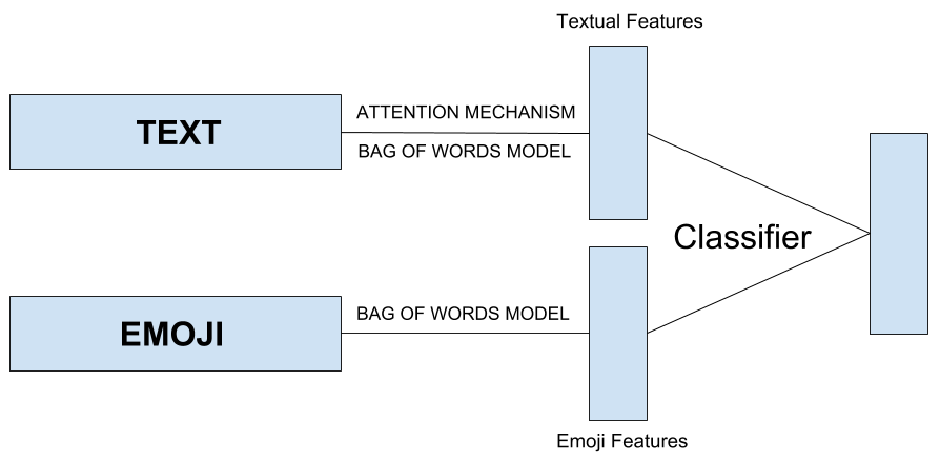
Instead of treating emojis as random discrete tokens, the authors use EmojiNet to extract "Sense Definitions" and "Sense Forms." This allows the model to understand that a heart emoji ❤️ relates to "love" or "fondness" semantically. They use a Bag-of-Words model to project these emoji definitions into the same 300-dimensional vector space as the text.
2. The Narrative Flow (Text + Emoji)
The architecture uses a Bi-Directional LSTM with Attention. Interestingly, the authors found that treating emojis as part of the text sequence (sequential input) yielded better results than processing them separately. This confirms the linguistic intuition that the meaning of an emoji is context-dependent.
3. Visual Context (ResNet-152)
To handle the image component, the study employs ResNet-152, a 152-layer deep residual network. While images alone are quite noisy for emotion detection (achieving only ~30% accuracy), they provide the necessary "grounding" when fused with the caption.
Experiments & Results: The Power of Three
The results confirm a clear hierarchy of information density: Multimodal > Text+Emoji > Text > Image > Emoji.
- Unimodal Performance: Images were the weakest link (29.6% F1), likely because social media photos (e.g., a photo of a coffee cup) are often emotionally ambiguous without the caption.
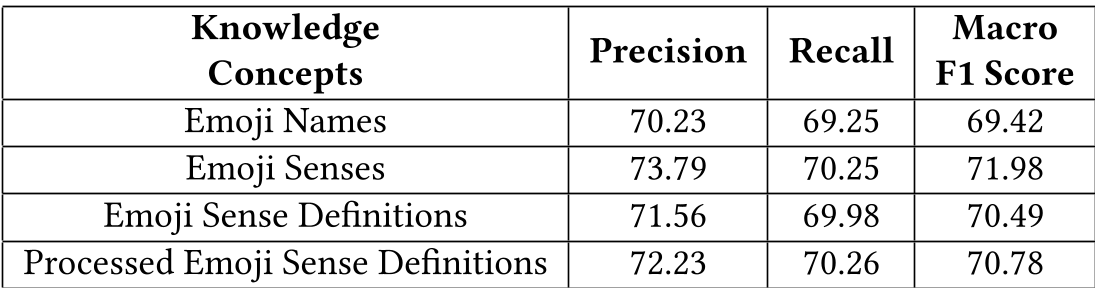
- The Emoji Boost: Adding emoji embeddings to the text boosted the F1-score from ~60% to over 65%.
- The Final Fusion: By combining all three modalities, the model achieved its peak performance.
Key Insights:
- Length Matters: The authors discovered that after a caption length of 80 words, accuracy plateaus. Social media emotion is typically "bursty" and concentrated.
- Sequence is King: Emojis function like words. The Bi-LSTM's ability to see an emoji in its textual neighbors is what drives the accuracy gain.
Critical Analysis & Conclusion
Takeaway
This work highlights that for modern AI to understand human sentiment, it must be "digitally literate"—meaning it must understand emojis as a semantic system, not just a set of icons. The integration of EmojiNet serves as a vital bridge between raw data and psychological concepts.
Limitations & Future Work
One notable limitation is the focus on English-only posts. Social media is inherently multilingual, and emojis often cross language barriers in unique ways. The authors suggest that transfer learning and human-annotated test sets (to move beyond hashtag-based distant supervision) are the next logical steps for the field.
In summary, if you want to know how a user feels, don't just look at the photo or read the text—look at the 😭 or the ✨. They contain the metadata of the human heart.