
FBP-AL: Elevating Multimodal Emotion Recognition via Factorized Bilinear Pooling and Adversarial Learning
Multimodal Emotion Recognition with Factorized Bilinear Pooling and Adversarial Learning
This paper introduces a novel Multimodal Emotion Recognition framework that combines Factorized Bilinear Pooling (FBP) for sophisticated feature fusion with an Adversarial Learning (AL) mechanism. By integrating ResNet-based visual features and Bi-LSTM-based textual features, the model achieves state-of-the-art performance on the extended FI dataset, specifically targeting 8-category fine-grained emotion classification.
TL;DR
Recognizing human emotion from social media is challenging due to the abstract nature of feelings and the "semantic gap" between raw data and high-level perception. This paper presents FBP-AL, an end-to-end framework that fuses visual and textual data using Factorized Bilinear Pooling and refines these features through Adversarial Learning. The results? A new SOTA on the FI dataset with an 80.7% accuracy.
Context & Motivation
In the era of social networks, emotions are rarely expressed through a single medium. A "happy" caption might accompany a smiling face, or a "beautiful nature" text might complement a serene landscape.
Previous SOTA methods suffered from two main flaws:
- Single-modality bias: Relying solely on images or text ignores the complementary nature of multimodal data.
- Linear Fusion Limitations: Simply concatenating vectors (Feature Fusion) doesn't allow the model to learn the "math" of how a specific word interacts with a specific image region.
The authors' insight was to treat multimodal fusion as a complex interaction problem and a distribution alignment problem simultaneously.
Methodology: The Core Engine
The FBP-AL architecture consists of two revolutionary components replacing the standard "concatenate and classify" pipeline.
1. Factorized Bilinear Pooling (FBP)
Bilinear pooling is powerful because it calculates the outer product of two vectors, capturing every possible interaction between visual () and textual () features. However, the parameter explosion is massive. FBP solves this by factorizing the weight matrix into low-rank matrices.
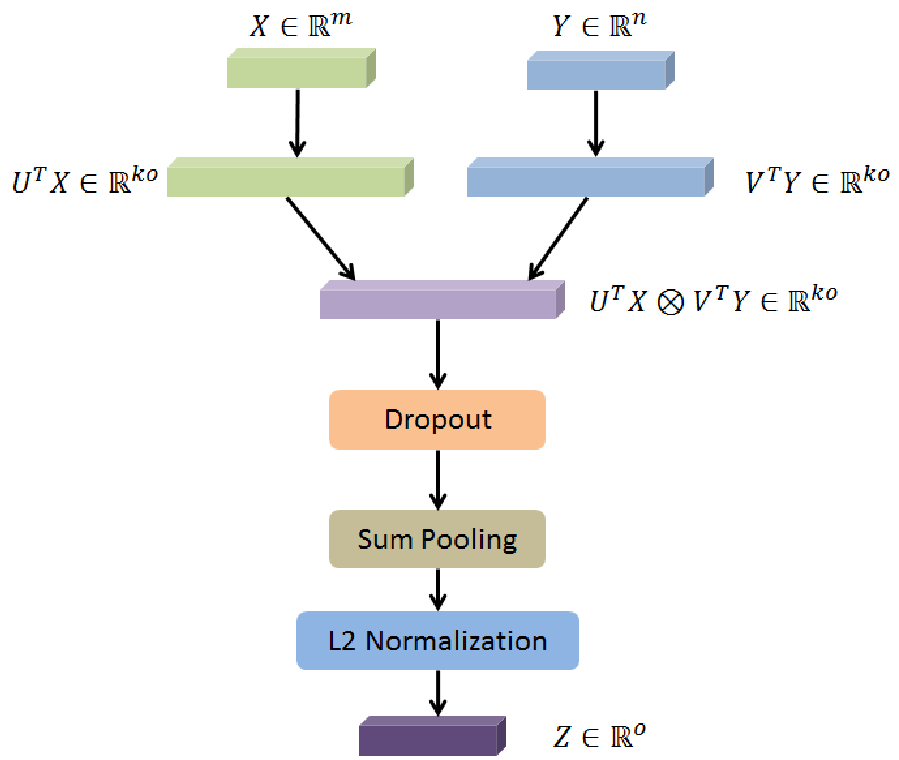 Figure: The FBP module facilitates effective inter-modality interaction via sum-pooling and element-wise products.
2. Adversarial Learning (AL) Module
The authors introduce a "hidden" task. Beside the Emotion Classifier (EC), they add a Multimodal Fusion Classifier (MFC).
- The Game: The MFC tries to identify the "source" of the fusion (e.g., whether the input is a matched pair or a permuted pair).
- The Goal: By training the generator to "fool" or compete against these classification losses, the model is forced to learn representations that are robust and purely focused on the emotional signal rather than the noise of modality differences.
Experimental Validation
The model was tested on the Extended FI Dataset (22,000+ images with crawled text).
SOTA Comparison
| Algorithm | Accuracy (ACC) | MAP |
|---|---|---|
| Visual (Fine-tuned CNN) | 58.3% | 50.4% |
| Text (SVM) | 71.0% | 65.5% |
| Multimodal (Late-BMA) | 76.0% | 69.6% |
| FBP-AL (Ours) | 80.7% | 76.3% |
The jump from 76% to 80.7% is substantial in the context of fine-grained (8-class) emotion recognition, where categories like "Excitement" and "Amusement" are notoriously difficult to distinguish.
Ablation Insights
The ablation studies confirmed that using FBP instead of simple concatenation improved performance across almost all categories, notably in "Awe" and "Contentment." Furthermore, the loss curves indicate that adversarial training acts as a "directional guide," leading the model to a deeper local minimum than standard training.
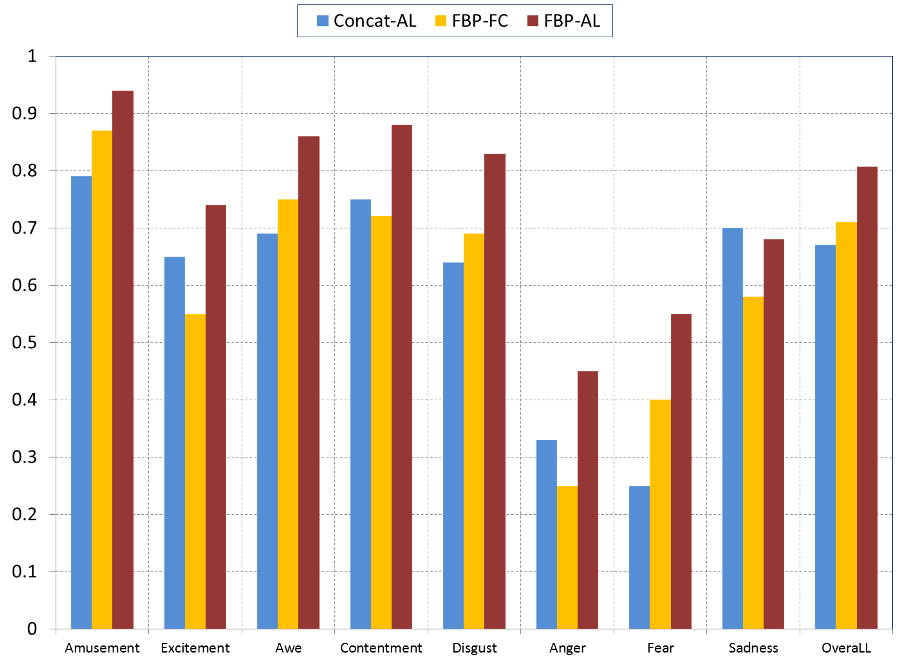 Figure: Performance comparison across 8 emotional categories showing the superiority of FBP-AL.
Critical Analysis & Conclusion
Takeaway
The strength of this work lies in its move away from "black-box" concatenation toward structured interaction. By using FBP, the model achieves the expressive power of bilinear models without the computational overhead.
Limitations
Despite the gains, the model still struggles with "Anger" and "Fear," often misclassifying them as "Sadness." This suggests that even with FBP, the "affective gap" for high-arousal negative emotions remains a hurdle. Additionally, the textual data was crawled via URLs, which may introduce noise if the metadata isn't strictly emotional.
Future Work
The next step for this lineage of research would likely involve Cross-modal Attention (Transformers) to focus on specific image regions mentioned in the text, further narrowing the semantic gap.