
TikTec: Unmasking COVID-19 Misinformation in the TikTok Era through Multimodal Co-Attention
10008_A Multimodal Misinformation Detector for COVID-19 Short Videos on TikTok.
This paper introduces TikTec, a multimodal deep learning framework specifically designed for detecting COVID-19 misinformation in TikTok short videos. It achieves SOTA performance by integrating visual, audio, and textual features, outperforming strong baselines like 3D-ResNet with a 6.1% improvement in accuracy on a real-world TikTok dataset.
TL;DR
TikTok has become a breeding ground for COVID-19 misinformation, where misleading claims are often buried in a mix of fast-paced visuals, catchy audio, and superimposed text. TikTec is a new framework that treats these modalities as a unified signal. By using speech and captions to "guide" visual attention, it filter out noise and identifies the subtle contradictions that characterize fake news, achieving a significant 6.1% accuracy boost over previous SOTA models.
Background: Why TikTok is a Hard Nut to Crack
Traditional misinformation detection usually looks for "forgeries" (like Deepfakes) or analyzes text-based "fake news." However, TikTok creators often use composed misinformation:
- The Component is Benign: A video of a man with a coin on his arm is just a video.
- The Context is Toxic: When paired with audio claiming "the vaccine makes you magnetic," it transforms into dangerous health misinformation.
Existing computer vision models get "distracted" by TikTok's aggressive editing—filters, stickers, and fast cuts—making it difficult to pinpoint the actual misleading evidence.
The Core Innovation: Guiding Sight with Sound
The authors argue that we cannot understand the video without the "script." TikTec breaks the problem into three sophisticated modules:
1. Caption-guided Visual Representation Learning (CVRL)
Instead of letting a CNN scan the whole frame blindly, TikTec extracts captions (both from the audio track and the text overlays on screen). These captions act as a "flashlight," guiding the model to focus on specific object regions (detected via Faster R-CNN) that are semantically relevant to the claims being made.
2. Acoustic-aware Speech Representation (ASRL)
Misinformation isn't just about what is said, but how. TikTec combines text embeddings (GloVe) with acoustic features (MFCC) to capture the tone, volume, and emphasis of the speaker, providing a richer context than simple transcriptions.
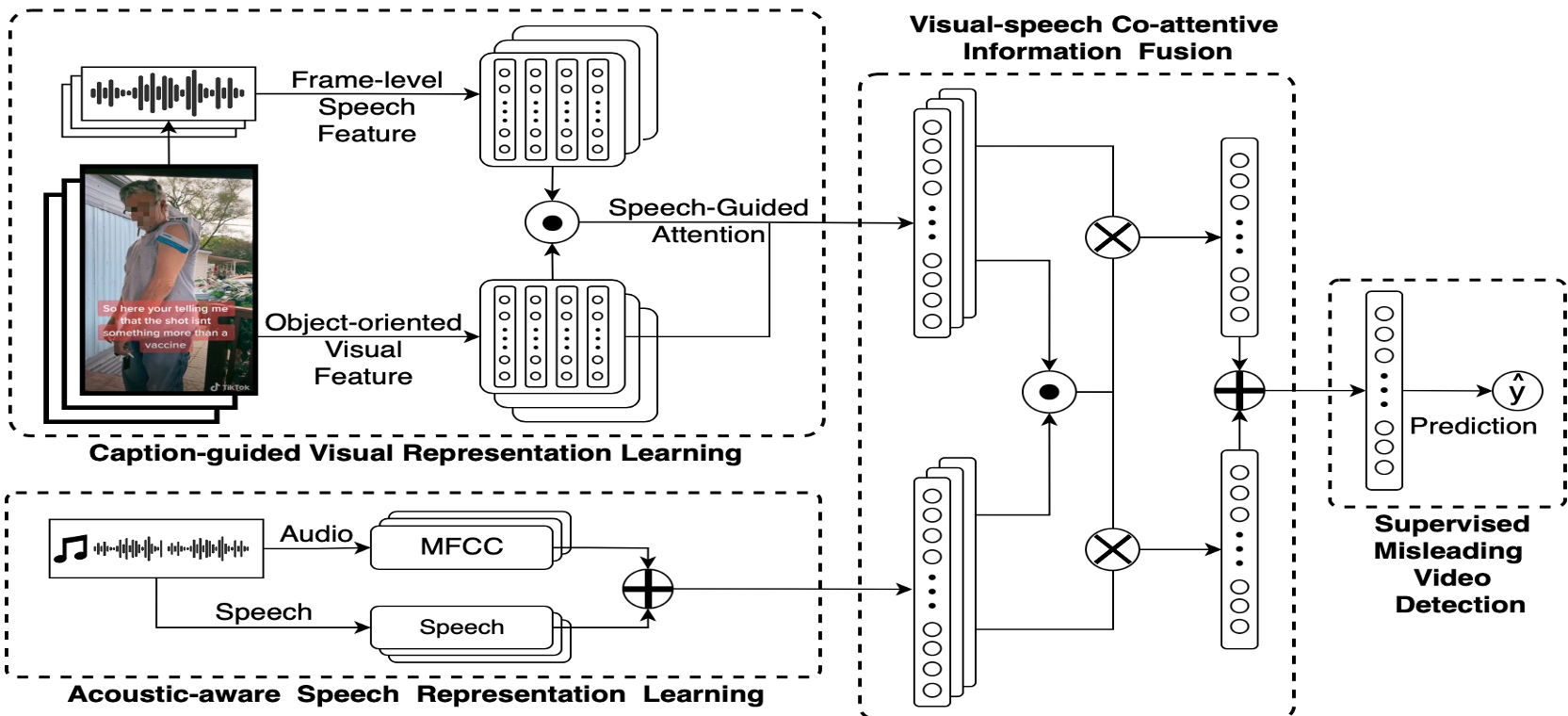
3. Visual-Speech Co-Attention (VCIF)
This is the "secret sauce." The Co-attentive Information Fusion module builds an affinity matrix between every video frame and every spoken word. This allows the model to "realize," for example, that the visual of a "magnetic arm" and the spoken word "shot" are the two most important features to correlate for a final verdict.
Proven Results: Outperforming the Baselines
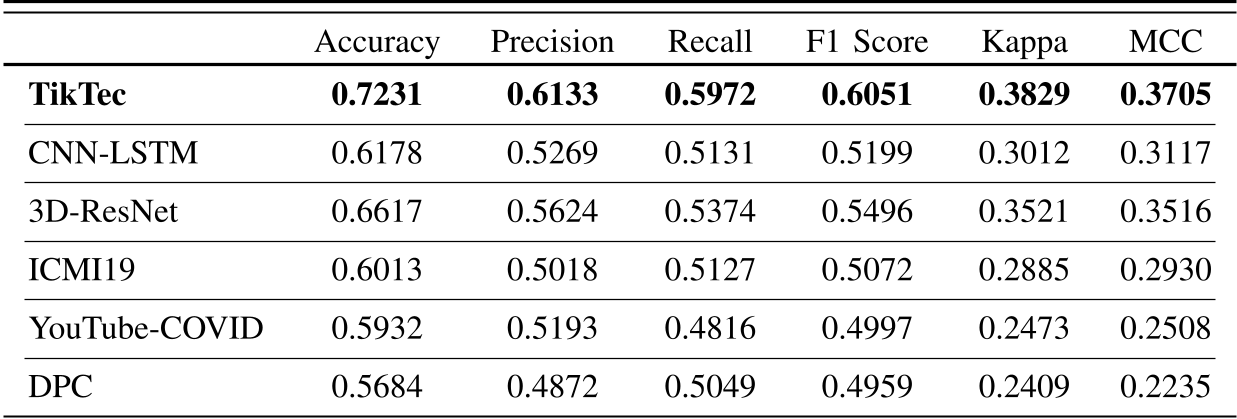
The researchers curated a dataset of 891 TikTok videos, rigorously fact-checked via sites like Factcheck.org.
| Method | Accuracy | F1 Score | Kappa |
|---|---|---|---|
| TikTec | 0.7231 | 0.6051 | 0.3829 |
| 3D-ResNet | 0.6617 | 0.5496 | 0.3521 |
| YouTube-COVID (Comment-based) | 0.5932 | 0.4997 | 0.2473 |
Notably, methods that relied on user comments (YouTube-COVID) performed poorly. This confirms the "echo chamber" effect: users on TikTok often lack medical expertise and tend to endorse/comment positively on fake news, which provides a "false signal" to metadata-reliant detectors.
Critical Insight: The "Speech" Imperative
An ablation study revealed that removing the Speech component caused a sharper drop in performance than removing the Visual component. This suggests that in the realm of short-video misinformation, the audio track is the primary vehicle for spreading "alternative facts," while the video often serves as mere illustrative (and often distractive) support.
Conclusion & Future Outlook
TikTec proves that misinformation detection must evolve from "looking for pixel-level edits" to "understanding cross-modal semantics."
Limitations: The current model focuses on English-speaking TikTok. In the future, expanding this to multi-lingual environments and incorporating real-world knowledge graphs (to check facts against a medical database in real-time) would be the next logical step toward a global, automated "TikTok Fact-Checker."