
Zeno the Mediator: Breaking Social Barriers in Autism Therapy through Multimodal Robotics
A multimodal and multilevel system for robotics treatment of autism in children
The paper presents a multimodal robot-assisted system using the Robokind Zeno R25 humanoid for treating Children with Autism Spectrum Disorder (ASD). It introduces a multilevel therapeutic protocol focusing on eye contact, joint attention, body imitation, and facial expression recognition, where the robot acts as a social mediator.
TL;DR
Researchers have developed a sophisticated, multilevel robotic system designed to assist in the behavioral treatment of children with Autism Spectrum Disorder (ASD). By utilizing the Zeno R25 humanoid robot, the system automates the "Stimulus-Response-Reinforcement" loop of traditional therapy. Preliminary results indicate a significant "bottleneck break" in social engagement, with children dramatically reducing the time it takes to make eye contact and react to social cues after just a few sessions.
Perspective: The Robot as a Social Bridge
Autism therapy is often a grueling, repetitive process where human therapists must maintain infinite patience to elicit basic social signals like eye contact or joint attention. The core insight of this paper is that children with ASD often find robots less intimidating and more predictable than humans. By positioning the robot not as a replacement for the therapist, but as a Social Mediator, the system leverages the "Inductive Bias" that robots are safer interaction partners for neurodivergent minds.
Methodology: The Multimodal Architecture
The system's "intelligence" is split into two critical layers that work in a tight feedback loop:
- Social Signal Manager (SSM): Utilizing a Kinect sensor and the robot's onboard 5MP camera, the system tracks 32 geometric facial features and 3D body posture. This allows the robot to "know" if the child is actually looking at it or successfully imitating a gesture.
- Behavior Plan Manager (BPM): This carries out the therapeutic protocol. Unlike static programs, this is multilevel. If a child struggles, the therapist can dial back the difficulty (e.g., adding more verbal prompts); as the child improves, the reinforcement (like music) is faded out to encourage natural social behavior.
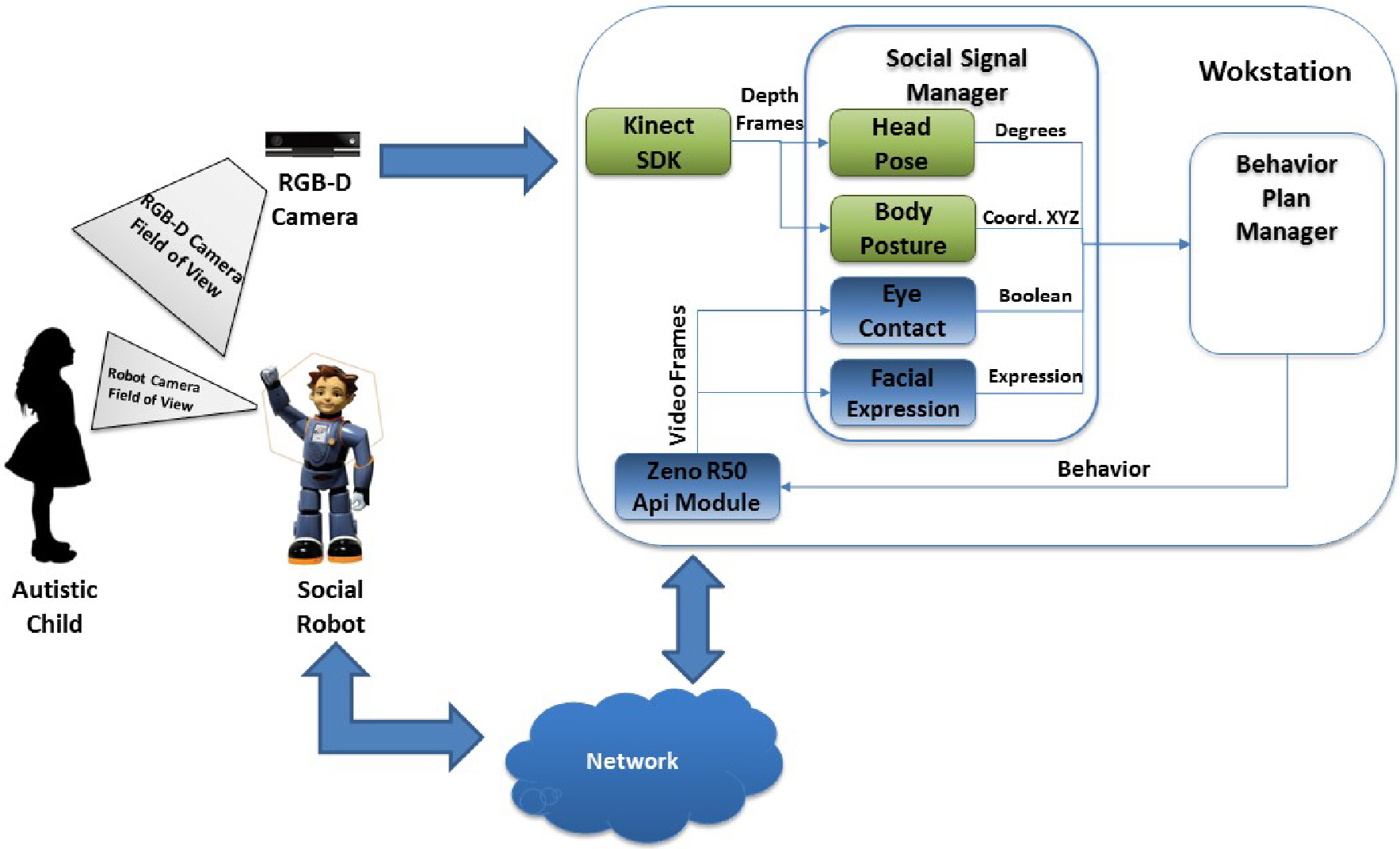 The architecture highlights the bidirectional interaction between the child's social signals and the robot's behavioral responses.
The Protocol: Four Pillars of Interaction
The system targets four fundamental social deficits in ASD:
- Eye Contact: Training the child to orient towards a speaker.
- Joint Attention: Following the robot’s gaze or gesture toward an external object.
- Body Imitation: Mimicking gross motor movements (e.g., raising an arm).
- Facial Expression Imitation: The most complex level, requiring the child to recognize and reproduce emotions like happiness, sadness, anger, and fear.
Experimental Insights & Results
The study conducted a "before and after" comparison across two sessions (S1 and S2). The data revealed a striking trend: Processing Speed.
- Eye Contact Latency: For two of the three subjects (C2 and C3), the time taken to look at the robot dropped by over 60%.
- Imitation Speed: Subjects C1 and C2 showed a massive leap in how quickly they attempted to mirror the robot's facial expressions.
- Accuracy Stability: Interestingly, while the speed improved, the accuracy of the expressions (nRFI) didn't see a massive statistical jump immediately. This suggests that the robot helps with engagement and attention first, while the actual skill acquisition requires more prolonged exposure.
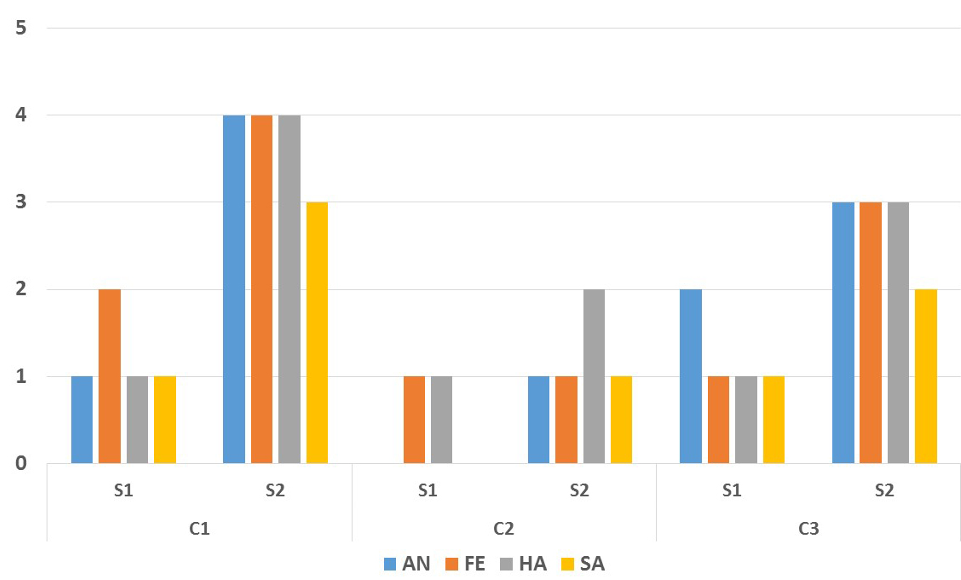 Graph showing the number of correctly imitated expressions across different emotions. Happiness and Anger saw the most notable improvements between sessions.
Critical Analysis & The Path Forward
While the results are promising, the study is a "Preliminary Study" with a small cohort (). The limitation is the "Novelty Effect"—would children remain this engaged after 20 sessions?
However, the value here isn't just in the tech, but in the multilevel customization. By allowing the robot to scale difficulty, it solves a major pain point in clinical settings where "one size fits all" software fails. Future work needs to integrate more robust computer vision (perhaps Transformers-based pose estimation) to handle children who move erratically, ensuring the "Social Signal Manager" remains locked on even during high-activity sessions.
Takeaway: Robotics is moving from being a "toy" in the therapy room to a data-driven "mediator" that can quantify a child's progress with millisecond precision.