
Beyond the Screen: How Collaborative Context Unlocks Automated Personality Recognition
Multimodal recognition of personality traits in human-computer collaborative tasks
This paper presents a multimodal approach to automatically recognize the "Big Five" personality traits in Human-Computer Interaction (HCI) using 2-5 minute video samples. By employing a simulated Map Task with varying levels of computer collaboration, the study achieves significant classification accuracy for Emotional Stability and Extraversion using acoustic and visual non-verbal cues.
TL;DR
Can a computer tell if you are an introvert or high in neuroticism just by "annoying" you a little? This research investigates the automatic detection of the Big Five personality traits during a Human-Computer collaborative task. By varying how "helpful" or "aggressive" a computer simulates itself to be, the authors found that certain traits, like Emotional Stability, are highly visible across all settings, while others, like Agreeableness, only surface when the computer acts in a specific, moderately non-collaborative way.
Background Positioning
In the landscape of HCI, this work acts as a bridge between traditional trait psychology and modern signal processing. It moves beyond static "self-reports" and dives into behavioral elicitation, proving that to see someone's true personality, the system must interact with them dynamically rather than just observing them passively.
Problem & Motivation: The Masking Effect
Why is it so hard for AI to recognize personality? The "Trait Activation Theory" suggests that if the environment is too neutral, people's natural dispositions remain hidden. Prior works often focused on human-to-human interaction, which is inherently different from how we treat machines. The authors hypothesized that by manipulating the Collaboration Level (CL) of the computer, they could "force" different personality traits to manifest through speech and movement.
Methodology: The Elicitation Framework
The researchers used a modified Map Task, where a human participant guides a "machine" (actually a simulated experimenter) through a path on a map.
1. The Interaction Variables
The "machine" utilized four distinct behaviors:
- CL1 (Full Collaboration): Enthusiastic and trusting feedback.
- CL2 & CL3 (Intermediate): Ranging from neutral to mildly unhelpful.
- CL4 (Non-Collaborative): Aggressive and offensive (e.g., "Learn to explain yourself better!").
2. Feature Engineering
The system analyzed two primary streams of data:
- Acoustic: Pitch, intensity, and turn-taking dynamics (extracted via Praat and GMM-based diarization).
- Visual: Motion Vector Magnitude (MVM) and Residual Coding Bitrate (RCB). Interestingly, they used "compressed domain" features, which look at how the video is encoded to estimate motion without heavy pixel-level processing.
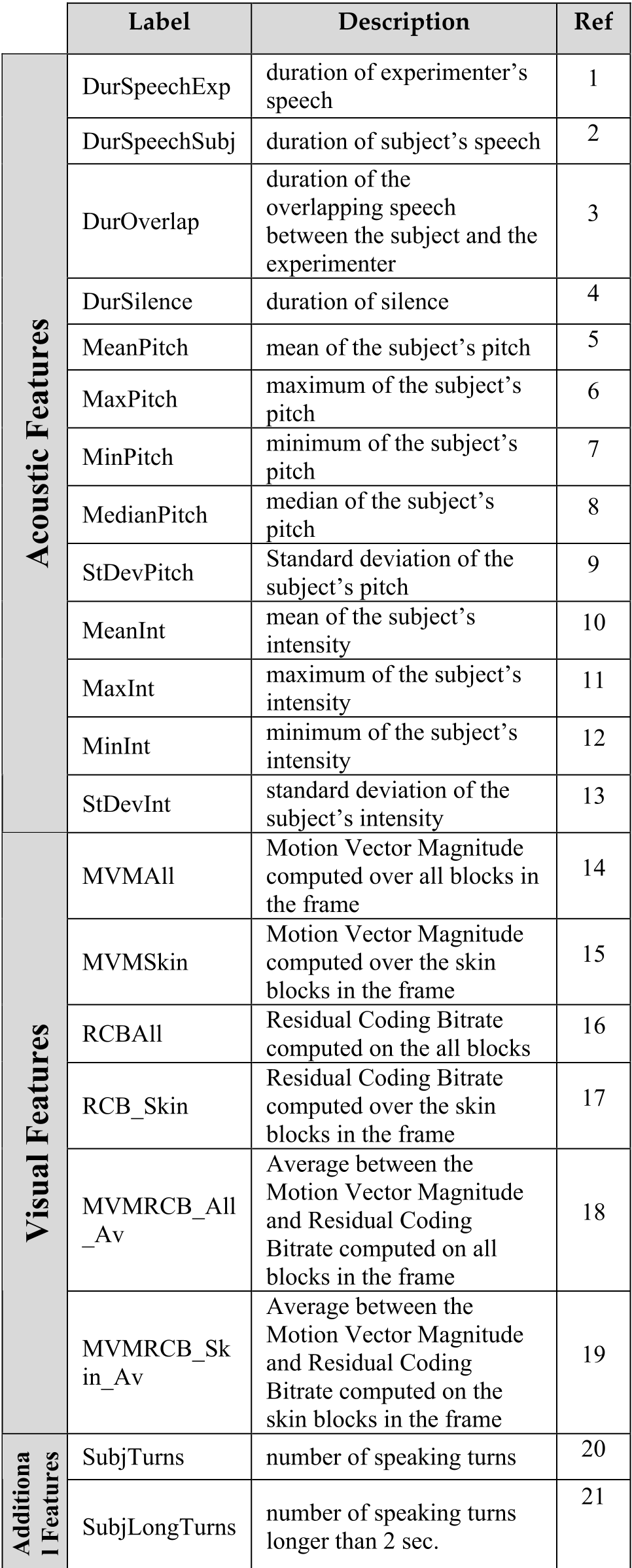 Table: Summary of the Acoustic and Visual features extracted for the SVM classifiers.
Experiments & Results: The Highs and Lows
The classification was performed using Support Vector Machines (SVM) with a linear kernel.
Key Findings:
- Emotional Stability/Neuroticism: Could be detected in almost every CL setting. Anxious people responded to non-collaboration with specific pitch changes, while collaborative settings elicited different but equally predictable vocal markers.
- Extraversion: Detected best in CL2 (Intermediate). Extraverts tended to have longer speaking turns and higher intensity when the computer was slightly less than perfectly helpful.
- The "Invisible" Traits: Creativity (Openness) remained elusive. The structured nature of the Map Task likely suppressed creative expression, effectively "masking" this trait.
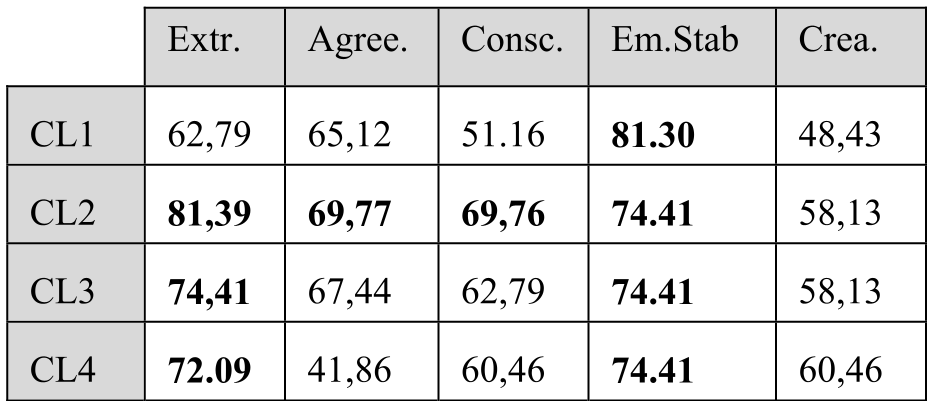 Experimental Results: Note the high accuracy (0.81) for Extraversion and Emotional Stability compared to the baseline.
Critical Analysis & Conclusion
Takeaway
The core contribution here isn't just the accuracy—it's the validation that context matters. A machine cannot reliably judge personality if it is a passive observer. To truly "know" the user, the AI might need to strategically vary its own level of cooperation to see how the user reacts under pressure or ease.
Limitations & Future Work
- Sample Size: With only 43 subjects, the results are an "exploratory" success but require larger-scale validation.
- Language Specificity: The study was conducted in Italian; cross-cultural behavioral differences in response to "aggressive machines" remain an open question.
- Next Steps: Future AI might use Personality States—tracking how a person drifts between introverted and extroverted behaviors during a single session—to build a more nuanced profile.
This research lays the groundwork for "personality-aware" assistants that don't just follow orders, but understand who is giving them.