
Decoding Instagram Popularity: A Multimodal Marketing Approach
3875_Multimodal Popularity Prediction of Brand-related Social Media Posts.
This paper introduces a multimodal approach for predicting the popularity of brand-related posts on Instagram by extracting "Engagement Parameters" inspired by marketing theory. Using a dataset of 75,000 fast-food brand posts, the authors demonstrate that integrating visual and textual sentiment with automated marketing-inspired cues significantly outperforms traditional low-level feature baselines.
TL;DR
Why do some brand posts go viral while others vanish? Researchers from the University of Amsterdam have moved beyond simple "pixel-pushing" to solve this. By integrating marketing theories (like vividness and brand centrality) into a machine learning pipeline, they successfully predicted post popularity on Instagram with double the accuracy of standard visual-text models.
The Missing Link: Why Pixels Aren't Enough
In the world of social media analytics, predicting "Likes" has traditionally been treated as a technical challenge: extract enough SIFT features or CNN vectors, and the model will learn. However, brand engagement is psychological, not just visual.
Existing research on Flickr or Twitter doesn't translate well to Instagram's brand ecosystem. A high-quality photo of a sunset (Aesthetics) is not the same as a photo of a "Big Mac" shared during a social outing (Brand Engagement). The authors identified that the Brand Context—the presence of logos, products, and social interaction—was the missing variable in current SOTA models.
Methodology: The "Engagement Parameter" Layer
The core innovation is a mid-level feature layer that translates raw visual/textual data into marketing-relevant cues.
1. The Architecture
Instead of mapping images directly to a popularity score, the system passes data through an intermediate layer of nine "Engagement Parameters."
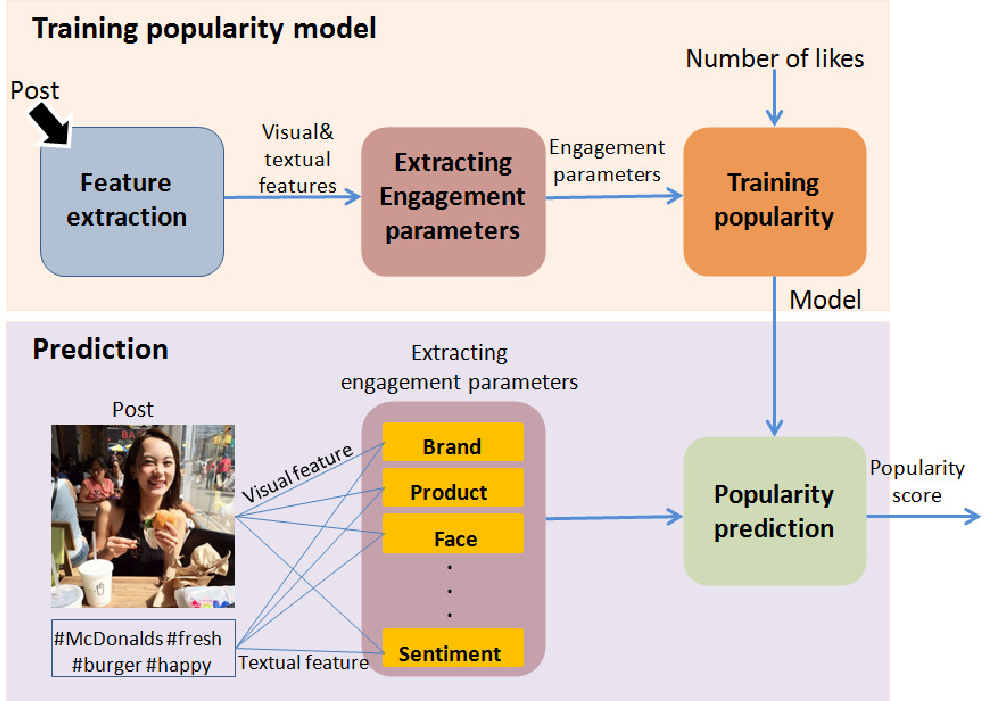
2. Key Engagement Cues
- Brand & Product: Automated detection of logos and food items using Google Vision API and Freebase.
- Social Context: Distinguishing between a "Person with a Product" (Individualistic) and "People with a Product" (Social/Communal).
- Sentiment Fusion: Combining visual sentiment (via Adjective-Noun Pairs) and textual sentiment (via SentiStrength).
- Aesthetics: Utilizing Instagram filters as a proxy for visual vividness.
Experiments and Results
The study analyzed 75,000 posts across six fast-food giants: McDonald’s, Burger King, Culver’s, Wendy’s, Sonic, and Jack in the Box.
Performance Leap
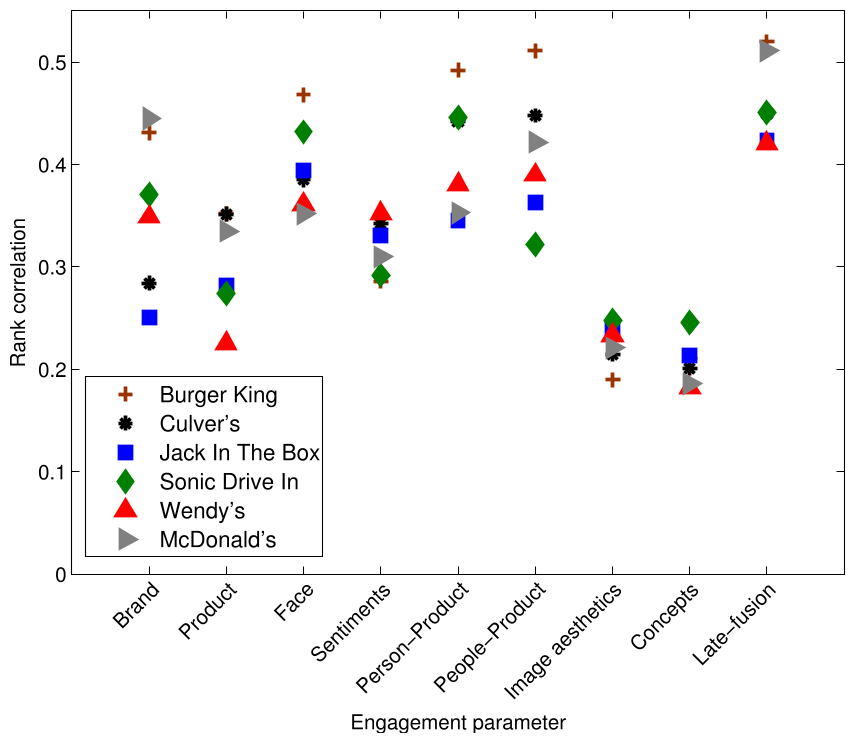
The results were clear: Domain knowledge wins. Using engagement parameters reached a Spearman rank correlation of 0.462, whereas using standard CNN features and Word2Vec only achieved 0.290.

Brand Archetypes
The model also allowed for "Brand Personalities" to emerge. By analyzing which parameters drove likes for specific brands:
- McDonald’s & Burger King: Highly Brand-based. The logo itself is a driver of likes.
- Culver’s & Jack in the Box: Product-based. Users care more about the visual appeal of the food.
- Sonic Drive-In: Individual-based, showing a stronger correlation with single-person posts.
Critical Insight: The "Social" Multiplier
One of the most profound takeaways is the synergy between People and Products. The correlation scores for "People-Product" were significantly higher than just "Face" or "Product" alone. On Instagram, users don't just want to see a burger; they want to see the experience of sharing that burger with friends.
Conclusion & Future Outlook
This paper serves as a blueprint for specialized AI. It proves that to understand human-centric data like "popularity," we must supplement our neural networks with frameworks from the social sciences—in this case, Marketing.
While the study is limited to fast food, the methodology is highly extensible. Future research could apply this to luxury brands, where "Image Aesthetics" likely outweighs "Product Presence," or to the political sphere, where "Sentiment" and "Face" would dominate the popularity landscape.