
Influencer Profiler: Decoding Social Media Identities via Multimodal Attention
Multimodal Post Aentive Profiling for Influencer Marketing
2020-04-20
Summary
Problem
Method
Results
Takeaways
Abstract
This paper introduces Influencer Profiler, a multimodal deep learning framework designed to categorize social media influencers into niche interest topics (e.g., travel, beauty) and classify their individual posts. By leveraging a post-attentive mechanism over BERT-encoded text and Inception-v3-encoded images, the model achieves a state-of-the-art 98.32% influencer classification accuracy.
## TL;DR
The "Influencer Profiler" is a deep learning framework presented at WWW '20 that automates the categorization of social media influencers by analyzing their history of images and captions. By utilizing a post-level attention mechanism and multi-task learning, it achieves a remarkable **98.32% accuracy**, allowing brands to find the perfect marketing partners without relying on limited agency databases.
## Background & Motivation: The Discovery Gap
Influencer marketing has evolved from a $2B to a $10B+ industry, yet the process of "influencer discovery" remains remarkably manual. Brands often face a "discovery gap": they can see an influencer's follower count, but accurately pinpointing their specific niche (e.g., is this a "Lifestyle" or a "Fitness" influencer?) at scale is difficult.
Previous SOTA methods for user profiling typically looked at:
1. **Metadata/Tags**: Often too sparse or generic.
2. **Single Modality**: Either text-heavy (ignoring the visual nature of Instagram) or image-only (missing the context provided by captions).
The authors recognized that not every post by an influencer is "professional." A travel influencer might post a picture of their dog; a food blogger might post a vacation photo. **How do we separate the representative signal from the personal noise?**
## Methodology: Multimodal Fusion with Attention
The proposed architecture consists of three sophisticated layers:
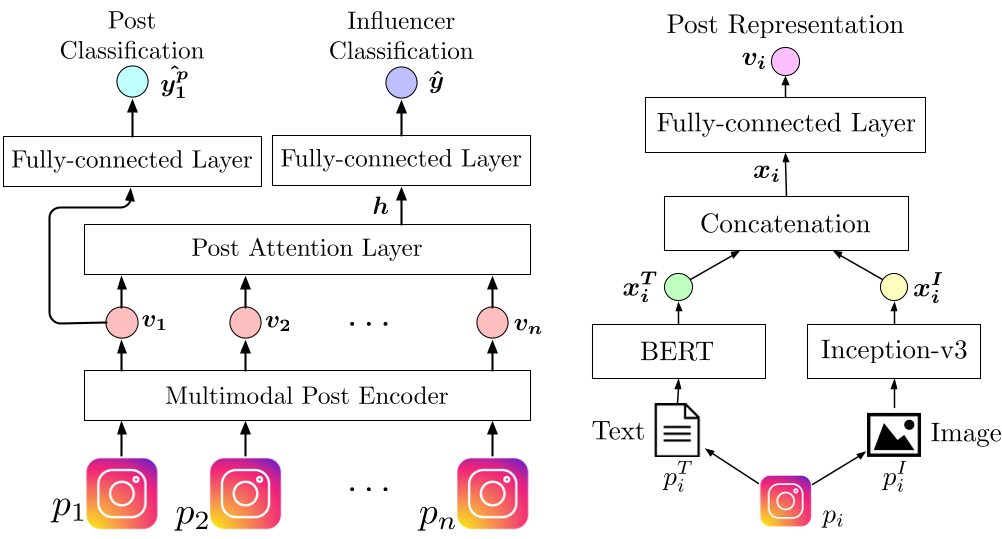
### 1. Multimodal Post Encoder
Each post is treated as a pair of $(Image, Text)$.
* **Visuals**: Processed via **Inception-v3** (fine-tuned on the top layers) to extract high-level semantic features from 1,024-dimensional vectors.
* **Textual context**: Extracted using **BERT**, capturing the nuances of captions and hashtags.
The two are concatenated to form a holistic "post representation."
### 2. Post Attentive Choice (The Core Innovation)
Why is this model so accurate? Because it doesn't treat all posts as equal. The model uses an **Attention Mechanism** to weight each post. If a user is a "Food" influencer, the model learns to assign high attention scores to posts containing food imagery and culinary keywords, while down-weighting the outlier "vacation" posts.
### 3. Multi-task Learning
The model is trained to solve two problems simultaneously:
* **Main Task**: What is the category of this Influencer?
* **Auxiliary Task**: What is the category of this specific Post?
This joint optimization forces the post-encoder to learn features that are useful at both a granular and a global level.
## Experimental Insights: Better with Images
The researchers conducted extensive testing on a dataset of **33,935 influencers** and over **10 million posts**.
| Modality | Influencer Accuracy | Post Accuracy |
| :--- | :--- | :--- |
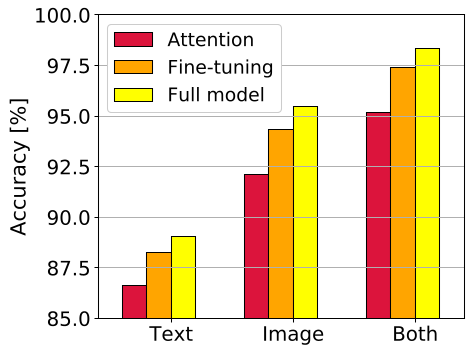
| Text Only | 89.04% | 60.90% |
| Image Only | 95.47% | 90.75% |
| **Multimodal (Combined)** | **98.32%** | **96.20%** |
A critical takeaway from the ablation study is the **dominance of visual data**. On Instagram, an influencer's "visual style" is a much stronger indicator of their niche than their writing style, which can often be idiosyncratic or unrelated to the topic.
As shown in the charts above, the attention mechanism provides **robustness**. While baseline methods saw performance crater when only 20 posts were analyzed, Influencer Profiler remained highly accurate, proving its efficiency for real-time profiling.
## Critical Analysis & Conclusion
**The Takeaway**: This research successfully bridges the gap between raw social media data and actionable marketing intelligence. By releasing a dataset of 33k+ labeled influencers, the authors have provided a foundation for the next generation of recommendation engines.
**Limitations**:
* **Categorical Breadth**: The study focuses on 8 major categories. While these cover 90% of the market, hyper-niche categories (e.g., "Mechanical Keyboards" or "Sustainable Fashion") might require more granular labels.
* **Video Content**: The model currently focuses on static images and text. As Reels and TikTok become dominant, future iterations will need to incorporate temporal video features.
In conclusion, **Multimodal Post Attentive Profiling** proves that "Style" can be quantified. For brands, this means finding the right voice for their products is no longer a matter of luck, but a matter of math.