
θ-MTLBO: Harmonizing Economy and Environment in Large-Scale Power Dispatch
9267_Theta -Multiobjective Teaching-Learning-Based Optimization for Dynamic Economic Emission Dispatch.
The paper introduces a novel θ-multiobjective teaching-learning-based optimization (θ-MTLBO) algorithm specifically designed to solve the Dynamic Economic Emission Dispatch (DEED) problem. By transforming the search space using phase angles (θ-space) and integrating a new learning mechanism with fuzzy clustering, the method achieves superior Pareto-optimal fronts compared to standard metaheuristics and GAMS solvers.
TL;DR
Balancing the operational cost of power plants with their environmental impact is a classic "tug-of-war" in electrical engineering. This paper introduces θ-MTLBO, an enhanced optimization algorithm that uses phase-angle mapping and advanced social learning to solve the Dynamic Economic Emission Dispatch (DEED) problem. It outperforms traditional solvers (GAMS) and standard AI metaheuristics on large 120-unit power grids.
The "Curse" of Dynamic Dispatch
Why is DEED so hard? In a modern grid, you can't just flip a switch to change power output.
- Ramp-Rate Limits: Specifically, units have physical limits on how fast they can increase (URi) or decrease (DRi) generation.
- Valve-Point Effects: The fuel cost curves are not smooth; they contain "ripples" (modeled as sine components) due to the opening of steam valves, making the problem non-convex.
- Conflicting Objectives: Reducing usually costs more fuel, requiring a set of "trade-off" solutions called the Pareto-Optimal Front (POF).
Methodology: Thinking in Angles (θ-Space)
The core innovation lies in the θ-transformation. Instead of searching for power values (P) directly in a vast, fragmented space, the algorithm searches in a compact phase-angle space.
1. The Mapping Mechanism
By using a bijective mapping: The algorithm ensures that the search always stays within the physical bounds of the generators, while the "compactness" of θ-space allows it to find global optima that point-to-point searching in P-space would likely miss.
2. Advanced Learning and Niching
Unlike basic TLBO, θ-MTLBO introduces a new learning method where three learners interact (), preventing premature convergence. To ensure the final solutions are diverse and cover the entire trade-off surface, a niching technique based on fuzzy clustering is used to prune the repository of solutions.
 The new learning logic utilizing multi-student interaction vectors.
Experimental Showdown
The authors tested θ-MTLBO against established benchmarks. In the 120-unit system—a scenario representing a real-world regional power grid—the algorithm showed absolute superiority.
| Optimization Technique | 120-Unit System Cost ($) |
|---|---|
| GAMS (MSNLP) | 12,316,109 |
| θ-TLBO (Proposed) | 12,277,674 |
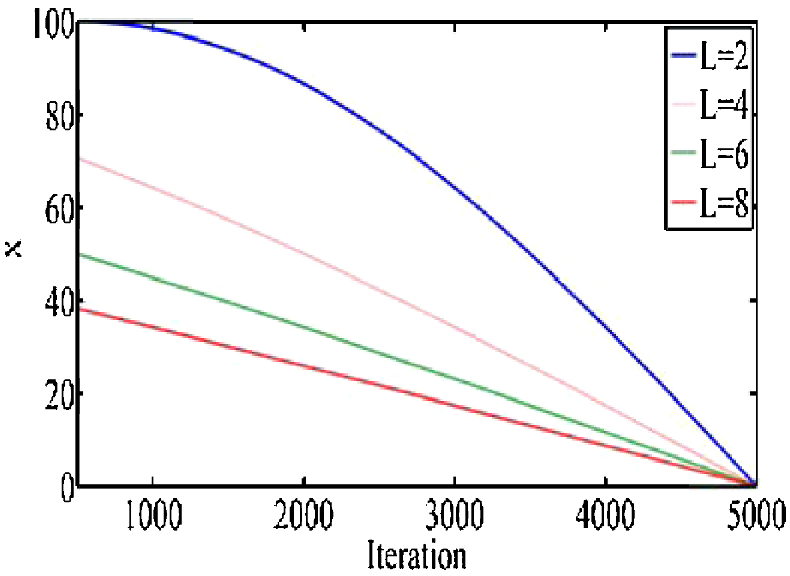 Convergence behavior shows θ-MTLBO reaches lower costs faster than basic TLBO variants.
Critical Insight: Why Does It Work?
The effectiveness of θ-MTLBO boils down to its Exploration vs. Exploitation balance.
- Exploration: The niching and multi-student learning ensure the algorithm explores "lesser explored regions."
- Exploitation: The θ-space mapping acts as a natural regularizer, focusing the search on feasible, high-quality regions.
Conclusion
θ-MTLBO represents a significant step forward in Power System Intelligence. By moving away from purely mathematical solvers (which struggle with non-convexity) and refining stochastic search through domain-specific mapping (θ-space), the authors provide a tool that is both robust and computationally efficient—taking only 58 seconds to solve a massive 120-unit dispatch problem.
Future Outlook: The next frontier for this algorithm likely involves integrating intermittent renewable energy sources (Wind/Solar), where the uncertainty adds yet another layer of complexity to the DEED problem.