
MController: Solving the "Shared Photo" Dilemma with Multiparty Authorization
Multiparty Authorization Framework for Data Sharing in Online Social Networks
The paper introduces the Multiparty Authorization Framework (MAF), designed to address the lack of collaborative access control in Online Social Networks (OSNs). It enables owners, contributors, stakeholders, and disseminators to jointly regulate shared data, a feat demonstrated through a Facebook-integrated prototype called MController.
TL;DR
Online Social Networks (OSNs) have long operated on a "dictatorship" model of privacy: if you upload a photo, you alone decide who sees it. But what about the friends tagged in that photo? This paper introduces the Multiparty Authorization Framework (MAF), a system that allows everyone with a stake in a piece of data—be they the uploader, the contributor, or the person tagged—to have a say in who gets access.
The "Ownership" Illusion in Social Media
Current OSNs (like Facebook or X) treat data as being owned by a single entity. However, social data is inherently collaborative.
Consider these two common "security leaks":
- The Tagging Problem: Alice uploads a party photo featuring Bob. Bob is tagged, but he doesn't want his boss to see him at a party. In current systems, Bob can "untag" himself, but the image remains visible to Alice’s friends—including the boss.
- The Dissemination Leak: Alice shares Bob’s private note. Even if Bob had strict settings, Alice’s weaker privacy settings might expose Bob's information to a wider, unintended audience.
The authors argue that the lack of Multiparty Access Control (MPAC) is a fundamental flaw in modern OSN architecture.
Methodology: Who Actually Controls the Data?
The paper breaks down the "Collaborative Space" into four distinct roles:
- Owner (OW): The user in whose space the data resides.
- Contributor (CB): The user who actually created or posted the content.
- Stakeholder (SH): Users explicitly tagged or mentioned in the content.
- Disseminator (DS): The user who re-shares existing content to a new space.
Architecture of the Decision Engine
To handle the inevitable conflicts (e.g., Alice says "Permit," Bob says "Deny"), the framework uses a two-tier evaluation process:
- Local Evaluation: Resolves conflicts within a single user's own set of rules (using strategies like Deny-overrides).
- Global Aggregation (Multiparty Conflict Resolution): This is the "Secret Sauce." It uses a Voting Scheme combined with Sensitivity Scores.
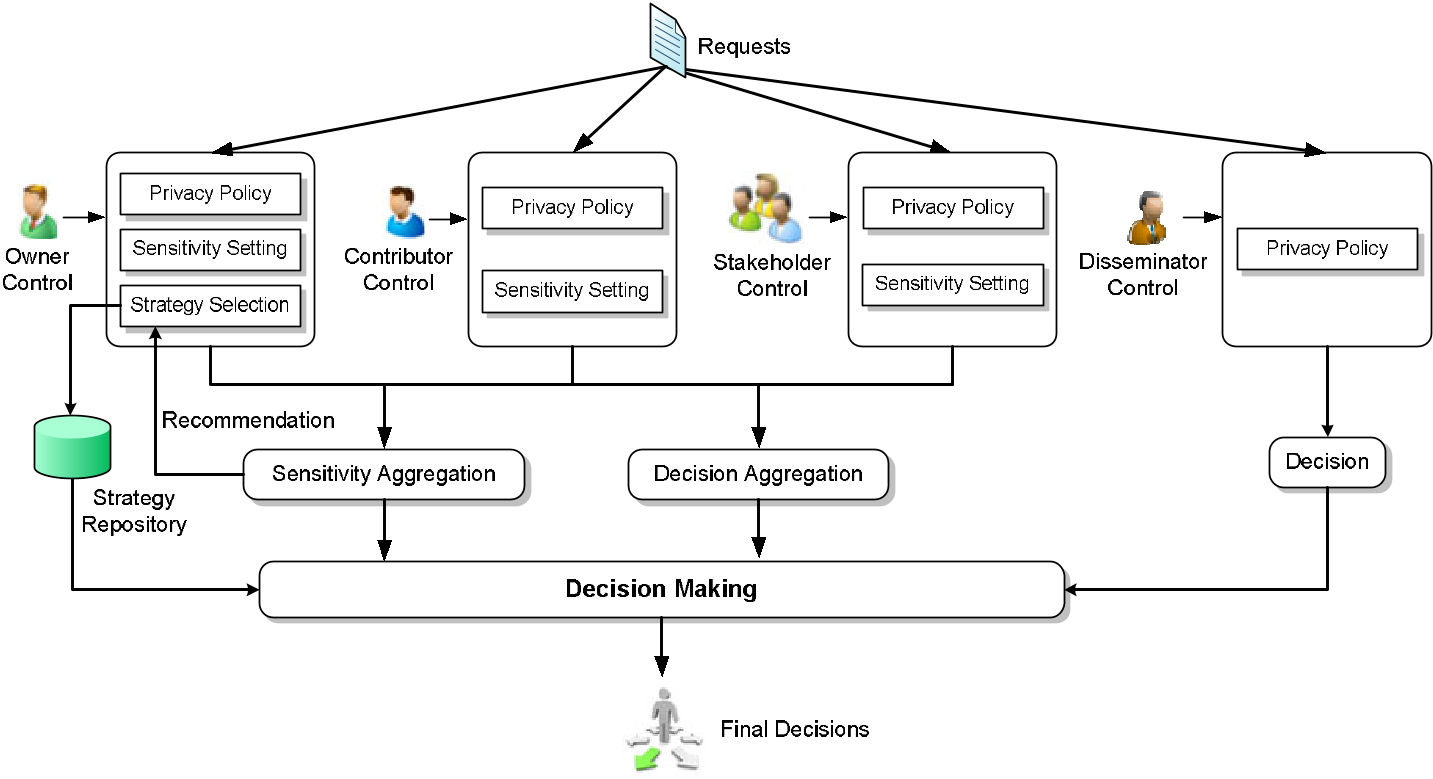
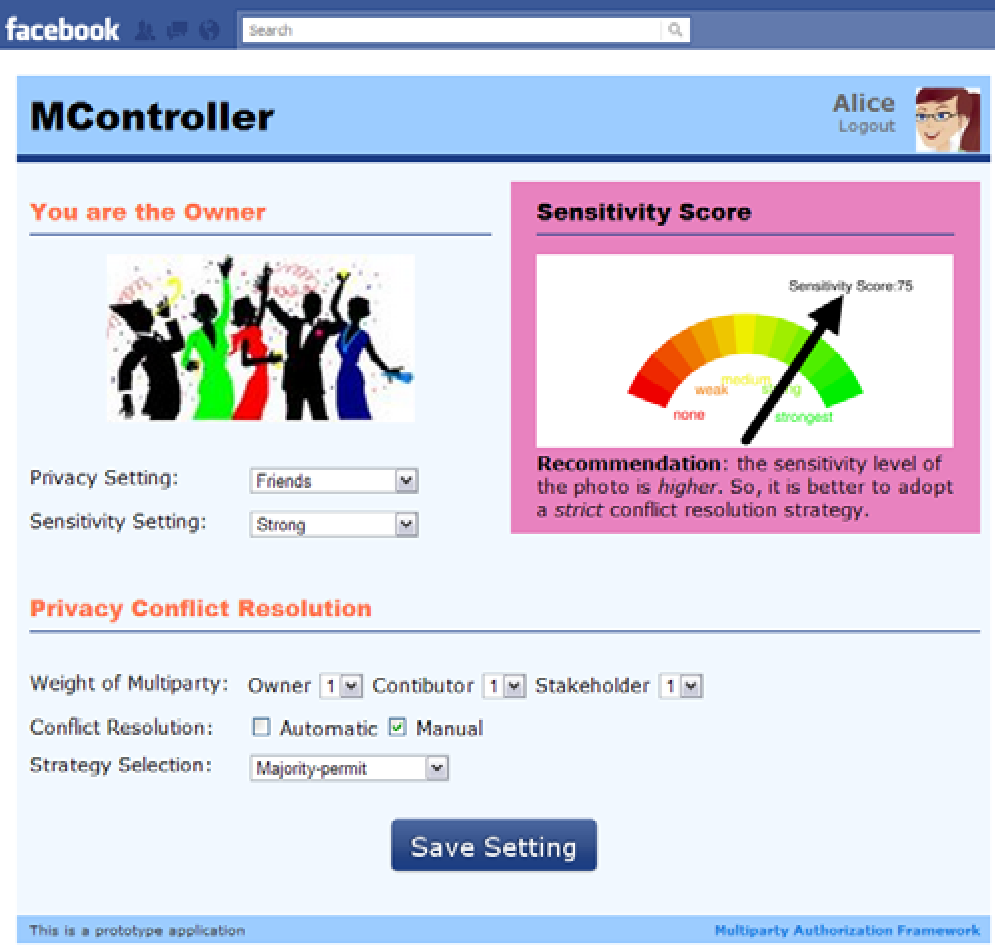
The sensitivity score acts as a threshold: if the collective "privacy concern" is high, the system defaults to a stricter "Full-consensus" (everyone must agree). If the sensitivity is low, it might allow a "Majority-permit" approach to maintain the social utility of the platform.
Experimental Results: MController in Action
The authors built MController, a proof-of-concept Facebook application. They tested it against varying numbers of controllers (up to 20 users per data item).
Key Findings:
- Latency: The policy evaluation time stays remarkably low, even as the number of stakeholders increases.
- Data Protection: By using a mandatory Deny-overrides strategy for disseminated data, the system ensures that a re-share never accidentally bypasses the original creator's privacy settings.
Critical Insight & The Road Ahead
The real value of this research lies in its Heuristic Conflict Resolution. Unlike previous game-theoretic approaches (like Clarke-Tax) which were too complex for average users, MAF uses intuitive voting or automatic sensitivity thresholds.
Limitations: The current prototype relies on users manually setting their preferences for every photo they are tagged in—a "tedious task" according to the authors.
Future Outlook: The paper points toward Inference-based Privacy. Imagine an AI that knows your "Face" and your "Typical Privacy Needs" and automatically generates these policies for you the moment someone tags you. This moves OSNs away from being a manual administrative chore toward an automated, secure social environment.