
UMA: Solving the Multi-Network Identity Puzzle Through Structural Transitivity
Multiple Anonymized Social Networks Alignment
The paper introduces UMA (Unsupervised Multi-network Alignment), a framework for identifying anchor links (shared users) across three or more anonymized social networks. It leverages structural information and social graph consistency to achieve alignment without prior ground truth, achieving significant performance leads over pairwise methods.
Executive Summary
TL;DR: The research presents UMA (Unsupervised Multi-network Alignment), a robust framework designed to link user accounts across multiple anonymized social platforms. By shifting from the traditional "pairwise" alignment mindset to a "multi-network" perspective, UMA utilizes the Transitivity Law to achieve high-precision alignment (AUC 0.87) without any labeled data or user attributes.
Background Positioning: This work is a significant advancement in the field of Unsupervised Network Alignment. While previous SOTA methods like Big-Align focused on matching two graphs at a time, UMA addresses the more complex and realistic scenario of multiple partially aligned networks where users are often fragmented across three or more services.
The Problem: The Anonymity and Sparsity Trap
In modern data research, privacy is paramount. Consequently, social network datasets are often anonymized, stripping away names, emails, and photos, leaving only a "skeleton" of social connections (nodes and edges). This creates a massive challenge: how do you know if "User 123" on Stack Overflow is the same "User ABC" on Quora if you can't see their names?
Existing methods fail here because:
- Lack of Supervision: Most models require a set of "seed" links to learn, which are rarely available.
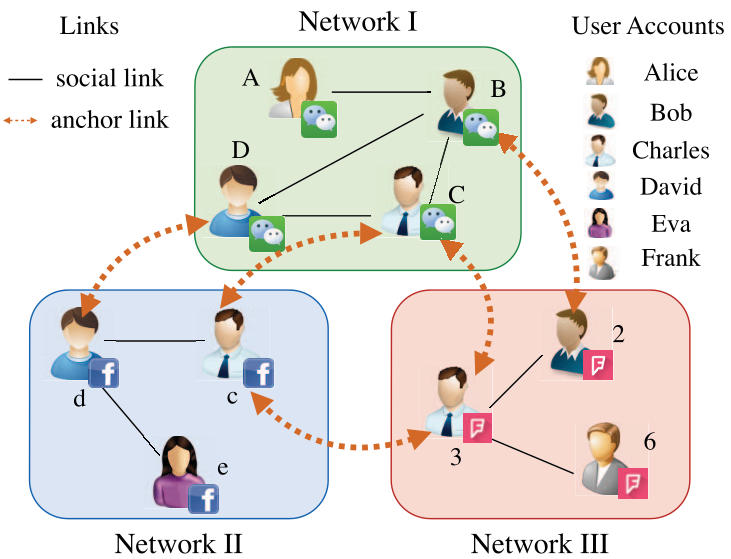
- Global Constraint Violations: Pairwise alignment often leads to logical contradictions. For example, if and , but a model says , the alignment is logically broken.
Methodology: Mining Symmetry and Transitivity
UMA's core innovation lies in its two-phase optimization process that treats transitivity not just as a rule, but as a mathematical catalyst for accuracy.
1. Transitive Integrated Network Alignment
UMA moves beyond simple friendship consistency. It introduces the Alignment Transitivity Penalty, which forces the transitional matrices () between three networks to be consistent across different paths.
If we have three networks , UMA minimizes the difference between:
- Direct mapping:
- Indirect mapping:
2. Transitive Network Matching
The first phase outputs probabilities (soft alignment). The second phase, Transitive Network Matching, converts these into hard "one-to-one" assignments. It solves a discrete optimization problem to ensure that the final result does not allow one user to possess multiple accounts in the same network, while strictly enforcing the transitivity law.
Experiments: Real-World Q&A Benchmark
The authors tested UMA on three interconnected Q&A sites: Stack Overflow, Super User, and Programmers.
Performance Gains
UMA showcased a remarkable ability to filter out false positives. As shown in the ROC and Precision-Recall analysis, UMA significantly outperformed traditional pairwise methods like Big-Align.
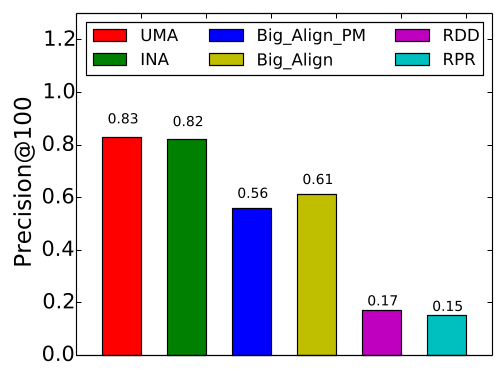 (Top: AUC achieved across different network pairs. Bottom: Precision@100 metrics showing UMA's high accuracy in top-ranked predictions.)
Key Results:
- AUC improvement: ~13% higher than pairwise SOTA.
- Precision@100: Reached 0.85, nearly doubling the performance of methods that do not use multi-network transitivity.
- Convergence: Despite the complex objective function, the model converges within 5 iterations using alternating gradient descent.
Critical Analysis & Takeaways
Why does it work?
The "secret sauce" of UMA is that multi-network alignment is actually easier than pairwise alignment in some respects. The third network acts as a "validator." If the social structure of Network A matches both Network B and Network C, the evidence for a match is exponentially stronger than if we only looked at A and B.
Limitations
- Computational Cost: As the number of networks () increases, the number of triplet combinations grows, potentially leading to complexity issues.
- Structural Similarity Dependency: The method relies on the "Friendship Consistency" assumption—that users behave similarly across different platforms. If a user is a "lurker" on Stack Overflow but highly active on Super User, UMA may struggle.
Conclusion
UMA represents a shift toward Holistic Network Alignment. By mathematically enforcing the transitivity law, it successfully navigates the limitations of anonymized data. For researchers in data mining and social computing, this provides a powerful toolkit for cross-site user modeling and link prediction without compromising individual privacy.