
Beyond the Million Follower Fallacy: A Decision-Making Framework for Social Media Advertising
The Multiple Attribute Association Decision-Making Method to Make Online Advertisements Using Influential Users in Social Network
The paper proposes a Multiple Attribute Association Decision-making model to optimize online advertising by matching influential social network users with specific marketing objectives. By integrating social capital theory with a joint probability and information distance transfer algorithm, the method achieves a precise "influential users-advertising performance objectives" mapping on the Sina-blog platform.
Executive Summary
TL;DR: This paper introduces an analytical decision-making framework that moves beyond generic "influence" scores. It maps high-dimensional user attributes (like authority and interaction styles) directly to enterprise-level marketing goals (Coverage, Acceptance, and Conversion) using probability matrices and information distance.
Academic Context: Positioned at the intersection of Social Capital Theory and Management Decision-making, this work acts as a bridge between social network analysis and practical marketing ROI optimization. It challenges the "Million Follower Fallacy" by providing a mathematical basis for selecting niche influencers over general celebrities.
The Core Motivation: The Mismatch in Social Marketing
Enterprises often burn marketing budgets by hiring top-ranked celebrities who reach millions (High Coverage) but fail to drive sales (Low Conversion). The researchers argue that this happens because existing discovery algorithms like PageRank or HITS focus on network topology rather than the qualitative association between a user's content behavior and an audience's purchasing journey (AISAS model).
The insight here is rooted in Social Capital: Influence is not a monolithic score but a resource manifested through power, prestige, and wealth. A user with "Prestige" (Interaction) might trigger "Acceptance," while a user with "Power" (Domain Authority) triggers "Attention."
Methodology: Mapping Influence to Performance
The researchers developed a two-stage model to solve the matching problem:
1. Attribute Matrix Construction
They decompose user influence into ten sub-indices across three primary dimensions:
- Domain Authority (): Rank, fan count, and friend quality.
- Text Quality (): Posting frequency, keywords, and likes.
- Interaction Degree (): Forwarding and reply rates from high-rank peers.
2. The Association Adaptation Model
Using a Joint Probability Method, the model calculates the probability of achieving a performance objective (e.g., Conversion) given a specific user attribute. To find the "Best Match," they apply Information Distance Transfer Theory. The logic is elegant: the smaller the "information distance" between a user’s influence profile and a marketing goal, the higher the adaptation degree.
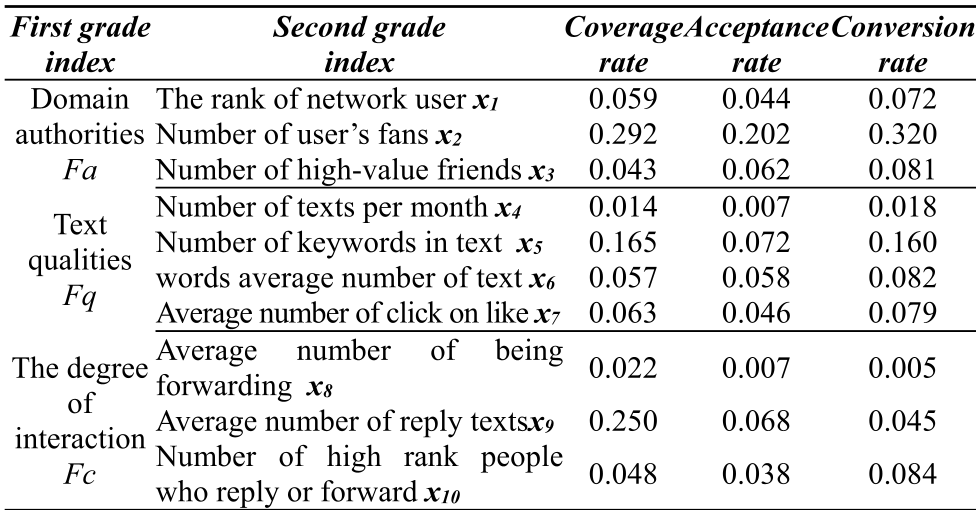 Table 3: The matrix above shows how specific attributes of a single user (u1) correlate differently with Coverage, Acceptance, and Conversion.
Empirical Evidence: Sina-blog Case Study
The authors tracked 100 Sina-blog users (Opinion Leaders vs. Fashion Circle Influencers). The experimental results, visualized through distribution curves, provide a striking revelation:
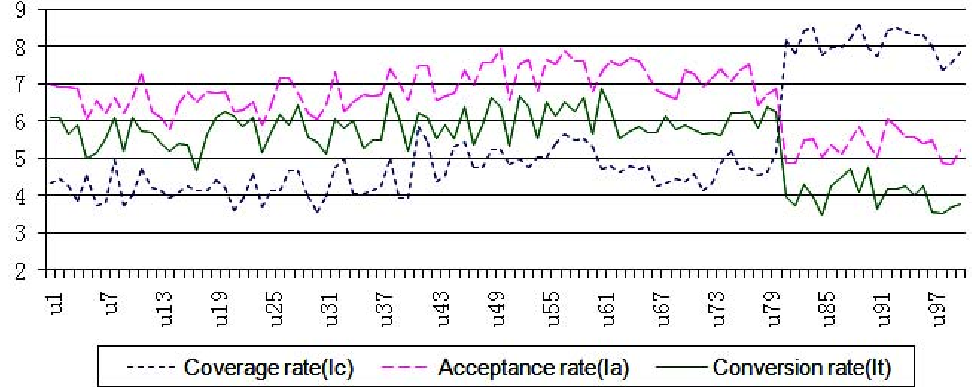 Figure 1: Comparison of adaptation degrees across 100 different users for three distinct objectives.
Key Findings:
- The Coverage/Conversion Trade-off: Public opinion leaders (u81-u100) consistently outperformed niche influencers in Coverage Rate. However, niche users (u1-u80) showed superior Conversion Rates.
- Ranking Divergence: The study found that a user’s ranking according to this model's specific objectives often contradicted the platform's general popularity ranking.
- Strategic Matching: An enterprise seeking brand awareness should target the "Power" nodes, while a brand seeking immediate sales should target "Interaction" nodes with high "Text Quality."
Critical Insight & Conclusion
The true value of this paper lies in its Multiple Attribute Association Decision-making Method. It transforms the selection of influencers from a "gut-feeling" marketing task into a verifiable mathematical optimization problem.
Takeaway for Future Research: While the model is robust, it primarily uses static two-month data. Future extensions could incorporate Temporal Dynamics—how an influencer's association with a brand objective evolves as their social capital grows or fluctuates over time.
Conclusion: This work proves that in the age of social media, "Influence" is relative. A user is only "influential" if their social capital aligns with the specific phase of the consumer journey an enterprise aims to influence.