
Hybrid Scheduling: Balancing Greedy Intuition and Maxflow Optimization in Data Grids
Multiple job scheduling in a connection-limited data parallel system
The paper introduces a Hybrid scheduling approach for data-parallel jobs in connection-limited distributed systems like Nile. It explores the trade-off between a Greedy heuristic and an optimal Maxflow-based algorithm, achieving superior performance by dynamically switching between the two to minimize turnaround time.
Executive Summary
TL;DR: In data-intensive distributed systems, the bottleneck is often the data server's bandwidth rather than the CPU. This paper presents a Hybrid Scheduler that combines the "use-it-now" agility of Greedy algorithms with the "optimal-partitioning" intelligence of Maxflow algorithms. By starting jobs greedily and refining them via maximum flow optimization, the system eliminates the idle-time penalties of pure optimization.
Background Positioning: This work bridges the gap between simple FIFO/Greedy heuristics and complex combinatorial optimization in the context of Large-Scale Data Grids (e.g., the Nile project for high-energy physics data).
The Core Conflict: Greedy vs. Optimal
The researchers identified a fundamental tension in scheduling:
- The Greedy Trap: A greedy scheduler might assign the first available connection to a run that exists on multiple servers, effectively "blocking" a server that is the only source for other required runs. This leads to serialized execution where parallel execution was possible.
- The Maxflow Perfectionism: A Maxflow scheduler finds the mathematically optimal way to partition runs across servers to minimize the time . However, it is "lazy"—it won't start a job if one required run's server is busy, leaving other available connections idle while waiting.
Methodology: The Bipartite Job Graph
To solve the partitioning problem, the authors treat the relationship between Data Servers () and Data Runs () as a Bipartite Graph.
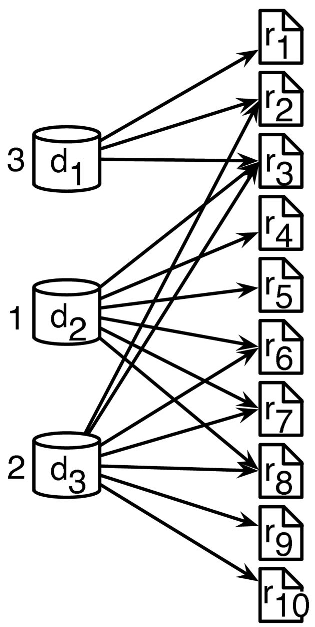
The Maxflow Scheduler transforms this into a flow network:
- Source to Servers: Capacity = .
- Servers to Runs: Capacity = 1.
- Runs to Sink: Capacity = 1.
The algorithm performs a binary search (or a more efficient parametric search) for the smallest (processing time) that allows a valid flow.
The Hybrid Breakthrough
The Hybrid Scheduler functions as a state machine:
- Stage 1 (Greedy): If a job enters and is not yet possible due to busy servers, it spawns tasks greedily to ensure some progress is made.
- Stage 2 (Optimization): Whenever a connection is released, the scheduler re-evaluates the system. If it can now form an optimal Maxflow partition for the remaining runs, it migrates the schedule to the optimized version.
Experiments & Performance
The authors tested these strategies across 1,000 simulations, varying "hot" vs "cold" data replication.
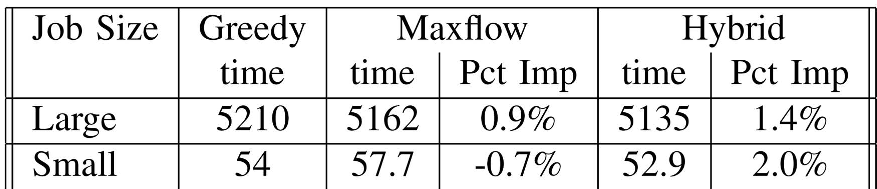
Key Findings:
- Single Job Success: For a single isolated job, Maxflow is always superior, reducing completion time by up to 50% for small jobs.
- System Throughput: In a stream of 10 jobs, pure Maxflow actually lost to Greedy in nearly 51% of cases because of its tendency to leave connections idle (the "startup delay").
- Hybrid Dominance: The Hybrid model achieved the best of both worlds. It was never worse than Greedy and frequently yielded 20-30% improvements in turnaround time.
Critical Insights: The "Data Placement" Variable
An unexpected but vital insight from the study is that Data Placement (how runs are distributed across servers) is often more impactful than the scheduler itself.
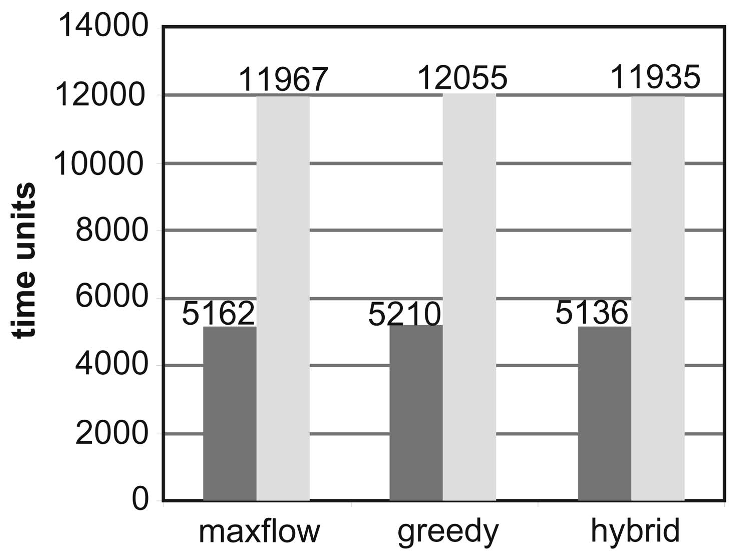
When "hot" (frequently accessed) data was spread across all servers (the Shared policy), performance was twice as fast as when hot data was concentrated on specific servers (Partitioned). This highlights that a scheduler cannot fix a fundamentally bottlenecked data distribution.
Conclusion & Future Look
The Hybrid Scheduler proves that opportunism (Greedy) and strategic planning (Maxflow) are not mutually exclusive. For modern cloud-native systems, this suggests that "Eager" scheduling with "Lazy" refinement is the optimal path for high-throughput data processing.
Limitations: The study assumes runs take equal time to process. In heterogeneous environments where processing times vary, the bipartite weights would need to be replaced with more complex cost functions, likely requiring a move from Maxflow to Min-Cost Max-Flow algorithms.