
MSNL: Decoding Prosocial Behavior Through Multi-Platform Social Intelligence
Multiple Social Network Learning and Its Application in Volunteerism Tendency Prediction
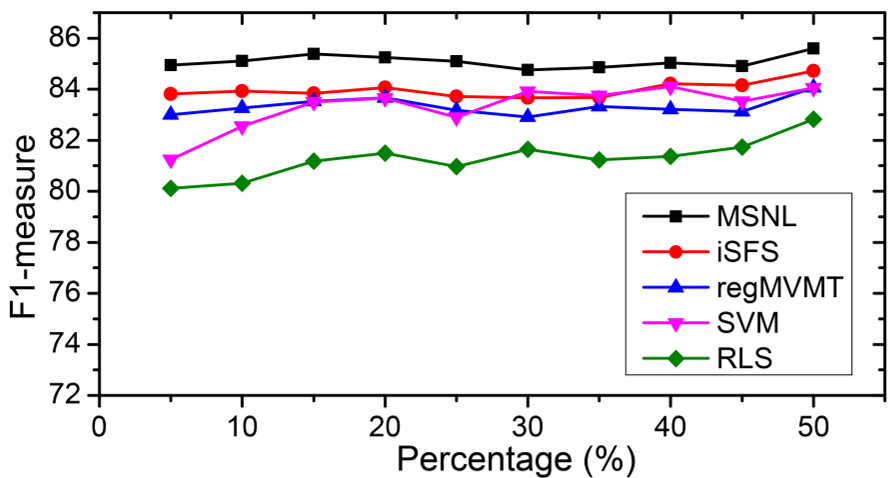
This paper introduces a Multiple Social Network Learning (MSNL) framework and a data completion method (MSNDC) to predict volunteerism tendency by aggregating user data from Twitter, Facebook, and LinkedIn. It achieves State-of-the-Art (SOTA) performance in volunteer identification, reaching an F1-measure of 85.59%.
TL;DR
Researchers from the National University of Singapore have developed MSNL (Multiple Social Network Learning), a sophisticated framework that aggregates data from Twitter, Facebook, and LinkedIn to predict a user's likelihood of volunteering. By solving the twin challenges of source reliability and missing data, the model achieves an impressive 85.59% F1-score, proving that our digital footprints across different platforms are complementary pieces of a single psychological puzzle.
The "Single-Source" Blind Spot
In the era of social media, our digital identity is fragmented. You might post professional updates on LinkedIn, share private life moments on Facebook, and engage in public discourse on Twitter. For AI, looking at just one of these is like trying to describe an elephant by feeling only its trunk.
Existing models face two major hurdles:
- Heterogeneity: Different networks have different "confidence" levels for specific tasks.
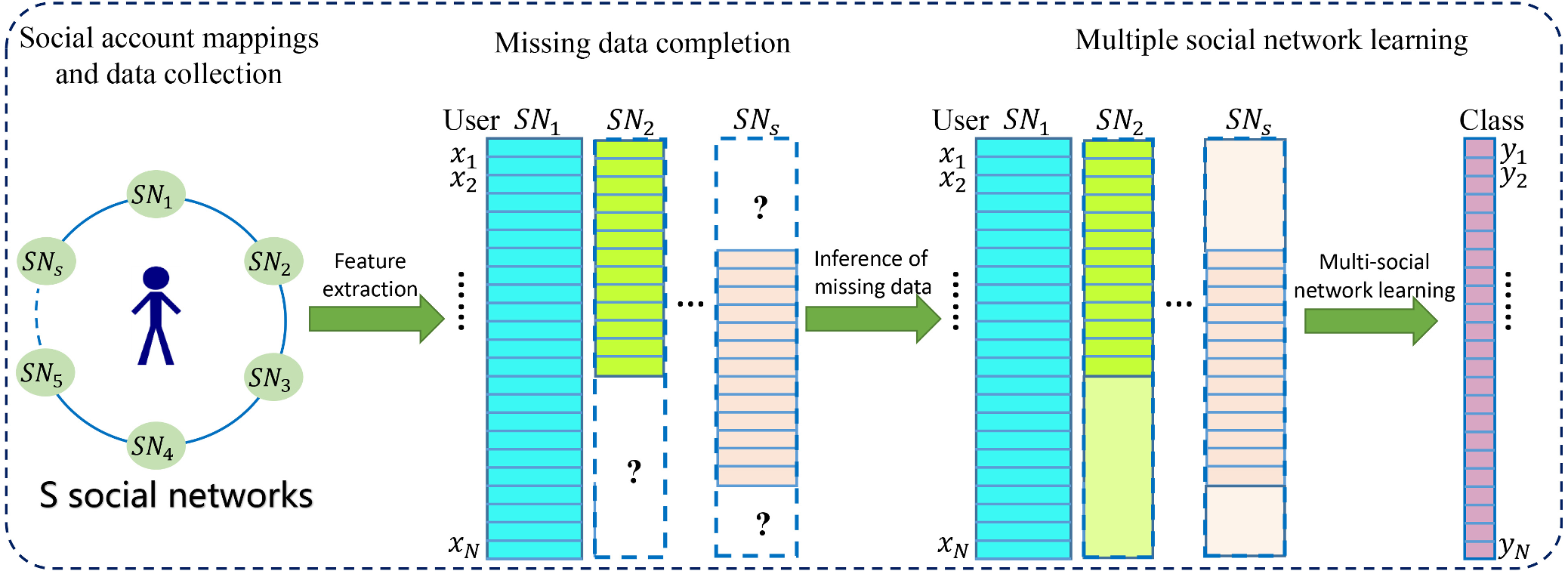
- The Ghost User Problem: Most users aren't equally active everywhere. If a user is silent on Facebook but loud on Twitter, traditional models often just discard the user, leading to massive data waste and selection bias.
Methodology: The MSNL Framework
The proposed solution is a two-stage pipeline: MSNDC for data recovery and MSNL for prediction.
1. Filling the Blanks (MSNDC)
Instead of deleting users with missing profiles, the authors use Non-negative Matrix Factorization (NMF). The intuition is that if Twitter and LinkedIn data are both generated by the same human personality, they must share a latent space. By learning this shared space, the model can "hallucinate" the missing feature blocks for an inactive platform based on the user's active ones.
2. Learning with Confidence and Consistency
The MSNL model introduces two critical regularization terms into its loss function:
- Source Confidence (): Not all platforms are equally useful for predicting volunteerism. The model learns weights for each source.
- Source Consistency (): Since all data belongs to one person, the predictions from Twitter features shouldn't wildly contradict predictions from LinkedIn features.
Experimental Battleground: Predicting Volunteerism
The authors curated a unique dataset of volunteers and non-volunteers, extracting features ranging from LIWC (Linguistic Inquiry and Word Count) to Egocentric Network patterns (who you follow).
Key Breakthroughs:
- The Power of Context: "Contextual topics" (the interests of your followees) were more predictive than your own posts. As the saying goes, "Birds of a feather flock together."
- Robustness: Even when volunteers represent a tiny 5% minority of the population—a common real-world scenario—the model maintained high precision.
Critical Insight: Why Does It Work?
The beauty of this work lies in its mathematical proof of invertibility for the linear system used in optimization, ensuring a closed-form solution that is computationally efficient. While a standard SVM struggles with high-dimensional cross-platform data, MSNL converges in roughly 20 iterations, taking only 19% of the training time required by SVM.
Future Outlook
While this paper focuses on volunteerism, the MSNL architecture is a "plug-and-play" solution for any cross-platform task, such as:
- Demographic Inference (Age/Gender prediction).
- Commercial Interest Prediction.
- Mental Health Monitoring.
The limitation remains the "Cold Start"—if a user is inactive on all platforms, no amount of NMF can recover their traits. However, for the 52% of adults who use multiple services, MSNL provides a powerful lens into the digital soul.
Reference: Xuemeng Song, et al. "Multiple Social Network Learning and Its Application in Volunteerism Tendency Prediction." SIGIR '15.